



James Bible Study
MISSION BRIEF
Your destination
| Place | Jerusalem and Jewish-Christian communities across the Roman Empire |
|---|---|
| Author | James, the brother of Jesus and leader of the Jerusalem church |
| Audience | The twelve tribes in the Diaspora |
| Written | Probably in the mid to late AD 40s, before the Jerusalem Council |
| Crisis | Trials and worldly pressure were exposing divided loyalties |
| Question | Does what you believe govern how you live? |
ONE EXPEDITION, TWO FORMATS
Choose how you will
explore James
Work through a Field Notes journal you can mark and keep, or carry the same visual expedition inside Bible Ventures.
WHY STUDY JAMES?
Faith is invisible until life gives it something to do.
James does not permit belief to remain an idea.
His readers claimed allegiance to Jesus Christ, but hardship exposed divided hearts. Loose speech, favoritism, selfish ambition, empty compassion, arrogant planning, and love of wealth revealed the distance between what they confessed and how they lived.
James calls Christians to active obedience. Genuine faith affects how we endure trials, receive God’s word, treat the poor, use our tongues, make plans, wait for Christ, pray, and restore those who wander.
- What does my faith produce when life becomes difficult?
- Where have I learned to excuse hearing without doing?
- Does my ordinary behavior resemble the Lord I say I trust?
BELIEVE
BEHAVE
Does your confession survive contact with ordinary life?
A LETTER WITHOUT ONE CITY
James writes to believers scattered across the Roman world.
The destination is not one church building or one famous city. It is the Diaspora.
By the first century AD, Jewish communities lived throughout the Mediterranean world. James addresses Jewish Christians outside the land of Israel with the ancient expression “the twelve tribes.” Some had long lived abroad. Others had recently been driven from Jerusalem.
The letter could be read in communities near Antioch, Phoenicia, Cyprus, Alexandria, Asia Minor, Macedonia, Rome, and beyond. The precise mailing list is not preserved. The point is a people dispersed among the nations but still called to live as one faithful people of God.
A MESSAGE FROM JERUSALEM FOR FAITH UNDER PRESSURE
THE TWELVE TRIBES
Israel’s ancient family name becomes an address for a scattered church.
“The twelve tribes” was a Jewish way of speaking about the people descended from Jacob.
Centuries of exile and migration had spread Jewish communities among Gentile nations. Many never returned to the land. Synagogues helped preserve Jewish identity, Scripture, worship, and community life on foreign shores.
James therefore writes in deeply Jewish categories. He appeals to the Law, calls the Christian gathering a synagogue, and uses Abraham, Rahab, Job, and Elijah as examples. Gentiles were not excluded from Christ, but this early Christian audience would immediately understand James’s language and world.
ONE SCATTERED
PEOPLE
BEFORE PAUL’S MISSIONARY JOURNEYS
The gospel may have reached many of them when pilgrims went home.
Jerusalem’s festivals gathered Jews from across the Diaspora into one city.
At Pentecost, Jewish pilgrims from many nations heard Peter proclaim Jesus Christ. Thousands believed. When the feast ended, these new believers returned to their homes and carried the gospel into communities far beyond Judea. Acts 2
This helps explain how Jewish-Christian communities could exist throughout the Roman world before Paul visited many of those regions. James’s readers belonged to the earliest outward movement of the church.
Diaspora pilgrims came to Jerusalem for the feast.
They heard the gospel of Jesus Christ in their own languages.
Many received the message and joined the church.
They carried the gospel back across the Roman world.
PERSECUTION AND SCATTERING
Persecution turned one congregation into many scattered witnesses.
The first Christian church did not leave Jerusalem only by choice.
The stoning of Stephen marked the beginning of a major persecution. Believers were dispersed through Judea and Samaria, and later traveled as far as Phoenicia, Cyprus, and Antioch. They carried the word with them. Acts 7:54-8:4 Acts 11:19-21
Some of these people had likely sat under James’s leadership in Jerusalem. They left homes, possessions, work, and familiar relationships behind. James’s opening command to consider trials with joy was written to people who knew the cost of upheaval.
- Stephen is killed
Violence against the church escalates in Jerusalem.
- Believers flee
The church disperses through Judea, Samaria, and farther north.
- The word travels
Scattered Christians continue speaking about Jesus Christ.
Pressure does not excuse ungodly behavior. It reveals where maturity is still needed.
LIFE IN THE AD 40s
They escaped Jerusalem, but hardship followed them.
Persecution, displacement, famine, poverty, and social vulnerability pressed on the scattered church.
The Field Notes study places James in the mid to late AD 40s, when economic strain and a famine under Emperor Claudius intensified life across the Roman world. Jewish Christians living on foreign shores would have faced particular difficulty finding food, work, and social protection.
Under pressure, the church’s weaknesses became visible. Some could not control their speech. Some honored the rich and humiliated the poor. Some pursued selfish desires, planned without God, or used wealth without mercy. James treats these failures as a faith problem.
Will suffering mature faith or feed temptation?
Will words bless God and wound people?
Will the church repeat the world’s hierarchy of worth?
Will believers seek God’s wisdom or friendship with the world?
WHO WROTE JAMES?
The brother who once did not believe became the leader of Jerusalem.
The most likely author is James, the brother of Jesus, known in the early church as James the Just.
James and Jesus’s other brothers did not believe during Jesus’s earthly ministry. After the resurrection, James became a follower and rose to prominence in the Jerusalem church. He interacted with Paul and later presided over the Jerusalem Council. John 7:5 1 Corinthians 15:7 Acts 15
James grew up in the household of Mary and Joseph.
He did not yet believe his brother’s claims.
The resurrection changes the direction of his life.
His first name alone carries authority among scattered believers.
He helps guide the church through the Jewish-Gentile question.
Josephus reports that James was illegally stoned in Jerusalem.
HOW TO HEAR THIS LETTER
A letter for the ear. A wisdom book shaped by Jesus.
James moves like a sermon, speaks like Jewish wisdom, and repeatedly sounds like the Sermon on the Mount.
The letter was intended to be read aloud in Christian gatherings. Its quick changes of subject become clearer when heard as the persuasive movement of a speaker rather than treated as disconnected notes.
James also writes in the tradition of Proverbs. He uses the ordinary world as a classroom: waves, flowers, mirrors, bridles, ships, fire, springs, trees, mist, rust, farmers, rain, and oil. Each image turns theology into wisdom for daily life.
James echoes the teaching of Jesus. His call to wholehearted obedience, mercy, peacemaking, prayer, humility, and readiness for judgment repeatedly parallels Matthew 5-7.
LETTER • PUBLIC READING • JEWISH WISDOM • VIVID IMAGERY • SERMON ON THE MOUNT • PRACTICAL EXHORTATION

Listen for the voice of Jesus
- Joy under trial and blessing under persecution
- Maturity, mercy, peacemaking, and purity of heart
- Asking God for wisdom and refusing divided loyalty
- Doing the word rather than merely hearing it
- Living now in view of the coming Judge
THE STRUCTURE OF JAMES
One letter arranged around the question: what does living faith look like?
The Field Notes study reads James in five movements.
The central discussion of faith and works is framed by two responses to the gospel and two sections contrasting Christian living with worldly living.
Christian living in a worldly setting
Trials, wisdom, divided loyalty, poverty and riches, temptation, and God’s good gift.
Respond to life God’s way.
Responding to the gospel
Receive the word, hear and do, practice pure religion, reject favoritism, and fulfill the royal law.
The gospel bears fruit.
The gospel: a faith that works
Empty claims are exposed. Abraham and Rahab demonstrate that living faith acts.
Faith and works go hand-in-hand.
Responding to the gospel
Speech, wisdom, desire, quarrels, friendship with the world, humility, and judgment of others.
The gospel bears practical fruit.
Christian living versus worldly living
Planning, wealth, patient waiting, integrity, prayer, confession, healing, and restoration.
Wait for Christ by living God’s way.
James 1:1-18
Trials do not create faith, but they reveal and mature it.
James begins with believers whose lives have been disrupted.
Joy is not pleasure in pain. It is confidence that God can use testing to produce endurance, maturity, and wholeness. The believer who lacks wisdom is invited to ask the God who gives generously.
James then separates outward trial from inward temptation. God is always good. Temptation grows when desire lures and drags the heart toward sin. By contrast, God gives new birth through the word of truth and makes believers the firstfruits of his new creation.
Faith meets pressure it did not choose.
Steadfast trust continues under weight.
God forms a whole and undivided person.
The believer asks how to respond God’s way.
Do not become a wave driven by every wind.
Double-mindedness is divided loyalty. James calls for a faith that depends on God without continually shifting between God and the world.
James 1:19-2:13
The word is not heard until it is obeyed.
James moves from receiving new birth through the gospel to producing a life consistent with it.
Believers are to be quick to listen, slow to speak, and slow to anger. They must remove moral filth, humbly receive the implanted word, and refuse the deception of hearing without doing.
The mirror exposes the problem. A person may look carefully and still walk away unchanged. James then gives concrete applications of obedient hearing.
Religious speech is worthless when ordinary speech is uncontrolled.
Pure religion acts for orphans and widows in distress.
The church must resist the world’s values and desires.
The glorious Lord Jesus Christ does not permit a hierarchy of human worth.
Love your neighbor as yourself. Mercy triumphs over judgment.
James 2:14-26
Faith alone saves. Saving faith never remains alone.
James attacks a claim of faith that produces no mercy, obedience, or action.
Demons possess correct information about God and still remain opposed to him. Empty words to a hungry person do not become compassion. A body without breath is dead, and a faith-claim without works is dead.
Abraham’s willingness to offer Isaac and Rahab’s protection of the spies did not purchase righteousness. Their actions displayed the reality of the faith they possessed.
How is a sinner declared righteous?
By faith in Jesus Christ, apart from works of the law. Romans 3:28
How is a claim of faith shown to be alive?
By works of faith that demonstrate trust, love, and obedience.
James 3:1-12
A small tongue can steer a life or set a world on fire.
Speech is small in size and enormous in consequence.
Teachers face stricter judgment because their words shape others. James compares the tongue to a bit directing a horse and a rudder steering a ship. He then changes from control to destruction: a spark can ignite a forest, and the tongue can poison the course of a life.
The deepest problem is inconsistency. The same mouth blesses God and curses people made in God’s likeness. A spring cannot naturally produce both fresh and salt water. A fig tree cannot bear olives. Double-tongued speech exposes a divided heart.
Steer
A small instrument determines a large direction.
Destroy
A small spark can consume what took years to grow.
James 3:13-4:12
Two kinds of wisdom reveal two different allegiances.
James does not measure wisdom by impressive claims. Conduct reveals its source.
WISDOM FROM BELOW
Earthly, self-seeking, and unstable
Jealousy and selfish ambition produce disorder. Desires battle within, prayers become self-serving, and friendship with the world becomes hostility toward God.
- Bitter jealousy
- Selfish ambition
- Disorder
- Quarrels
- Coveting
- Judging others
A divided heart tries to hold God and the world at the same time.
WISDOM FROM ABOVE
Pure, peaceable, gentle, and sincere
Godly wisdom appears in humble conduct. It listens, shows mercy, refuses partiality, and plants peace that grows into righteousness.
- Pure
- Peace-loving
- Gentle
- Reasonable
- Merciful
- Impartial
- Sincere
- Peacemaking
A whole heart submits to God and expresses his character toward others.
Submit to God, resist the Devil, clean your hands, purify your heart, grieve over sin, and humble yourself before the Lord. James’s cure for double-mindedness is repentance and renewed loyalty.
James 4:13-5:11
Plan humbly. Use wealth justly. Wait as though the Judge is at the door.
James closes his excavation by contrasting self-reliant worldly living with patient Christian dependence.
SCENE ONE
The merchant and the mist
Planning is not condemned. Arrogant planning is. Life is brief, tomorrow is unknown, and every intention belongs under the will of God.
Life is a mist. Dependence is wisdom.
SCENE TWO
The rich and the unpaid worker
Hoarded wealth, withheld wages, self-indulgence, and abuse of power cry out for judgment. Money cannot protect anyone before the righteous Judge.
Resources are entrusted for faithful use, not self-protection.
SCENE THREE
The farmer, prophets, and Job
Believers wait like a farmer expecting rain. The prophets endured because they spoke for God. Job continued through severe affliction and learned the Lord’s compassion and mercy.
Patient hope does not grumble. It strengthens the heart.
Morning mist: Mathias Erhart, 2007, CC BY-SA 2.0; resized and cropped for display. Other images: Albert Bierstadt, The Portico of Octavia; current-edition James Field Notes study page.
It turns suffering, joy, sickness, sin, and wandering toward God and the care of his people.
James 5:13-20
A faith that behaves becomes a community that prays and restores.
James ends not with private spirituality, but with believers caring for one another before God.
The suffering are to pray. The cheerful are to sing praise. The sick may call the elders, who pray and anoint in the name of the Lord. Christians confess sins and pray for one another. Elijah shows that an ordinary righteous person’s prayer can be powerful because God listens.
The final action is restoration. When someone wanders from the truth, mature believers do not merely discuss the failure. They seek to turn the wanderer back.
Pray rather than retreat into self-reliance.
Sing praise and direct joy toward God.
Call the elders for prayer and care.
Confess, seek forgiveness, and repair relationships.
Ask with the patient trust modeled by Elijah.
Act lovingly to bring a brother or sister back.
Prayer is not a formula guaranteeing physical healing. James calls for faith in God’s power and submission to the will of the Lord.
THE COMPLETE EXPEDITION
Seven Field Studies through James
The study begins in the world of the scattered church, excavates the complete letter in five major units, and finishes by placing James inside the grand story of Scripture.
SURVEY THE LAND
Christians struggle to live out their beliefs
James background
EXCAVATE THE SITE
Respond to life God’s way
James 1:1-18
The gospel bears fruit
James 1:19-2:13
Faith and works go hand-in-hand
James 2:14-26
The gospel bears practical fruit
James 3:1-4:12
Wait for Christ by living God’s way
James 4:13-5:20
ANALYZE THE FIND
Believe in Christ—behave like Christ
James in Scripture
Maps, timelines, history, culture, and vivid illustrations illuminate the ancient world.
Questions, writing, activities, journaling, memorization, prayer, and personal notes move learning into life.
LOOK INSIDE
Open the James Field Notes
This preview moves through the setting, author, major excavations, active-learning pages, and final connection to Jesus Christ.
OPEN FULL PREVIEW · 26 SELECTED PAGES
Open the sampler, then use the arrow keys or page controls to explore. A fullscreen view is available inside the reader.
Open the PDF alternative in a new tab · Choose your edition
Sample pages show the current Field Notes edition. The revised print edition is in development.
YOUR NEXT EXPEDITION
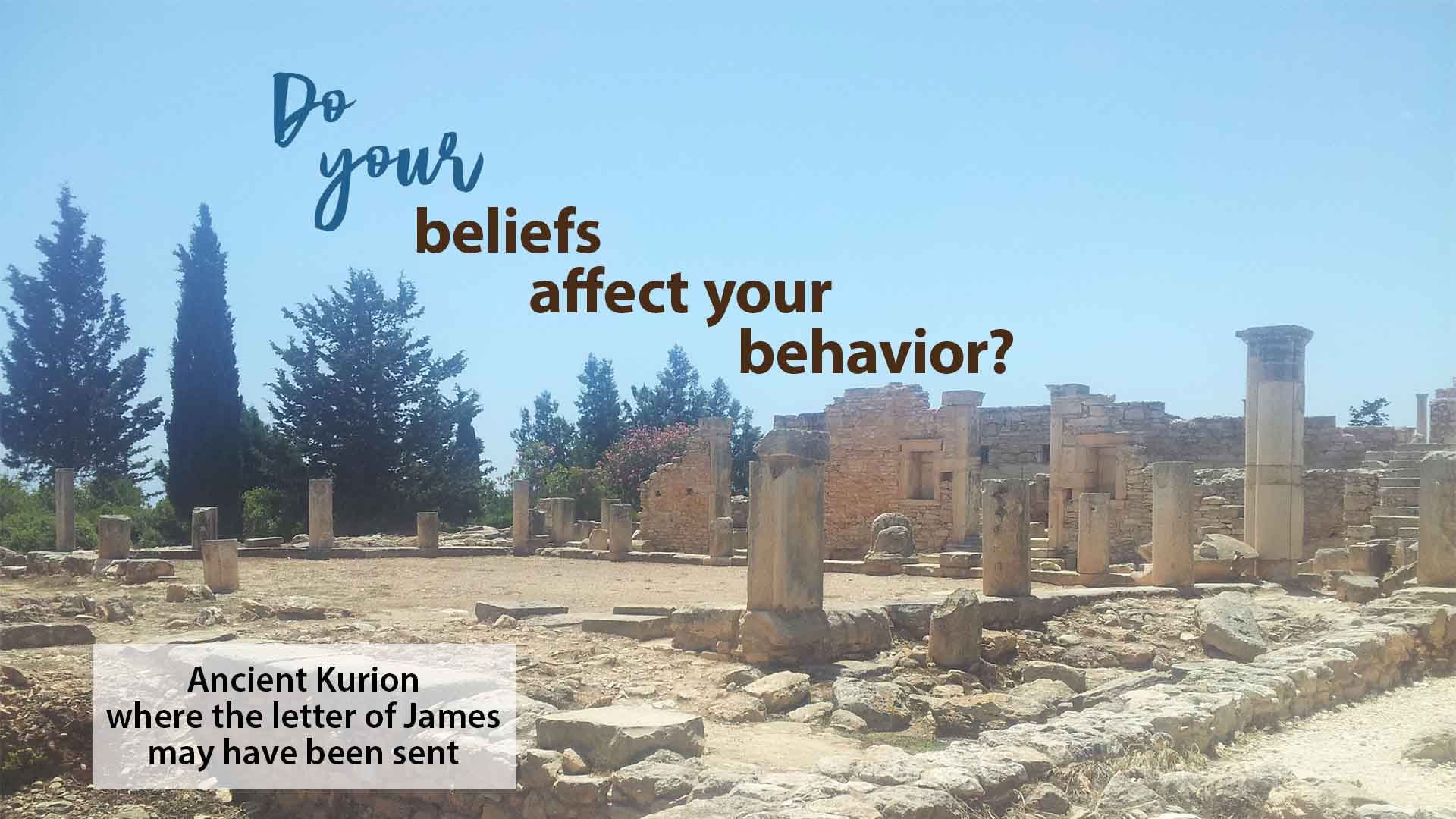
Do your beliefs affect your behavior?
Walk the roads of the Diaspora. Hear the wisdom of James. Let the mirror of God’s word move you from hearing to doing.
James calls for a whole faith: tested by trials, visible in mercy, disciplined in speech, humble before God, patient for Christ’s return, and dependent in prayer.
STUDY IN BIBLE VENTURESJOIN THE PRINT EDITION LIST
BELIEVE IN CHRIST • BEHAVE LIKE CHRIST
BEHAVES
REVISED PRINT EDITION
Let us know you’re waiting for James.
Leave your email for an update when the revised print edition is available.