


Bartholomew/Nathanael
The True Israelite Who Came and Saw
Carousel of images for this Bible Exhibit
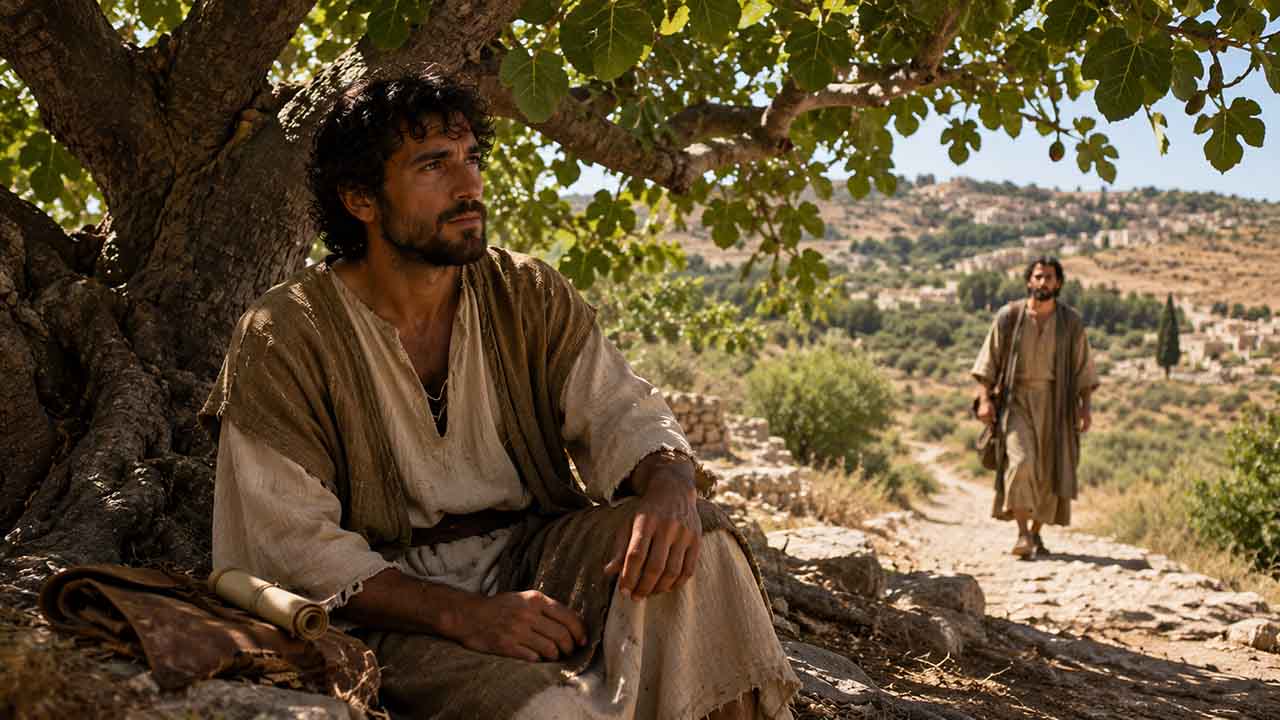
Bartholomew/Nathanael
Beneath the fig tree’s quiet shade, Nathanael waits in honest reflection, unaware that Jesus has already seen the hidden place of his heart. Soon his cautious question will become a worshipful confession: “Rabbi, you are the Son of God; you are the king of Israel.”
Listen to this Bible Exhibit
A Name with a Question
Bartholomew stands near the edge of the Gospel story with quiet strength. Scripture does not give him many scenes, but it places him among the Twelve, the men Jesus chose to be with Him and to bear witness to His kingdom. If Bartholomew is Nathanael, as many careful readers have believed, then his life shows how an honest question can become true faith when it is brought to Jesus.
Bartholomew is named among the Twelve in the apostolic lists of Matthew, Mark, and Luke [Matthew 10:2-4] [Mark 3:13-19] [Luke 6:12-16]. His name likely means “son of Talmai,” which may be a family name rather than his personal name. That matters because John’s Gospel never names Bartholomew, while Matthew, Mark, and Luke never name Nathanael. In the Synoptic Gospels, Bartholomew is closely linked with Philip. In the Gospel of John, Philip brings Nathanael to Jesus.
This does not prove beyond all doubt that Bartholomew and Nathanael are the same man. Scripture does not say that directly. Yet the connection is strong enough that we follow the traditional identification with appropriate humility. If Bartholomew is not Nathanael, then Scripture tells us little more about him than his place among the Twelve. If he is Nathanael, John gives us one of the most beautiful call stories in the Gospels.
Brought by Philip to Jesus
Nathanael was from Cana in Galilee. His name means “God has given.” He first appears when Philip, newly called by Jesus, finds him and announces that the promised One has come. Philip does not describe Jesus as a private spiritual discovery. He says they have found the One written about by Moses and the Prophets: Jesus of Nazareth, the son of Joseph.
Nathanael’s reply is sharp: “Can anything good come out of Nazareth?” His words should not be treated as empty scorn. Nathanael seems to be a man who cares about Scripture. Nazareth was small, ordinary, and not the place many expected the Messiah to come from. His question shows caution, not hardness. Philip does not argue. He gives the best invitation: “Come and see” [John 1:43-51].
An Israelite Without Deceit
Before Nathanael can weigh Jesus, Jesus reveals that He already knows Nathanael. The Lord calls him “an Israelite indeed, in whom there is no deceit.” This is not a claim that Nathanael was sinless. It is a word about his sincerity before God.
The language reaches back into Israel’s story. Jacob, the father of Israel, was often marked by cunning. Nathanael stands before Jesus as a true son of Israel, open rather than false, searching rather than pretending. Jesus then says He saw Nathanael under the fig tree before Philip called him. John does not tell us what happened there, and we should not pretend to know. Perhaps Nathanael had been praying, thinking, or searching the Scriptures. What matters is clear: Jesus saw the hidden man.
Nathanael understands that he stands before no ordinary teacher. He answers, “Rabbi, you are the Son of God! You are the King of Israel!” These are royal, messianic words. At this early point, Nathanael may not understand all that John’s Gospel will reveal about the Son of God. Yet his confession is true. The King promised in Scripture is standing before him [Psalm 2:6-12].
The Son of Man and the Open Heaven
Jesus does not leave Nathanael with a small view of the Messiah. He promises that Nathanael will see greater things. He will see heaven opened and the angels of God ascending and descending on the Son of Man.
This promise traces back to Jacob’s dream, in which heaven and earth were joined in a vision of God’s presence [Genesis 28:10-17]. But Jesus changes the center of the picture. The meeting place between God and man is not a ladder or a holy site. It is Jesus Himself. He is the true place where heaven opens, God is revealed, and sinners are brought near.
This is why Nathanael matters for the whole story of Scripture. Israel’s hope is not finally tied to an impressive city, a famous school, or human expectation. God’s promise is fulfilled in Jesus, even Jesus of Nazareth. The true Israelite must come to Him.
Witness to the Risen Christ
Nathanael appears again after the resurrection. He is with Peter, Thomas, the sons of Zebedee, and others by the Sea of Tiberias when the risen Jesus fills empty nets with abundance [John 21:1-14]. The man who was promised greater things did see greater things. He saw not only Jesus’ hidden knowledge under the fig tree, but the risen Lord standing beyond death.
If Nathanael is Bartholomew, then he is also among the apostles gathered in Jerusalem after Jesus’ ascension, praying and waiting for the promised work of God [Acts 1:12-14]. Scripture does not provide a specific record of his later ministry or death. Many traditions speak about Bartholomew’s missionary work and martyrdom, but they differ, and the biblical portrait should not rest on them.
What Scripture gives is enough. Jesus chose Bartholomew. Jesus saw Nathanael. The honest skeptic became a confessing disciple. The man from Cana learned that Israel’s King had come from Nazareth.
Why Bartholomew Matters
Bartholomew, also known as Nathanael, teaches us that true faith is not afraid to ask Christ honest questions. Nathanael did not begin with shallow excitement. He tested Philip’s claim against the hope of Scripture. Yet when he came to Jesus, he was willing to be corrected by revelation.
His life also shows the power of a simple witness. Philip did not answer every objection. He brought his friend to the Lord. “Come and see” is still one of the truest patterns of Christian witness.
Most of all, Bartholomew helps us see Jesus. Jesus knows the heart. Jesus fulfills the Scriptures. Jesus is the King of Israel and the Son of Man. He is the true meeting place between heaven and earth. The disciple who wondered whether anything good could come from Nazareth came to see that the hope of Israel, and the hope of the world, stood before him in Christ.
What is a Disciple?
A disciple is a follower and learner of Jesus. During his earthly ministry, Jesus called many to follow him, but he chose twelve to be his closest companions and witnesses.
These men walked with Jesus, heard his teaching, saw his miracles, and were formed by his presence. He sent them to proclaim the Kingdom of God, heal the sick, and bear witness to his authority.
The disciples were not flawless heroes. They misunderstood, doubted, argued, and failed. Yet Jesus patiently shaped them by grace. After his resurrection, and through the gift of the Holy Spirit, these once-fearful followers became bold witnesses to the risen Christ.
Their lives show the heart of discipleship: to be called by Christ, formed by Christ, and sent by Christ. A disciple does not merely admire Jesus from a distance, but follows him in faith, obedience, and love.