



Galatians
Bible Study
MISSION BRIEF
Your destination
| Place | The Roman province of Galatia in Asia Minor |
|---|---|
| Author | The apostle Paul |
| Audience | Churches troubled by a distorted gospel |
| Written | Likely from Antioch in Syria around AD 48 |
| Question | Can anything be added to Christ? |
| Journey | Survey, eleven excavations, final analysis, and Discoveries |
ONE EXPEDITION, TWO FORMATS
Choose how you will
explore Galatians
Work through a printed journal you can mark and keep, or carry the same full-color expedition inside Bible Ventures.
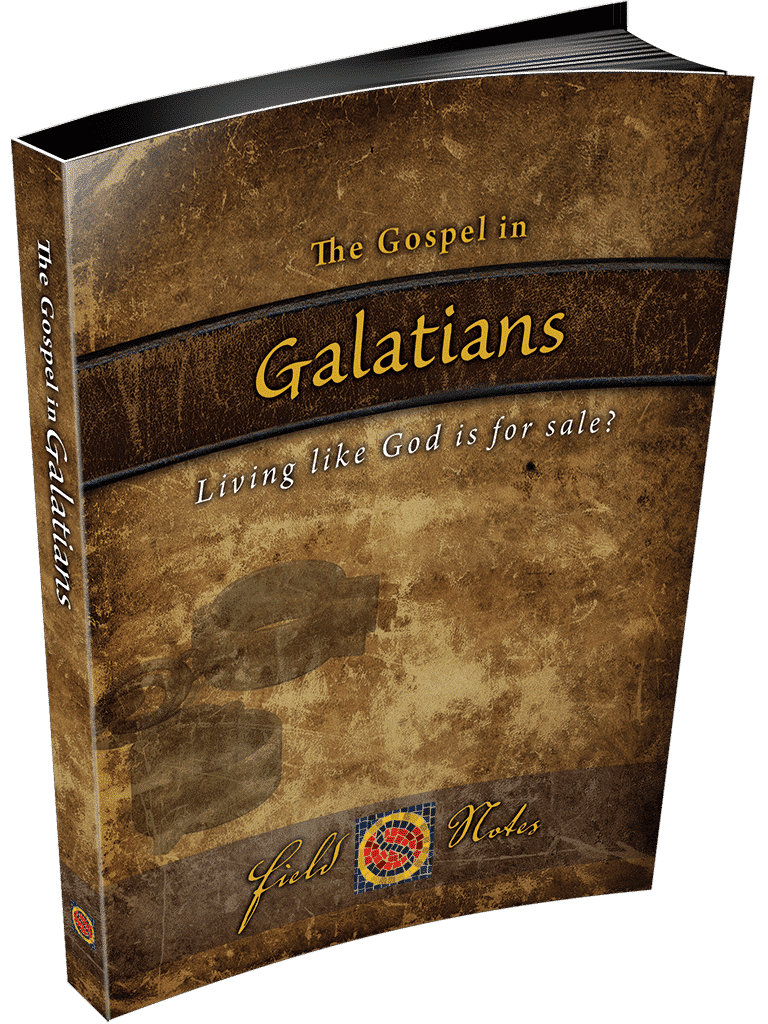
PRINTED FIELD NOTES
Printed Field Notes
- 13 complete Field Studies
- 212 full-color pages
- Maps, timelines, charts, Discoveries, and writing space
Original price was: $29.95.$19.95Current price is: $19.95.Add to cart

WHY STUDY GALATIANS?
We receive grace, then quietly try to pay God back.
The human heart keeps turning God’s gift into a transaction.
Galatians was written to Christians who had heard the gospel and believed in Jesus Christ. Their danger was not open rejection of Christ. It was the far subtler claim that Christ was necessary but not sufficient.
Paul exposes every attempt to add human achievement, religious identity, or rule keeping to God’s work. He then carries the same gospel into daily Christian living. We begin by faith, and we continue by faith through the Holy Spirit.
Do I trust Christ while living as though God’s approval must still be earned?
What part do obedience and good works properly play in Christian life?
Am I standing in freedom, or returning to a form of slavery?
THE GALATIAN DISTORTION
Christ + my works
God’s gift cannot be improved, completed, purchased, or renegotiated.
RECEIVED
BY FAITH
Where was Galatia?
Paul addresses the churches planted during his first missionary journey through the southern part of the Roman province of Galatia. Acts 13-14 takes us into their cities and shows how these communities first received the gospel.

Four cities. One gospel.
Sent by the church in Antioch in Syria, Paul and Barnabas preached Christ and established churches in these four cities:
- Antioch in Pisidia — Acts 13:13-52
- Iconium — Acts 14:1-7
- Lystra — Acts 14:8-20
- Derbe — Acts 14:20-21
Strengthening the churches
From Derbe they returned through Lystra, Iconium, and Antioch, encouraging the disciples and appointing elders. These are the churches Paul addresses in Galatians. Acts 14:21-23
After returning to Antioch in Syria, Paul writes around AD 48 to defend the gospel these churches had received.
Follow the gospel from Antioch to Galatia
Paul’s letter grew out of a real journey through dangerous roads, crowded cities, synagogues, marketplaces, homes, and hostile crowds.
The church at Antioch in Syria sent Paul and Barnabas. They crossed Cyprus, sailed north to Asia Minor, climbed inland, and preached through the southern portion of the Roman province of Galatia.
When the outward journey reached Derbe, they turned around and revisited the same churches, strengthening believers who had watched the gospel advance through both conversion and suffering. Acts 13-14
Antioch in Syria → Seleucia → Cyprus (Salamis and Paphos) → Perga → Antioch in Pisidia → Iconium → Lystra → Derbe
The return: Derbe → Lystra → Iconium → Antioch in Pisidia → Perga → Attalia → Antioch in Syria. Paul and Barnabas revisit the churches to strengthen the disciples.

A gospel for the nations
Antioch in Pisidia was the most important of the southern Galatian cities. Paul and Barnabas first spoke in the synagogue, tracing God’s promises through Israel’s story and proclaiming their fulfillment in Jesus Christ.
Many Gentiles wanted to hear more. The message spread, but opposition followed. The missionaries were driven from the region, leaving behind a community that had heard good news powerful enough to cross ethnic and religious boundaries. Acts 13:13-52

Grace creates both faith and conflict
In Iconium, Paul and Barnabas again spoke in the synagogue. A great number of Jews and Gentiles believed, while others rejected the message and stirred hostility against the believers.
The city itself became divided. When a violent plot formed, the missionaries fled toward Lystra and Derbe. Galatians was not written to quiet, protected congregations. These churches were born inside conflict and learned from the beginning that the gospel demands a decision. Acts 14:1-7

From mistaken worship to attempted murder
At Lystra, Paul healed a man who had been unable to walk from birth. The crowd interpreted the miracle through its pagan world and tried to honor Paul and Barnabas as gods. The missionaries tore their clothes and redirected the city toward the living Creator.
The mood soon reversed. Opponents arrived, the crowd stoned Paul, and he was dragged outside the city as though dead. Yet Paul rose, returned to the city, and later came back again to strengthen the disciples. Acts 14:8-22

The journey turns homeward
Derbe is now an archaeological mound covering a city whose buildings have largely disappeared. Paul and Barnabas preached there and made many disciples.
Instead of taking the safest direct route home, they turned back through Lystra, Iconium, and Antioch. They strengthened the new believers, appointed elders, and prepared the churches for hardship. Those are the same churches that soon received Paul’s urgent letter. Acts 14:20-28
The teachers did not remove Christ. They added to Christ.
After Paul left, other teachers entered the Galatian churches with a message clothed in biblical language. They argued that Gentile believers needed more than faith in Jesus.
The Galatians were deserting the gospel while believing they were improving it.
The new message attached Jewish conditions to Christ. It also undermined Paul so that the churches would distrust the messenger and accept a different message.
Circumcision
Gentile believers were pressured to adopt the visible covenant badge of Jewish identity.
Jewish customs
Table fellowship, purity distinctions, and patterns of Jewish life were treated as conditions of full belonging.
Calendar observance
Days, months, seasons, and years became signs of a return to religious bondage.
Works of the law
Human conduct was set beside the cross as though Christ’s work needed partnership.
Discredit Paul
If Paul could be portrayed as a secondhand, incomplete, people-pleasing apostle, his gospel could be dismissed as incomplete too.


His message did not begin with men.
Paul answers the attack on his credibility by tracing the source and transforming power of his gospel.
He had advanced in Judaism, guarded ancestral traditions, and persecuted the church. Then God revealed Jesus Christ to him and called him to proclaim Christ among the Gentiles. The change could not be explained by career strategy, social pressure, or instruction from Jerusalem.
Paul’s route through Arabia, Damascus, Jerusalem, Syria, and Cilicia showed both independence from human authorization and agreement with the apostolic church. His life became evidence that only God has the power to change lives. Galatians 1:11-24
One gospel for Jew and Gentile
Paul’s defense moves from his personal calling to public tests in Jerusalem and Antioch. Both reveal that ethnic identity, table customs, and human approval cannot be added to justification by faith.
Titus did not need to become Jewish.
Titus was a Gentile believer. The Jerusalem leaders did not require his circumcision, and they recognized that Paul had been entrusted with the gospel for the Gentiles.
Galatians 2:1-10
Peter’s conduct contradicted what he believed.
Peter had eaten with Gentile believers. When a group arrived from Jerusalem, fear led him to withdraw. His separation implied that Gentiles were not fully acceptable without Jewish practice.
Galatians 2:11-21
One letter. Three movements. One gospel from beginning to end.
Paul first defends the source and purity of the gospel. He then explains how a sinner is declared righteous before God and how a believer continues to live before God.
Defending the true gospel
Paul establishes his divine calling, the transforming power of grace, apostolic agreement, and the necessity of confronting conduct that compromises the gospel.
→
How one becomes a Christian
Paul argues from the Spirit, Abraham, the promise, the law, adoption, and sonship that justification comes through faith in Jesus Christ.
→
How one lives as a Christian
Paul defines freedom as life by faith under the Holy Spirit, expressed through love, service, holiness, perseverance, and the cross.
Paul places two ways of approaching God side by side.
The Galatians wanted to combine faith and law. Paul treats them as opposing principles when the question is how a sinner can be declared righteous before God.
Receive by faith
God acts in grace. The sinner trusts what God has accomplished through Jesus Christ and receives the Holy Spirit.
Attempt to earn
The sinner treats obedience as currency and makes personal performance the basis of acceptance.

Abraham believed before Moses received the law.
The law did not replace the promise, improve it, or create another way to life.
Paul reaches back to Abraham because the Galatian dispute involved the Hebrew Scriptures. God’s promise came first and was received by faith. The law came later and could not cancel what God had already established.
The law exposed transgression, confined humanity under sin, and guarded God’s people until Christ. It could identify the problem, but it could not give the life God promised. The promise finds its fulfillment in Christ, and those who belong to Christ are Abraham’s offspring according to promise. Galatians 3:1-22
God speaks to Abraham
God’s blessing is received through faith and reaches toward the nations.
The law is added
It exposes sin, restrains, guards, and prepares. It does not replace the promise or create righteousness.
Christ comes
The promised offspring bears the curse and opens the blessing to those who believe.
One family by faith
Jew and Gentile receive the same promised blessing and belong to God through Christ.

The law was a temporary guardian, not the final home.
Paul uses the household world of the Roman Empire to explain the purpose of the law and the new status believers receive in Christ.
A child might be the future heir of an estate while living under guardians and trustees. At the time appointed by the father, the child’s status changed. Paul uses that familiar world to distinguish life under guardianship from mature sonship.
When the right time came, God sent his Son to redeem those under the law so that believers could receive sonship. Those united to Christ are no longer slaves. They are sons and heirs, and the Spirit of the Son confirms their relationship with the Father. Galatians 3:23-4:7
Freedom is lost in more than one direction.
The Galatians had left pagan bondage. Paul was astonished that they would choose another form of slavery clothed in biblical religion.
He appeals to their relationship with him, their identity as children of promise, and the contrast between slavery and freedom represented by Hagar and Sarah. Then he warns that accepting circumcision as a condition of righteousness obligates a person to the whole law and empties the cross of its saving sufficiency.
Legalism
Rules, rituals, or religious identity become a means of earning what only God can give.
Licentiousness
Freedom is treated as permission for the flesh rather than an opportunity to love and serve.
Galatians 4:8-31; 5:1-15
Freedom has the shape of Christ.
Paul does not release believers from law so that they can be ruled by desire. He calls them to walk by the Holy Spirit, where faith expresses itself through love and the character of Christ becomes visible.


Thirteen Field Studies through Galatians
The study follows Paul’s argument passage by passage, then places the complete letter inside the grand story of Scripture.
Corrupting the gospel is an age-old tendency
Survey the historical setting, audience, date, letter form, salvation, and legalism.
Tampering with the gospel offends God
Hear Paul’s alarm over desertion, distortion, and people-pleasing.
Only God has the power to change lives
Trace Paul’s calling, transformation, and gospel received from Christ.
The truth of the gospel must never be compromised
Follow Titus to Jerusalem and see apostolic unity around one gospel.
Justification before God is only by faith in Jesus
Enter the confrontation at Antioch and the heart of Paul’s defense.
Justification before God has always been by faith
Examine the Spirit, Abraham, Scripture, blessing, curse, and Christ.
Even the law points to justification by faith
Clarify the promise, the purpose of the law, and God’s plan in history.
The law prepared us for the gospel of Jesus
Move from jailer and guardian to Christ, sonship, Spirit, and inheritance.
Believers are to live in freedom not bondage
Listen to Paul’s emotional appeals and the contrast between slavery and promise.
Christians are free from law and sin to live for God
Stand firm between legalism and licentiousness as faith works through love.
Christians are free to live in step with the Spirit
Contrast the works of the flesh with the fruit of life in the Spirit.
Christians are free to serve one another
Restore, bear burdens, sow good, boast in the cross, and live as a new creation.
Salvation is God’s gift received and lived by faith
Gather the discoveries, trace the letter to Christ, and carry its gospel into life.


Do more than read about Galatians.
Observe the text, test the argument, record discoveries, and practice the freedom Paul describes.
Each Field Study places the essential explanation in the main column, adds deeper historical and cultural resources in the margins, and provides generous room for notes. The Discoveries sections extend the lesson into personal reflection, group discussion, wider biblical study, creative teaching, service, memorization, observation journaling, and prayer.
Open the Galatians Field Notes
Explore 30 selected pages from the actual study: the Galatian setting, a complete field study on Galatians 2:1-10, life in the Spirit, and the final discoveries.

Open the cover. Begin the expedition.
Begin with Survey the Land, printed page 1, opposite the inside front cover. Turn through original pages and discover how the study works.
Open the study samplerUse the reader’s arrows to turn pages, zoom for detail, or open full screen. Escape closes the reader.
God is not for sale.
Walk the roads of Galatia. Hear the crisis in Paul’s urgent letter. Follow the promise from Abraham to Christ. Learn why salvation is God’s gift received and lived by faith.
