


Simon the Zealot
The Apostle Whose Zeal Was Claimed by Christ
Carousel of images for this Bible Exhibit
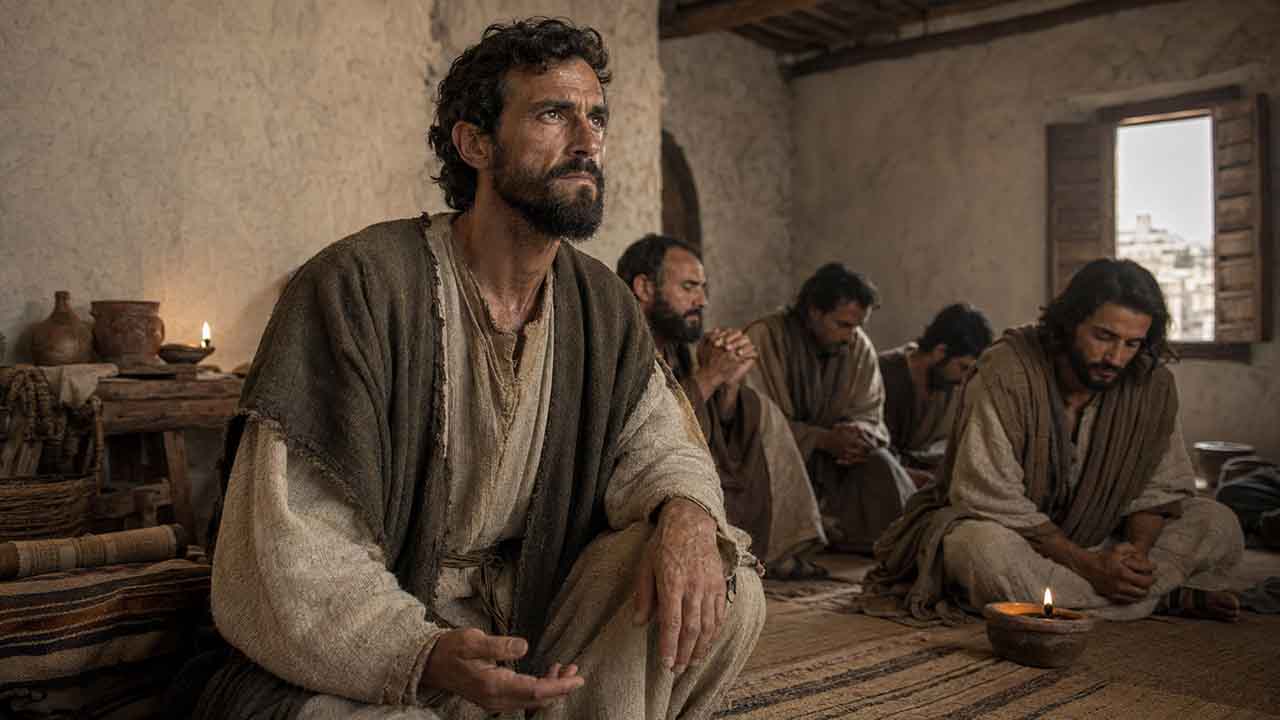
Simon the Zealot
In the quiet upper room, Simon the Zealot sits in watchful prayer, his fierce passion now surrendered to Christ and His kingdom. Among the waiting apostles, his steady gaze reveals zeal purified into holy loyalty.
Listen to this Bible Exhibit
One Simon Among Several
Simon the Zealot stands among the Twelve with a name full of fire and a life mostly hidden from view. Scripture gives us no speech from him, no personal miracle, and no private conversation with Jesus. Yet his name tells us enough to see the wonder of Christ’s kingdom: Jesus calls people with strong passions, deep loyalties, and divided histories, then gathers them under His own rule.
Simon was a common name in the New Testament, so Scripture carefully distinguishes this disciple from Simon Peter. Matthew and Mark call him Simon the Cananaean [Matthew 10:1-4] [Mark 3:13-19]. This does not mean he was from Canaan, nor that he came from Cana. The title comes from an Aramaic word connected with zeal. Luke gives the meaning more plainly when he calls him Simon the Zealot [Luke 6:12-16].
That title may describe Simon’s past. He may have been connected with a Jewish movement that longed for Israel’s freedom from Rome. Or the name may describe his character, marking him as a man known for deep zeal for God, the law, or the hope of Israel. Scripture does not give enough detail to decide with certainty.
What is clear is this: Simon was a man marked by zeal, and Jesus called him into a kingdom that would not advance by rage, revolt, or the sword.
Chosen by Jesus
The Gospels do not preserve Simon’s call story, but they place him among the Twelve. That is no small thing. Jesus appointed the apostles to be with Him, to hear His teaching, to see His works, and to be sent as witnesses of the kingdom.
Simon was not merely an admirer at a distance. He belonged to the close circle of disciples Jesus chose and formed. He walked with the One who preached good news to the poor, touched the unclean, forgave sinners, confronted hypocrisy, and set His face toward the cross.
His silence in the Gospel record should not make him seem unimportant. Some disciples are remembered through many scenes. Others are known mainly by their names. But every apostle was chosen by the same Lord and drawn into the same mission.
Zeal Under a New King
If Simon’s name points to political zeal, then his place among the Twelve is striking. The Jewish world of Jesus’ day carried deep tensions under Roman power. Some longed for a Messiah who would overthrow Rome and restore Israel through force. But Jesus announced a kingdom unlike the kingdoms of this world.
Jesus taught His followers to give to Caesar what belonged to Caesar and to God what belonged to God [Matthew 22:15-22]. Later, before Pilate, He declared that His kingdom was not of this world, otherwise His servants would fight [John 18:33-37]. This does not mean Christ’s kingdom is unreal or weak. It means it does not rise by the weapons of the present age.
Simon had to learn this. The Messiah did not conquer by killing His enemies. He conquered by giving Himself for sinners. The cross did not destroy the kingdom. It revealed its deepest glory.
A Zealot and a Tax Collector
Simon’s presence among the Twelve becomes even more powerful when set beside Matthew. Matthew had been a tax collector, a man tied to a system many Jews despised [Matthew 9:9-13]. If Simon was known for zeal against Rome, and Matthew was known for collecting revenue under Rome’s shadow, then Jesus brought men from opposite sides of a bitter divide into one fellowship.
This is one of the quiet miracles of the apostolic band. Jesus did not gather disciples who already agreed on every social and political question. He called them to Himself. Their deepest identity was no longer their former cause, occupation, party, or reputation. Their deepest identity was Christ.
Around Jesus, the zealot and the tax collector became brothers. The kingdom of God is stronger than old hostility.
Present in Prayer
After the resurrection and ascension, Simon appears again in Jerusalem with the apostles. He is not shown arguing, fighting, or pushing his own cause. He is gathered with the others in prayer, waiting for the promised Spirit [Acts 1:12-14].
This final biblical glimpse is fitting. The zealous one had become a waiting one. His passion had been brought under the command of the risen Christ. The kingdom would go forward, but not by Simon’s old strength. It would go forward by the power of the Holy Spirit through witnesses sent by Jesus.
Early church traditions remember Simon as carrying the gospel beyond Jerusalem, with some accounts connecting his later ministry to regions such as Egypt, Persia, or the wider East. Some traditions also remember him as a martyr. These reports differ, so they should not control his biblical portrait. Scripture gives us enough to know the main truth: Simon belonged to Christ and to the apostolic witness.
Why Simon the Zealot Matters
Simon the Zealot matters because he shows that Jesus does not destroy zeal. He redeems it. The Lord does not call passionless people into His kingdom. He calls sinners, reshapes their loves, purifies their loyalties, and turns their strength toward His mission.
Simon also shows that the kingdom of Christ creates a new people. In the Twelve, Jesus gathered fishermen, a tax collector, a zealot, doubters, strugglers, and sinners. Personality, politics, class, or background did not hold them together. The King held them together.
His life warns us not to give any earthly cause the place that belongs to Christ. Zeal can be holy, but zeal must bow. Passion can serve the kingdom, but the cross must govern it. Simon’s name reminds us that Jesus must claim the fire of the heart.
The Gospel does not make Simon less zealous. It makes his zeal true. In him we see a disciple whose old identity was overtaken by a greater calling: to follow the crucified and risen King, to wait for the Spirit, and to bear witness to a kingdom greater than every earthly power.
What is a Disciple?
A disciple is a follower and learner of Jesus. During his earthly ministry, Jesus called many to follow him, but he chose twelve to be his closest companions and witnesses.
These men walked with Jesus, heard his teaching, saw his miracles, and were formed by his presence. He sent them to proclaim the Kingdom of God, heal the sick, and bear witness to his authority.
The disciples were not flawless heroes. They misunderstood, doubted, argued, and failed. Yet Jesus patiently shaped them by grace. After his resurrection, and through the gift of the Holy Spirit, these once-fearful followers became bold witnesses to the risen Christ.
Their lives show the heart of discipleship: to be called by Christ, formed by Christ, and sent by Christ. A disciple does not merely admire Jesus from a distance, but follows him in faith, obedience, and love.