


The Gates of Jerusalem
Doorways of Restoration, Worship, and Glory
Carousel of images for this Bible Exhibit
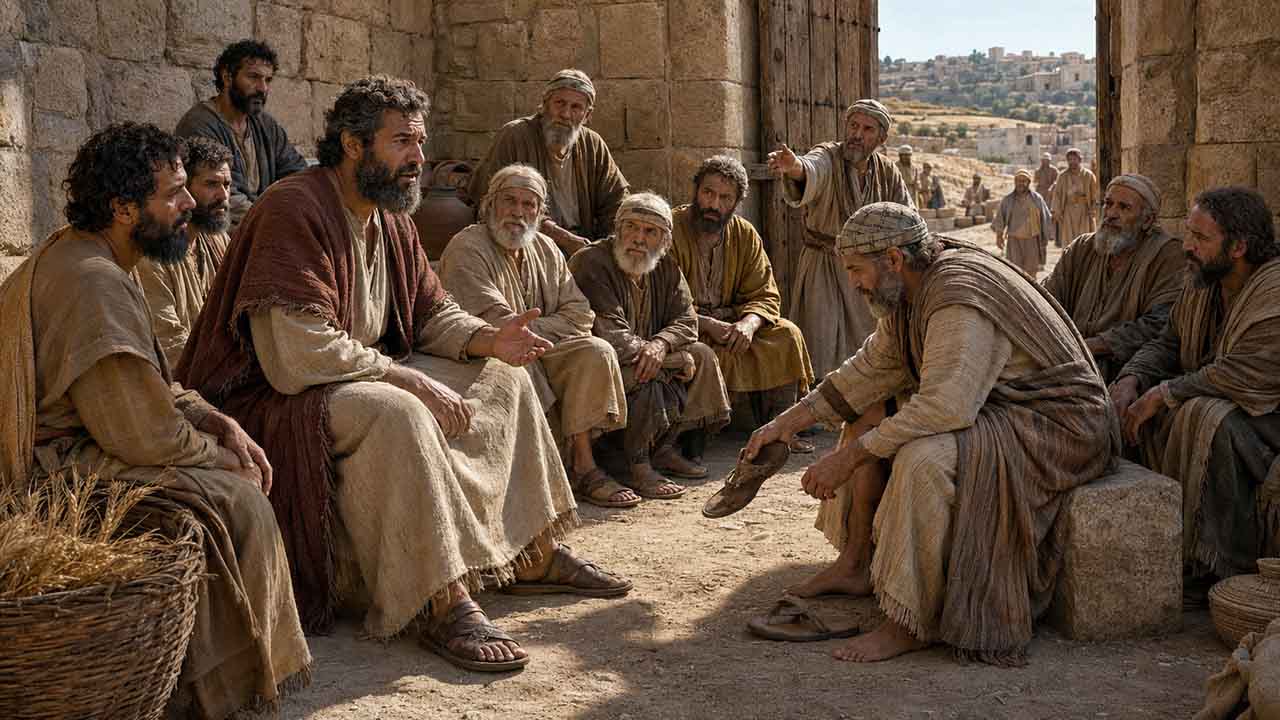
Boaz at the City Gate
At the sunlit city gate of Bethlehem, Boaz speaks with calm authority before the elders, while the nearer kinsman-redeemer removes his sandal in a solemn act of public witness. Surrounded by weathered stone, dusty earth, barley, and the attentive faces of Israel’s elders, the scene captures a quiet but powerful moment of honor, redemption, and providence.
Title
The gates of Jerusalem stand at the meeting place of history and hope. Through them came kings, merchants, worshipers, soldiers, exiles, and pilgrims. Scripture names these gates because they help us see Jerusalem as a real city where God judged sin, restored his people, sent his Son, and promised a kingdom that will never end.
The psalmist calls God’s people to walk around Zion, count her towers, and consider her ramparts so the next generation will know the Lord [Psalm 48:12-14]. The gates of Jerusalem help us do that. They teach us to read the Bible with our feet on the ground and our eyes lifted to Christ.
Why Gates Mattered in the Bible
In the ancient world, a gate was not just a door in a wall. It was the first view of the city, its defense against enemies, and the place where public life gathered. Gates had strong doors, bars, turns, towers, and chambers. To tear away a gate was to shame a city and leave it exposed, as Samson did at Gaza [Judges 16:3].
But gates were also places of judgment, trade, witness, and covenant business. Elders sat there. Merchants passed through. The king received the people. Legal matters were settled in public. When Boaz redeemed Ruth and preserved Naomi’s family line, he did it at the gate before witnesses [Ruth 4:1-11]. That scene matters because it leads to David and, from David, to Christ. Even a city gate can become part of the story of redemption.
Nehemiah and the Burned Gates
When Nehemiah came to Jerusalem after the exile, he found a city in disgrace. The walls were broken, and the gates had been burned. He rode by night past the Valley Gate, the Dragon Spring, the Dung Gate, and the Fountain Gate, seeing the ruin with his own eyes [Nehemiah 2:13-17]. Broken gates meant more than weak defenses. They showed the shame of a people judged for sin, scattered from the land, and in need of mercy.
Nehemiah 3 then gives a careful record of the rebuilding. At first, it can sound like a long list of names. Yet the list is rich with meaning. Priests, goldsmiths, rulers, merchants, Levites, families, and even the daughters of Shallum all work near one another. The repeated words “next to him” show the beauty of shared obedience. God restored Jerusalem through ordinary people who repaired the place nearest to them.
The gates named in Nehemiah include the Sheep Gate, Fish Gate, Old Gate, Valley Gate, Dung Gate, Fountain Gate, Water Gate, Horse Gate, East Gate, and Inspection Gate [Nehemiah 3:1-32]. We should not treat each name as a secret code. Still, the uses of the gates help us see the whole life of God’s people being restored. Worship returned through the Sheep Gate. Daily laborers passed through the Fish Gate. Humble service began at the Valley Gate. Uncleanness left through the Dung Gate. Water and life were connected with the Fountain and Water Gates. Conflict stood under God at the Horse Gate. Hope faced east. Accountability was remembered at the Inspection Gate.
When the wall was finished in fifty-two days, the nations around Judah knew that God had helped his people [Nehemiah 6:15-16]. Jerusalem’s rebuilt gates announced that the Lord had not abandoned his covenant.
The Gates That Point to Christ
The Sheep Gate stands first in Nehemiah’s list because priests rebuilt it near the temple. Sheep used for sacrifice entered that way. The gate, therefore, points beyond itself to the costly truth that sinners do not approach a holy God without atonement. Near that gate, at Bethesda, Jesus healed a man who had been helpless for thirty-eight years [John 5:2-9]. The place of sacrificial animals became the setting where the true Son gave life by his word.
John the Baptist then gives the meaning plainly: Jesus is the Lamb of God who takes away the sin of the world [John 1:29]. Jesus also calls himself the door of the sheep, the only safe entrance into the flock of God [John 10:7-11]. Jerusalem’s gates guarded the city, but Christ opens the way to God.
Other gates add light. The Fish Gate reminds us that the Lord can take ordinary labor and turn it toward kingdom mission, as Jesus did when he called fishermen to follow him [Mark 1:16-18]. The Fountain Gate stood near water sources that kept the city alive. At the Feast of Tabernacles, Jesus cried out that the thirsty should come to him and drink, promising rivers of living water by the Spirit [John 7:37-39]. The Water Gate became the place where Ezra read the Law to men, women, and children, and the people learned again to hear God’s Word [Nehemiah 8:1-8]. Gates teaches us that God restores his people by sacrifice, mission, cleansing, life, and Scripture.
Jesus, the Temple, and the Gates
By the time of Jesus, Jerusalem had changed. Herod had enlarged the Temple Mount. Pilgrims came up through gates, streets, steps, and courts to worship. The southern Huldah Gates provided access to the temple area via passages and stairs. The present sealed Double and Triple Gates on the south side help modern visitors picture the movement of worshipers in the Second Temple period, even though they are not open today.
Jesus’ final week gives the city’s gates deep meaning. He came from the Mount of Olives toward Jerusalem as the humble King promised by the prophet [Zechariah 9:9]. The crowds praised him, but he wept over the city and entered the temple with holy authority [Luke 19:35-46]. Soon after, he was taken outside the gate to suffer. Hebrews tells us that Jesus suffered outside the gate to sanctify his people by his own blood, and it calls believers to go to him outside the camp [Hebrews 13:12-14]. The gates show both welcome and rejection. Jerusalem received pilgrims, but the Savior bore reproach outside the city to bring sinners in.
After the resurrection, the apostles continued to bear witness near the temple. At the gate called Beautiful, Peter and John met a man who was lame from birth. In the name of Jesus Christ of Nazareth, he rose, walked, and praised God [Acts 3:1-10]. The exact identification of that gate is debated, but the message is clear. The risen Christ still gives strength to those who cannot raise themselves.
The Gates Visitors See Today
Most gates tourists see in Jerusalem today belong to the Ottoman walls built under Suleiman the Magnificent in the sixteenth century. They are later than Nehemiah and later than Jesus. This matters. We honor Scripture best when we do not force every visible stone to be the exact biblical gate.
Even so, today’s gates still help readers understand the Bible. Jaffa Gate faces the old road toward the coast and was long a main western entrance. Damascus Gate, also called Shechem or Nablus Gate, faces north and still feels like a busy threshold into the city’s markets. Herod’s Gate is also called the Flower Gate, though it has no real connection to Herod the Great. Lions’ Gate, or St. Stephen’s Gate, stands in the eastern wall and leads toward the Via Dolorosa and the Bethesda area. Dung Gate gives close access to the Western Wall and recalls the older southern gate linked with refuse and the Hinnom Valley. Zion Gate bears modern battle scars and leads toward the Jewish and Armenian quarters. New Gate, opened in the nineteenth century, serves the Christian Quarter. The sealed Golden Gate, or Gate of Mercy, faces the Mount of Olives.
These modern gates do not replace the biblical ones, but they train the eye. Jerusalem is still a city one enters. Its roads still pull memory toward Jaffa, Damascus, Zion, the temple area, and the Mount of Olives. To walk those gates is to remember that Scripture happened in a city people could approach, defend, lose, rebuild, and long for.
The Eastern Gate and the Glory of God
The eastern side of Jerusalem carries special weight because it faces the Kidron Valley and the Mount of Olives. Ezekiel saw the glory of the Lord depart from the temple toward the east because of Israel’s sin [Ezekiel 10:18-19]. Later, he saw the glory of God return from the east and fill the house [Ezekiel 43:1-5].
Many traditions connect the sealed Golden Gate with messianic hope. We should be careful. Ezekiel’s visionary east gate is a temple gate, and the present Golden Gate is a later structure. Scripture does not require us to make uncertain claims to defend its truth. Yet the direction still teaches us. The glory that departed because of sin will return by God’s promise. No stone, seal, wall, or graveyard can keep the Lord from doing what he has spoken.
The City Whose Gates Never Close
The Bible’s story ends with gates. Ezekiel saw a restored city with gates named for Israel’s tribes, and the city was called “The LORD Is There” [Ezekiel 48:30-35]. John saw the New Jerusalem coming down from God, with twelve gates, the names of the tribes, and the foundations named for the apostles of the Lamb. Its gates are not shut because there is no night there [Revelation 21:10-27].
This is why Jerusalem’s gates matter. They help us read the Bible with our feet on the ground and our eyes lifted to Christ. They show a holy city ruined by sin, restored by grace, visited by the King, and destined for glory. They remind us that public life, worship, work, justice, suffering, healing, and hope all stand before God.
To know the gates of Jerusalem is to see the story of Scripture in stone. Burned gates are rebuilt. Closed gates cannot stop God. The true Gate is Christ. All who enter by him find life, and all who belong to him are being brought to the city whose gates will never close.