


Benjamin, Son of Jacob
Born in Sorrow, Kept by Mercy
Carousel of images for this Bible Exhibit
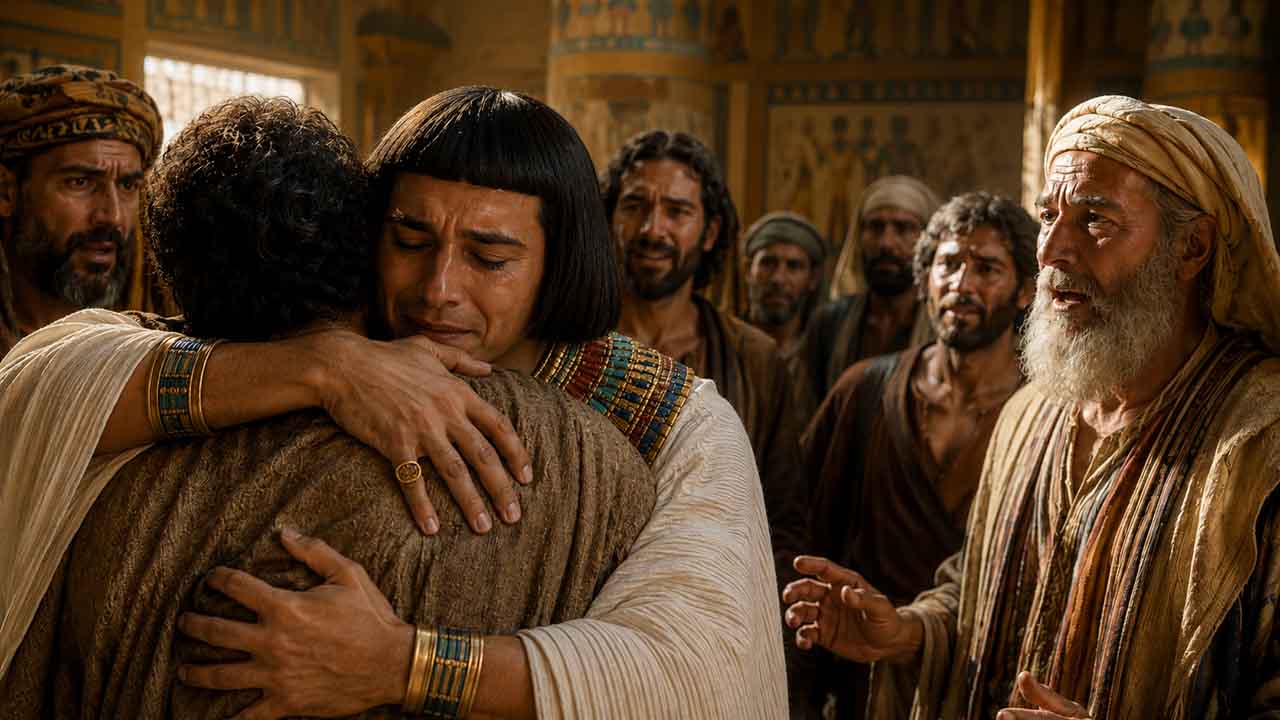
Benjamin: Rachel’s Sons Reunited
In Joseph’s tearful embrace of Benjamin, Rachel’s two sons stand together again after years of betrayal, exile, and hidden sorrow. Before the watching brothers, the Lord begins to turn guilt into mercy and a fractured family toward restoration.
Listen to this Bible Exhibit
The Beloved Son at the Center of the Test
Benjamin does not speak in Genesis, yet his life carries great weight. He was Jacob’s youngest son, Rachel’s second son, Joseph’s full brother, and the child born as Rachel died. His story stands at the meeting point of sorrow, love, fear, testing, repentance, and family restoration.
Benjamin matters because Genesis uses his presence to reveal others’ hearts. Jacob protects him. Joseph longs to see him. Judah offers himself in his place. Through Benjamin, the Lord brings old sin into the light and shows that Jacob’s broken family is beginning to change.
This makes Benjamin more than a quiet figure in the background. He is the beloved younger brother whose safety becomes the test of the family. The brothers once abandoned Joseph, Rachel’s first son. Would they now abandon Benjamin, Rachel’s other son? In that question, Genesis shows God’s mercy at work.
Born in Sorrow, Renamed in Hope
Benjamin was born on the road from Bethel to Ephrath, near Bethlehem. Rachel went into hard labor and died as he was born. As she was dying, she named him Ben-Oni, a name tied to sorrow or trouble. But Jacob renamed him Benjamin, usually understood as “son of my right hand” [Genesis 35:16-20].
That name change matters. Rachel’s sorrow was real, but Jacob would not let sorrow have the final word over the child. Benjamin’s first moments were filled with both grief and mercy. Death touched his birth, yet life was preserved. His mother was buried, but the child lived.
Benjamin was also the only son of Jacob born in the land of Canaan. The other sons had been born earlier during Jacob’s years away from the land, but Benjamin entered the family story as Jacob returned to the land of promise. His birth was painful, but it still belonged to the covenant story God was carrying forward.
Rachel’s Son in Jacob’s Wounded House
Benjamin was the second son of Rachel, the wife Jacob loved deeply. Jacob had served fourteen years for Rachel, and his love for her shaped the family from the beginning [Genesis 29:16-30]. Joseph and Benjamin, the two sons born to Rachel, therefore held a special place in Jacob’s heart.
That special love brought pain into the family. Jacob’s favoritism toward Joseph had stirred jealousy among the older brothers. Joseph was sold away, and Jacob believed he was dead [Genesis 37:3-36]. After that loss, Benjamin became the only remaining son of Rachel at Jacob’s side.
This helps explain Jacob’s fear. Benjamin was not merely the youngest son. He was the living reminder of Rachel, Joseph’s brother, and the child Jacob could not bear to lose. His life was wrapped in the family’s deepest wound.
The Son Jacob Could Not Bear to Lose
When famine struck Canaan, Jacob sent his sons to Egypt to buy grain, but he kept Benjamin at home. Jacob feared that harm might come to him. The brothers went without him, not knowing that the Egyptian ruler before whom they would stand was Joseph himself [Genesis 42:1-38].
Joseph recognized his brothers, but they did not recognize him. He tested them by demanding that they bring their youngest brother to Egypt. This demand struck Jacob at the place of his greatest fear. Simeon was held in Egypt, famine pressed on the family, and Jacob felt as if his sons were being taken from him one by one.
Benjamin had now become the touchpoint for the family’s old sin. The question was not only whether Benjamin would survive the journey. The deeper question was whether the brothers were still the same men who had once handed Joseph over and watched their father drown in grief.
Judah’s Pledge
When the grain ran out, Jacob had to face the demand from Egypt. He still hesitated to send Benjamin. Then Judah stepped forward and promised to bear the blame if Benjamin did not return safely [Genesis 43:1-14].
This was a major change. Earlier, Judah had been involved in the selling of Joseph. Now he pledged himself to Benjamin. The brother who had once helped send away one of Rachel’s sons was now willing to guard the other.
Benjamin still says nothing. Yet everything turns on him. His danger reveals whether the brothers have changed. His safety becomes the setting in which Judah’s repentance begins to take visible form.
Joseph Sees Benjamin
When the brothers returned to Egypt with Benjamin, Joseph saw his full brother and was deeply moved. He blessed him, left the room to weep, and later gave Benjamin a portion five times greater than the others at the meal [Genesis 43:29-34].
This was affection, but it was also a test. Years earlier, the brothers had hated Joseph because he was favored. Now Benjamin received visible favor in their presence. Would jealousy rise again? Would they resent Rachel’s son again? Genesis gives no sign that they did.
Benjamin’s presence exposed the family’s heart. Joseph loved him. Jacob feared for him. The brothers were being tested through him. God was using the beloved younger son to reveal whether mercy had begun its work.
The Brother They Would Not Abandon
Joseph then arranged one final test. His silver cup was placed in Benjamin’s sack. When the cup was found, Benjamin appeared guilty and was threatened with slavery in Egypt [Genesis 44:1-34].
This moment brought the old sin back in a new form. Years earlier, the brothers had returned to Jacob without Joseph. Now they had the chance to return without Benjamin. Joseph even gave them a way out: Benjamin could remain as a servant, and the rest could go free.
But they did not abandon him. Judah drew near and offered himself in Benjamin’s place. This is the turning point. The brother who once helped sell Joseph now offers to become a slave so Rachel’s other son can go free.
Benjamin is silent, but his danger calls forth costly love. Through him, the Lord exposes the family’s guilt and reveals the brothers’ change. The family that had been torn apart by envy begins to be restored through repentance and mercy.
Joseph Reveals Himself
After Judah’s plea, Joseph could no longer control himself. He revealed his identity to his brothers and told them that God had sent him ahead to preserve life. Then Joseph embraced Benjamin and wept, and Benjamin wept with him [Genesis 45:1-15].
Benjamin stood at the center of that reunion. He was not the ruler like Joseph. He was not the spokesman like Judah. Yet without Benjamin, the family’s restoration would not unfold in the same way. His threatened loss became the moment when the truth came out, repentance was seen, and mercy was received.
Joseph later gave Benjamin three hundred shekels of silver and five sets of clothes, far more than he gave the other brothers [Genesis 45:21-28]. This gift showed Joseph’s special love for his full brother. But now the old poison of jealousy no longer ruled the family in the same way. God was healing what sin had broken.
Then they journeyed from Bethel. When they were still some distance from Ephrath, Rachel went into labor and had hard labor. When she was in severe labor, the midwife said to her, “Do not be afraid, for now you have another son.” And as her soul was departing, for she was dying, she named him Ben-Oni; but his father called him Benjamin.
So Rachel died and was buried on the way to Ephrath, that is, Bethlehem. Jacob set up a memorial stone over her grave; that is the pillar of Rachel’s tomb to this day.
Genesis 35:16–20
A Father Within the Covenant Family
When Jacob’s household went down to Egypt, Benjamin was named among those who entered the land. By then, he was not merely the protected youngest son in Jacob’s house. Genesis names his ten sons: Bela, Beker, Ashbel, Gera, Naaman, Ehi, Rosh, Muppim, Huppim, and Ard [Genesis 46:21].
This detail gives Benjamin’s story a fuller shape. He was not only the child born in sorrow or the brother whose safety tested the family. He had become a father within the covenant household. The son Jacob feared losing was preserved by God, and his own children were carried into Egypt with the rest of Israel’s family.
That matters because Genesis is tracing more than private family grief. The Lord was preserving names, households, and generations. Benjamin’s life began with Rachel’s death, but it did not end in loss. God kept him, gave him children, and included his household in the family through whom His promise would continue.
Jacob’s Final Blessing
Near the end of his life, Jacob blessed his sons. His word over Benjamin was vivid and strong: “Benjamin is a ravenous wolf; in the morning he devours the prey, in the evening he divides the plunder” [Genesis 49:27].
This blessing looks beyond Benjamin himself to the strength and fierceness that would mark his descendants. It does not erase the tenderness of Benjamin’s own story. Rather, it shows that the child born in weakness and guarded in fear was not destined for insignificance.
Benjamin belongs fully among the sons through whom God formed the nation of Israel. He is not only Rachel’s last child but also Joseph’s beloved brother. He is a bearer of covenant promise, a father within Jacob’s household, and a quiet figure used by God at a decisive moment in Genesis.
Why Benjamin Matters
Benjamin matters because his life helps us understand how God works in wounded families. He was born in sorrow, loved with fear, protected through famine, placed in danger, and used by God to reveal whether his brothers had truly changed.
His story also helps us see a larger pattern in Scripture. Judah offered himself so Benjamin could go free. That does not make Judah the Savior, but it does show the kind of costly love that reaches its fullness in Christ. The Bible’s great story moves toward the Son who gives his life as a ransom for many [Mark 10:45].
Benjamin teaches us that God can use a quiet life to expose deep sin and bring real healing. The Lord does not need every person to speak loudly for that person to matter. Benjamin’s presence changed the course of Jacob’s family.
To know Benjamin is to see that God remembers the child born in sorrow. He preserves the vulnerable. He tests the guilty. He restores the broken. And he carries his covenant promise forward through grace.