


Thaddaeus

Thaddaeus
The Apostle Who Asked How Christ Would Be Seen
Carousel of images for this Bible Exhibit
Thaddaeus
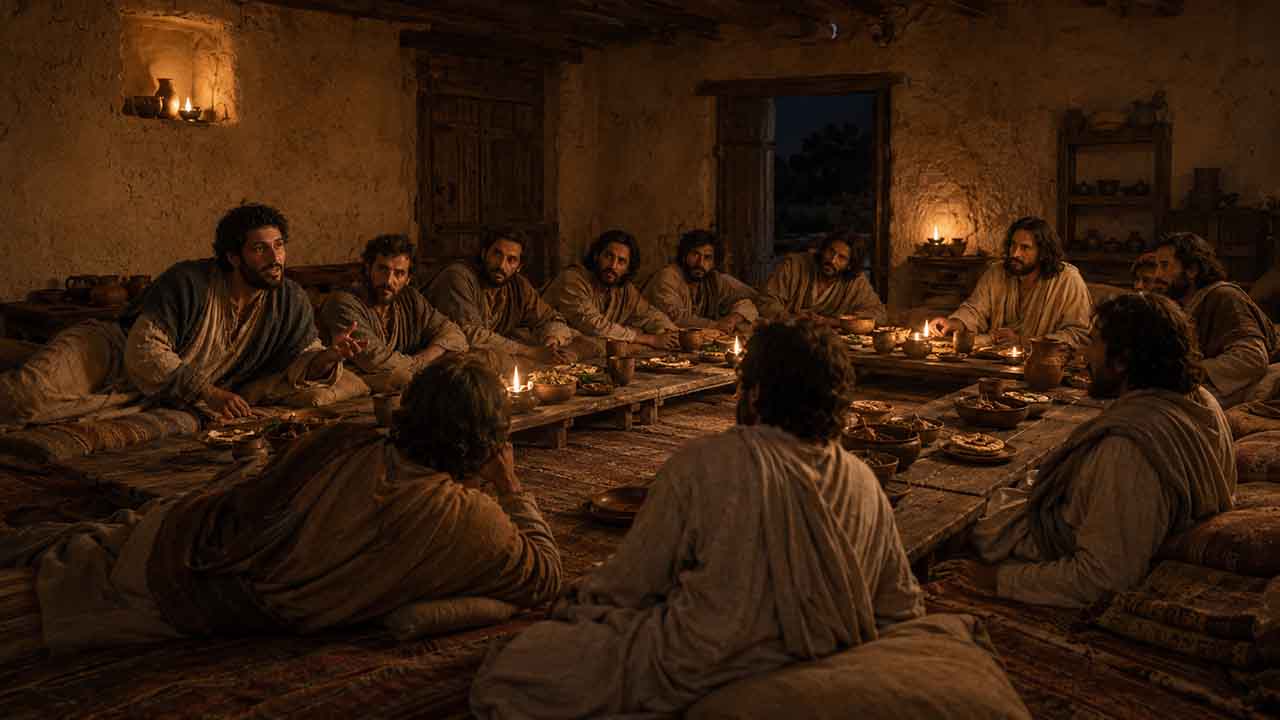
In the lamplit upper room, Thaddaeus asks Jesus his quiet question, revealing a faithful heart longing to understand how Christ makes Himself known to those who love Him.
Listen to this Bible Exhibit
A Disciple with Several Names
Thaddaeus stands in the upper room, listening as Jesus speaks of love, obedience, the Holy Spirit, and God’s nearness. He is not one of the most visible apostles, but his one recorded question opens a deep window into the heart of discipleship: how does the risen Christ make Himself known?
Thaddaeus is named among the Twelve in Matthew and Mark [Matthew 10:1-4] [Mark 3:13-19]. Luke appears to name the same apostle as “Judas son of James” [Luke 6:12-16]. John likely refers to him as “Judas, not Judas Iscariot,” carefully separating this faithful disciple from the betrayer.
This difference in names should not unsettle us. Many people in the New Testament were known by more than one name, and Judas was a common name. Matthew and Mark may have used the name Thaddaeus to avoid confusion with Judas Iscariot. Some manuscripts also preserve the name Lebbaeus, associated with the heart, but its exact meaning is uncertain. We should not build too much on what Scripture does not make plain.
What matters is clear: Thaddaeus was one of the Twelve. He was called by Jesus, formed by Jesus, and kept among the apostolic witnesses.
Chosen and Sent by Jesus
Thaddaeus does not receive a long personal story in the Gospels. No miracle is attached to his name. No sermon is preserved from his lips. Yet his place among the Twelve is not small.
Jesus first appointed the Twelve to be with Him, and then to be sent out. That order matters. Before the apostles were messengers, they were companions. Before they carried Christ’s authority, they lived under Christ’s teaching. Thaddaeus heard the words of the kingdom, watched the works of mercy, and learned the way of the cross alongside the others.
His quiet place reminds us that Scripture does not measure importance by how often a person speaks. Some disciples stand in the foreground. Others remain in the background. But every true apostle was chosen by the same Lord and drawn into the same mission.
The Question in the Upper Room
The clearest glimpse of Thaddaeus comes on the night before Jesus went to the cross. Jesus was preparing His disciples for His departure. He spoke of the Spirit, promised life beyond His death, and taught that love for Him would be shown in obedience.
Then Thaddaeus asked, “But, Lord, why do you intend to show yourself to us and not to the world?” [John 14:15-24]
It was an honest question. Like the other disciples, Thaddaeus was still learning what kind of King Jesus had come to be. If Jesus was the Messiah, why would He not reveal His glory in a public display before all people? Why would His presence be known first by His followers and not by the watching world?
His question exposes a common misunderstanding of the kingdom. We often expect Christ’s glory to be proven by visible power, public success, or immediate triumph. But Jesus was moving toward the cross, not away from it. His kingdom would not first appear as a spectacle. It would be known by love, faith, obedience, and the gift of the Holy Spirit.
Christ Revealed to the Obedient Heart
Jesus answered Thaddaeus with one of the richest promises in the Farewell Discourse. The one who loves Jesus will keep His word. The Father will love that person. The Father and the Son will come and make their home with that person.
This is a stunning answer. Jesus does not say that He will reveal Himself through worldly force. He does not promise a political sign to satisfy human curiosity. He promises the presence of God with those who love Him and obey His teaching.
The world may look at Jesus and see only weakness, rejection, and crucifixion. But the disciple sees more. By the Spirit, the disciple comes to know the Son’s union with the Father, the life that flows from the risen Christ, and the holy nearness of God dwelling with His people.
Thaddaeus’s question, then, helps us understand the shape of Christian faith. Jesus is not hidden because He is weak. He is hidden from unbelief because His glory is received by faith. He reveals Himself to those who love Him, trust Him, and keep His word.
Present in Prayer
After Jesus rose from the dead and ascended, Thaddaeus appeared again with the apostles in Jerusalem. He is not shown seeking attention or standing apart. He is gathered with the others in prayer, waiting for the promised work of God [Acts 1:12-14].
This is a fitting final biblical glimpse. The apostle who asked how Christ would reveal Himself is found waiting with Christ’s people for the gift of the Spirit. He had learned that the kingdom does not come by impatient display. It comes by the promise of the Father, the power of the Spirit, and the witness of those who belong to the risen Lord.
Scripture gives us no certain record of Thaddaeus’s later ministry. That silence should be respected. What Scripture gives is enough.
Why Thaddaeus Matters
Thaddaeus matters because his one question draws out a central truth of discipleship. Jesus is not known merely by being near religious things. He is not known by curiosity alone. He is known by those who love Him, receive His word, and live in obedience by the Spirit.
His life also reminds us that quiet disciples can ask deep questions. Thaddaeus does not dominate the Gospel story, yet his question helps every reader see how Christ makes Himself known. The glory of Jesus is not first displayed as a worldly spectacle. It is revealed in the hearts of those who belong to Him.
Thaddaeus was chosen, taught, corrected, and gathered with the apostles in prayer. His name may be difficult to trace, but his witness is clear. Christ reveals Himself to faithful hearts, and those hearts become a dwelling place for God.
What is a Disciple?
A disciple is a follower and learner of Jesus. During his earthly ministry, Jesus called many to follow him, but he chose twelve to be his closest companions and witnesses.
These men walked with Jesus, heard his teaching, saw his miracles, and were formed by his presence. He sent them to proclaim the Kingdom of God, heal the sick, and bear witness to his authority.
The disciples were not flawless heroes. They misunderstood, doubted, argued, and failed. Yet Jesus patiently shaped them by grace. After his resurrection, and through the gift of the Holy Spirit, these once-fearful followers became bold witnesses to the risen Christ.
Their lives show the heart of discipleship: to be called by Christ, formed by Christ, and sent by Christ. A disciple does not merely admire Jesus from a distance, but follows him in faith, obedience, and love.