


Dan, Son of Jacob
Named for Judgment, Waiting for Salvation
Carousel of images for this Bible Exhibit
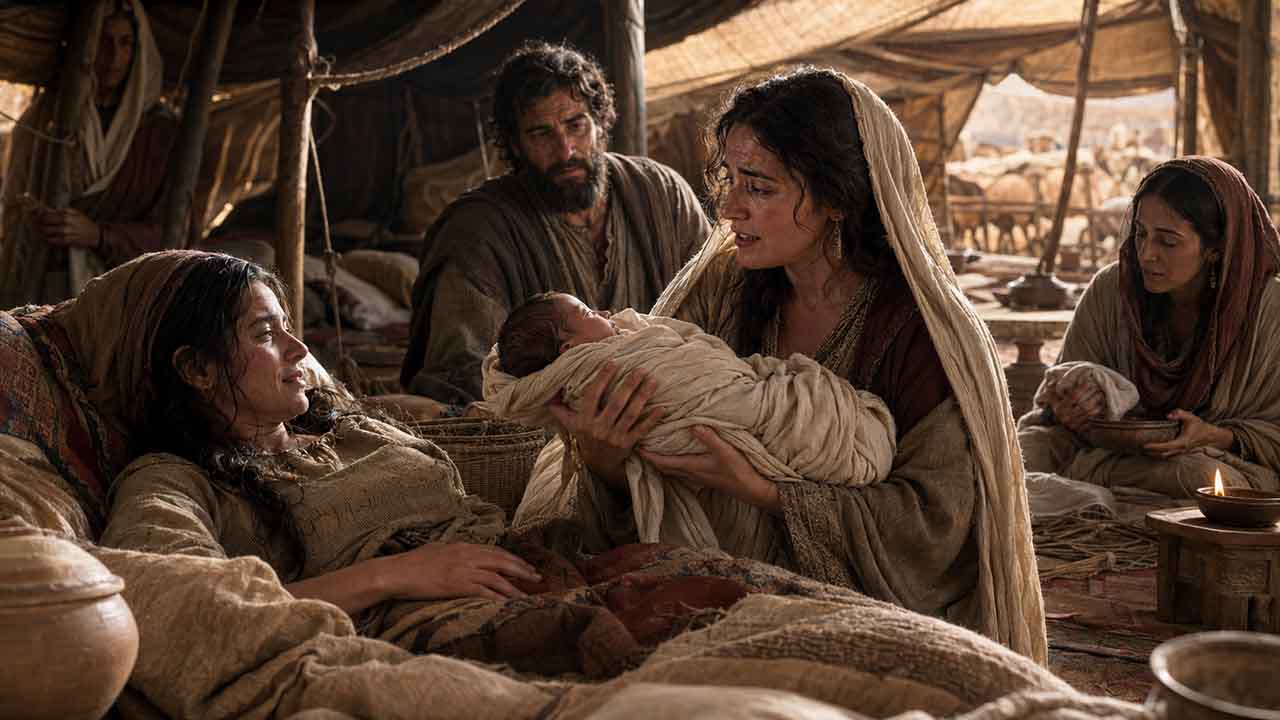
The Child of Vindication
Rachel receives Bilhah’s newborn son with tearful wonder, naming him Dan because God has heard her cry and judged her cause. In the fragile warmth of this birth, the Lord is forming Israel’s future even through sorrow, rivalry, and longing.
Listen to this Bible Exhibit
Born from Rachel’s Sorrow
Dan stands in Scripture as one of Jacob’s quieter sons. No speech of his is recorded. No personal act is preserved. Yet his name, birth, son, and blessing all carry weight in the story of Israel. Born through Bilhah in the sorrow of Rachel’s barrenness, Dan was named with the language of judgment. Blessed by Jacob with words of danger and dignity, his story leads to one of the most searching prayers in Genesis: “I wait for your salvation, O LORD.”
Dan was Jacob’s fifth son and the first child born to Bilhah, Rachel’s servant. Rachel had watched her sister Leah bear sons while she remained barren. In her grief and rivalry, she gave Bilhah to Jacob so that she might receive children through her [Genesis 30:1-6].
Genesis records this broken family moment honestly. Dan’s birth came through human pain, envy, and longing. Yet God’s covenant purpose was still moving forward. The family of Israel did not begin as a perfect household. It began in a house full of favoritism, sorrow, weakness, and grace.
Rachel named the child Dan because she believed God had judged her case, heard her voice, and given her a son. The name means “judge” or “he judged.” In Rachel’s words, Dan’s name became a testimony that God had seen her pain. But it also reminds us that receiving a gift from God does not mean every wound in the heart has been healed. Dan was born into mercy, but also into a family still in need of peace.
Counted Among Jacob’s Sons
Though Dan was born through Bilhah, he was fully counted among Jacob’s sons. Scripture names him with the sons of Israel and often places him with Naphtali, his full brother [Genesis 35:22-26] [Exodus 1:1-5]. When Jacob’s household went down to Egypt, Dan’s son Hushim is named [Genesis 46:23]. Later, Numbers refers to this line as the Shuhamites [Numbers 26:42-43].
That brief record matters. Scripture gives us almost nothing about Dan’s personal life, but it gives enough to show that he belonged. He was not a side note in the covenant family. He was one of the fathers of Israel.
Dan teaches us that biblical significance is not measured by how many scenes a person receives. Some lives are recorded in a sentence, yet still stand inside the faithful purpose of God.
The Blessing of Judgment and Danger
The deepest word over Dan comes from Jacob’s final blessing. Jacob says that Dan will judge his people as one of the tribes of Israel. This blessing plays on Dan’s name and confirms his standing. Dan would not be an outsider. He would share in the life, order, and future of Israel [Genesis 49:16-18].
But the blessing quickly becomes mysterious and sharp. Dan is compared to a serpent beside the road, a viper along the path, striking the horse’s heel so that the rider falls backward. The image is not gentle. It suggests danger, strategy, sudden action, and the ability to bring down something stronger by an unexpected strike.
We should read this carefully. Genesis does not record Dan himself committing any great sin, nor does it condemn his personal character. The words look forward. They cast a shadow over the tribe that would bear his name. Dan would be counted among Israel, but his story would carry both warning and honor.
“I Wait for Your Salvation”
Then Jacob suddenly turns from Dan to the Lord: “I wait for your salvation, O LORD.”
This is the theological center of Dan’s portrait. After judgment and danger, Jacob looks beyond human strength. Israel’s hope will not rest in tribal identity, clever strategy, or earthly power. The Lord must save.
That cry gathers up the need of the whole covenant family. Abraham could not secure the promise by his own strength. Isaac and Jacob were preserved by mercy. Joseph saved lives in Egypt because God was with him. And now, as Jacob blesses his sons, he confesses the truth every generation must learn: salvation belongs to the Lord.
The Tribe That Bore His Name
After Genesis, Scripture speaks far more about Dan’s descendants than about Dan himself. The tribe became large in the wilderness, camped north of the tabernacle with Asher and Naphtali, and marched as Israel’s rear guard [Numbers 1:38-39] [Numbers 2:25-31] [Numbers 10:25]. From Dan came Oholiab, the Spirit-gifted craftsman who helped build the tabernacle [Exodus 31:6]. From Dan also came Samson, the mighty and deeply flawed judge who fought the Philistines [Judges 13–16].
Dan’s later tribal story is sobering. The tribe struggled to possess its first inheritance, was pressed by Amorites and Philistines, and later migrated north to capture Laish, renaming it Dan [Joshua 19:40-48] [Judges 1:34-35] [Judges 18:1-31]. There, the Danites established an unauthorized shrine with a carved image. Centuries later, King Jeroboam placed one of his golden calves at Dan, making the city a center of false worship in the northern kingdom [1 Kings 12:25-33].
This does not mean Dan the man should be blamed for every later sin of his descendants. Scripture does not speak that way. But the tribe’s story does show the danger already felt in Jacob’s blessing. A people may bear a covenant name and still drift from covenant worship. Dan warns us that religion shaped by convenience, fear, or self-invention can become rebellion against the Lord.
Even so, Dan is not erased from every hope. Ezekiel names Dan in his vision of the restored land [Ezekiel 48:1]. Revelation 7, however, omits Dan from the list of sealed tribes, a silence Scripture does not fully explain [Revelation 7:4-8]. The right response is not speculation, but reverence. Dan’s story teaches both the seriousness of idolatry and the need for mercy.
Why Dan Matters
Dan matters because Scripture does not waste its quiet lives. He was born in rivalry, named in hope, counted among the sons, and blessed with words that point beyond him to the salvation of God.
His life reminds us that the Lord sees sorrow in wounded families. He includes the overlooked in His covenant purposes. He speaks truth over danger and sin. And He turns our eyes from human strength to divine salvation.
In the full light of Scripture, Jacob’s prayer finds its answer in Jesus Christ. Dan means judgment, and Jacob waits for salvation. Both meet in the Son of God, the true Judge who saves His people by grace.
Dan shall judge his people as one of the tribes of Israel. Dan will be a snake by the roadside, a viper by the path, that bites the horse’s heels so that the rider falls backward. I wait for your deliverance, O Lord.
Genesis 49:16–18