


Issachar, Son of Jacob
Rewarded by Grace, Tested by Rest
Carousel of images for this Bible Exhibit
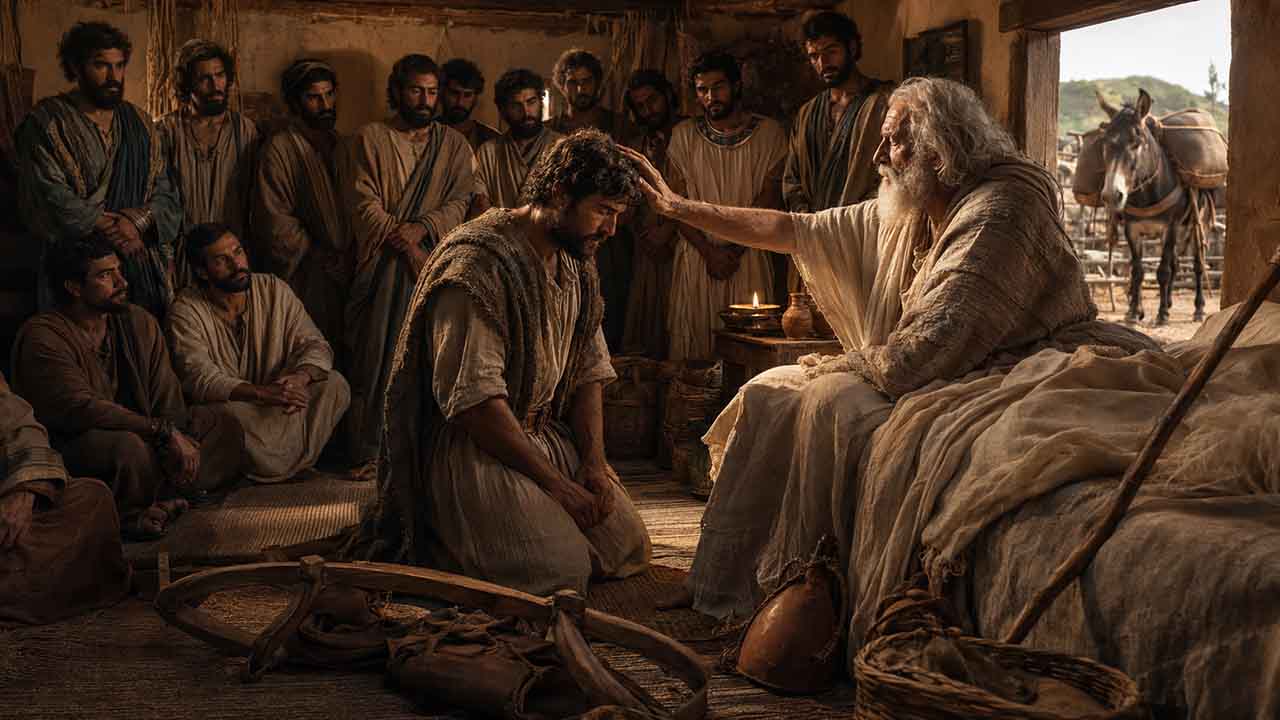
Strength Beneath the Burden
Issachar kneels beneath Jacob’s hand as a son marked for strength, labor, and quiet endurance. The resting donkey beyond the doorway echoes his blessing, a future of humble service, pleasant land, and shoulders bent to the burden.
Listen to this Bible Exhibit
Rewarded by Grace, Tested by Rest
Issachar stands among Jacob’s sons as a quiet figure with a weighty story. Scripture records no speech from him and no personal deed that sets him at the center of Genesis. Yet his birth, name, sons, blessing, and tribal legacy all matter. He was Jacob’s ninth son, the fifth born to Leah, and the ancestor of a tribe remembered for labor, fruitful land, courage in battle, and rare wisdom in a decisive hour. Issachar’s life teaches that God works through wounded homes, ordinary sons, and hidden generations. He gives reward by grace, but He also warns His people that comfort can become a snare.
Born in a Wounded Household
Issachar was born during the long sorrow between Leah and Rachel. Leah had already borne Reuben, Simeon, Levi, and Judah, but then she stopped bearing children. Rachel remained barren and envied her sister. Jacob’s home was full of longing, rivalry, and grief [Genesis 29:31-35] [Genesis 30:1-18].
Then Reuben found mandrakes in the field and brought them to Leah. Rachel wanted them, likely hoping they might help her conceive. Leah agreed to give them to Rachel only if Rachel allowed Leah to be with Jacob that night. The scene is painful because it shows how strained the household had become. Love, fertility, status, and sorrow were all tangled together.
Yet Genesis is careful to tell us what truly mattered: “God listened to Leah.” Issachar was not finally the product of mandrakes, bargaining, or human control. He was a child given by God. His birth came amid a broken family moment, but it was by the mercy of the Lord.
That is often how Genesis teaches us to see the covenant family. God does not wait for perfect homes before He keeps His promises. He enters real houses filled with envy, weakness, disappointment, and need. Issachar was born in sorrow, but not outside providence.
A Name of Wages and Reward
Leah named her son Issachar, saying, “God has given me my wages” [Genesis 30:18]. His name is tied to the ideas of hire, wages, reward, or recompense. The word fits the story around his birth. Leah had spoken of “hiring” Jacob with her son’s mandrakes, and after Issachar was born, she saw him as a reward from God.
This name carries both beauty and ache. Leah’s words are not free from the pain of her marriage. She still longs to be seen, loved, and honored. But she also recognizes that the child in her arms is not merely the result of human arrangement. He is God’s gift.
Issachar’s name, therefore, stands at the meeting point of human striving and divine kindness. Leah speaks the language of wages, but Genesis shows us grace. The Lord heard her. The Lord gave life. The Lord continued His promise through a son born in a household that still needed healing.
Counted Among Jacob’s Sons
Issachar is later listed among the sons of Leah and fully counted among Jacob’s sons [Genesis 35:22-26]. That matters because Scripture does not treat him as a minor footnote simply because he receives little narrative attention. He belongs to the covenant family from which the tribes of Israel would come.
When Jacob’s household went down to Egypt during the famine, Issachar went with them. Genesis names his four sons: Tola, Puah, Jashub, and Shimron [Genesis 46:13]. These sons later became clan lines within the tribe that bore Issachar’s name [Numbers 26:23-25] [1 Chronicles 7:1].
This brief record is enough to show that Issachar’s line was not forgotten. A quiet son became a fruitful father. A name born in Leah’s sorrow became a household preserved through famine. The Lord was building Israel not only through the famous scenes of Abraham, Jacob, and Joseph, but also through sons whose lives are recorded in only a few lines.
Issachar reminds us that biblical significance is not measured by public visibility. Some lives are quiet, but they still stand within God’s faithful purpose.
Jacob’s Final Word Over Issachar
The most important word spoken over Issachar comes from Jacob’s final blessing [Genesis 49:14-15]. Jacob does not picture Issachar as weak. He calls him strong. A donkey in the ancient world was a useful, sturdy animal, able to carry weight and endure hard labor. Issachar is not fragile. He has strength.
But the blessing also carries a warning. Issachar sees that the resting place is good and the land is pleasant. The danger is not that rest is evil. Rest is a gift from God. Good land is a blessing. Honest labor has dignity. The danger is that comfort may make a strong man willing to bend under burdens he should resist.
Issachar’s blessing is therefore both honoring and searching. He is strong enough to bear weight, but he must not love ease more than freedom. He is drawn toward settled land, but he must not trade holy resolve for comfortable compromise. Jacob’s words look beyond Issachar the man toward the tribe that would inherit fertile territory and live in a land both rich and exposed.
This is one of Scripture’s steady warnings: blessing must be governed by obedience. Pleasant land can nourish faith, but it can also dull courage. Strength is good, but strength without discernment may submit where it should stand.
A Tribe in a Fruitful Land
Issachar’s descendants became one of the tribes of Israel. In the wilderness, they camped on the east side of the tabernacle with Judah and Zebulun, under the leading standard of Judah [Numbers 2:3-9]. Their fighting men numbered 54,400 at the first census and 64,300 at the second [Numbers 1:28-29]. Nethanel, son of Zuar, served as their leader, Igal, son of Joseph, represented them among the spies, and Paltiel, son of Azzan, was appointed to help divide the land [Numbers 1:8] [Numbers 13:7] [Numbers 34:26].
Issachar also stood on Mount Gerizim when Israel pronounced covenant blessing in the land [Deuteronomy 27:12]. That placement is fitting. The son named for reward would have his tribe stand among those speaking blessings over Israel.
Their inheritance came by the fourth lot and lay in a fertile region connected with the Valley of Jezreel, near places such as Jezreel, Shunem, Chesulloth, and En-gannim [Joshua 19:17-23]. It was good land, full of promise, but also exposed to danger. Its richness made it desirable. Its openness made it vulnerable.
Moses later blessed Issachar together with Zebulun: “Rejoice, Zebulun, in your going out, and Issachar, in your tents” [Deuteronomy 33:18-19]. Zebulun and Issachar were brother tribes, often linked together. One is pictured going out; the other, settled in tents. Together, they would call people to the mountain and offer righteous sacrifices. The blessing holds together home, worship, provision, and joy.
Courage, Wisdom, and a Mixed Legacy
Issachar’s later tribal story shows both strength and complexity. In the days of Deborah and Barak, Issachar joined the battle against Sisera. The Song of Deborah honors the tribe’s participation, saying that Issachar was faithful with Barak and rushed into the valley [Judges 5:15]. This is one of Issachar’s brightest moments. The tribe did not merely enjoy a pleasant land. It also rose for Israel’s deliverance.
Issachar also gave Israel Tola, a judge who arose after Abimelech and judged Israel for twenty-three years [Judges 10:1-2]. Later, Baasha, a man from Issachar, became king over the northern kingdom of Israel after striking down Nadab [1 Kings 15:27-30]. His rule, however, followed the sinful path of Jeroboam, and his house came under judgment [1 Kings 16:1-7]. Issachar’s line could produce leaders, but leadership without faithfulness could not save.
One of the most memorable descriptions of the tribe comes in David’s day. The men of Issachar who came to David at Hebron were “men who had understanding of the times, to know what Israel ought to do” [1 Chronicles 12:32]. This line should not be turned into vague admiration for cleverness. In context, their wisdom was covenantal and practical. They understood the moment and supported the Lord’s chosen king.
That is a remarkable counterpoint to Jacob’s warning. Issachar could be tempted by comfort, yet Issachar could also discern the time for faithful allegiance. The strong donkey could bow under a burden, but the wise sons of Issachar knew when Israel must follow David.
Even after the northern kingdom drifted into sin, some from Issachar came to Hezekiah’s Passover in Jerusalem. They were not fully prepared according to the sanctuary requirements, but Hezekiah prayed for them, and the Lord heard and healed the people [2 Chronicles 30:18-20]. The story is full of mercy. The Lord was still receiving humbled worshipers from the northern tribes.
Issachar is later remembered in Ezekiel’s vision of restored tribal portions and in Revelation’s list of sealed servants from the tribes of Israel [Ezekiel 48:25-33] [Revelation 7:7]. The tribe’s story does not end with obscurity. It is carried into the Bible’s great hope of restoration.
Why Issachar Matters
Issachar matters because his story gathers together reward, labor, rest, wisdom, and warning.
He was born in a house where people were trying to secure blessings through painful human arrangements. Yet Genesis says God listened. Issachar teaches us that life is not controlled by human bargaining, hopes for fertility, or family status. Children are gifts. Covenant history moves by mercy.
He also teaches us that quiet lives matter. Issachar does not speak in Scripture. He performs no famous act as an individual. Yet he is named, counted, blessed, and remembered. Through him came clans, leaders, warriors, worshipers, and men who understood the times. God’s purposes often move through people whose personal stories remain mostly hidden.
His blessing warns every generation. Good land is dangerous when it becomes more precious than obedience. Rest is holy when received under God, but it becomes a trap when it teaches the soul to accept bondage. Strength must be used in faithfulness, not surrendered to ease.
In the full story of Scripture, Issachar points beyond himself. Israel needed more than strong tribes and wise chiefs. Israel needed the true King. The men of Issachar were praised because they knew the time to support David. The people of God are called to an even greater wisdom: to know the time of Christ, David’s greater Son.
Jesus bears the burden His people could not bear, but He never bows to sin. He gives rest, but not the rest of the compromise. He calls the weary to Himself and makes them servants of a kingdom that cannot be shaken. In Him, the reward is no longer wages earned by striving, but grace given by the God who hears, remembers, and saves.
Issachar is a strong donkey, lying down among the sheep pens. When he saw that a resting place was good and that the land was pleasant, he bowed his shoulder to carry burdens and became a slave at forced labor.
Genesis 49:14–15