


Simeon, Son of Jacob
Heard by God, Scattered by Anger
Carousel of images for this Bible Exhibit
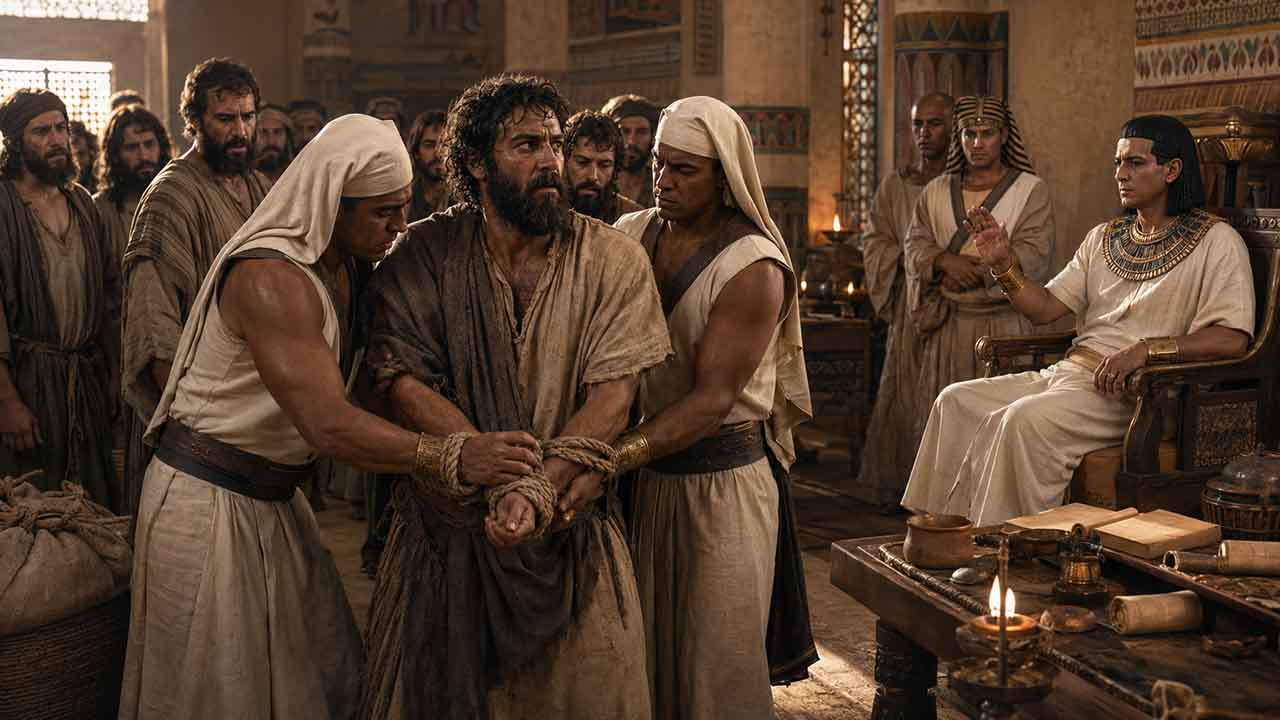
Bound Before the Brothers
Simeon stands restrained under Egyptian authority while his brothers watch in fear and shame, sensing that their hidden guilt has begun to find them. Across the room, Joseph remains composed, concealing both his identity and the sorrow that still binds him to them.
Listen to this Bible Exhibit
Heard by God, Scattered by Anger
Simeon was born in Leah’s sorrow, when the Lord heard that she was unloved and gave her another son. From the start, Simeon’s life was wrapped in both mercy and pain. He was not born into a peaceful home, but into a family marked by favoritism, rivalry, jealousy, and covenant promise.
Scripture gives only a few scenes from Simeon’s personal life, but they are morally weighty. He is named among Jacob’s sons, stands with Levi in the violent revenge at Shechem, is held by Joseph as a hostage in Egypt, and receives a severe word from Jacob at the end of Jacob’s life.
Simeon is not presented as a hero. He is a warning inside the covenant family. His story teaches that the Lord hears the afflicted and condemns the cruel anger that twists justice into revenge. It shows that zeal for family honor becomes sin when it resorts to deceit, misuses holy things, and repays evil with uncontrolled vengeance. Yet Simeon is not erased. He remains a son of Jacob, father of a tribe, and part of Israel’s larger story. His name begins with God hearing Leah’s sorrow; his legacy ends by calling God’s people to hear the Lord.
One Simeon Among Several
The Bible names more than one man called Simeon. The Simeon of this exhibit is not the righteous man in Jerusalem who held the infant Jesus [Luke 2:25-35]. He is not the Simeon in Jesus’ genealogy [Luke 3:30], nor is he Simeon called Niger in Antioch [Acts 13:1]. This Simeon is the son of Jacob and Leah, the brother of Reuben, Levi, Judah, Issachar, Zebulun, and Dinah [Genesis 35:23].
That careful distinction matters. Scripture gives Simeon, son of Jacob, only a brief personal portrait, but the few details it gives are enough. We should not fill the silence with invention. We should read what God has preserved: his birth, his violence, his testing in Egypt, his descendants, and his father’s final word.
Born When the Lord Heard Leah
Simeon’s birth begins with Leah’s sorrow. Jacob loved Rachel more than Leah, and Leah lived under the pain of being unwanted [Genesis 29:30-33]. Yet the Lord saw Leah and opened her womb. After Reuben was born, Leah hoped Jacob would love her. Then she bore Simeon and said, “Because the LORD has heard that I am hated, he has given me this son also.”
Simeon’s name is, therefore, a testimony before it is a warning. God heard Leah. The Lord was not deaf to the ache of an unloved wife. Simeon’s life began as a sign that God listens to the afflicted, even in a household twisted by human weakness.
This does not excuse Simeon’s later sin, but it gives the right beginning to his story. He was not born outside the mercy of God. He was not a lesser child because Jacob did not love his mother. He was a true son of Jacob and a living answer to Leah’s grief. Before Scripture shows us Simeon’s anger, it shows us the Lord’s compassion.
A Son Inside a Wounded Family
Simeon grew up in a divided home. Jacob’s household carried rivalry between Leah and Rachel, tension among the sons, and the sorrow that came from uneven love [Genesis 30:1-24]. Simeon was Leah’s second son, Levi’s older brother, and Dinah’s full brother.
This family setting is important. Genesis does not present the covenant family as clean, calm, or ideal. The house through which God would build Israel was full of strife. Yet God’s promise moved forward. Simeon’s life reminds us that covenant history is not the story of admirable people earning God’s favor. It is the story of God’s faithfulness moving through deeply flawed people.
But a wounded home does not excuse a violent heart. The grief of Jacob’s house shaped Simeon, but he remained responsible for his own choices. Scripture never treats family pain as permission for sin.
The Violence at Shechem
The central event in Simeon’s life is the violence at Shechem. Shechem, the son of Hamor, violated Dinah, Simeon’s sister [Genesis 34:1-31]. The sin against her was serious, and Jacob’s sons were right to be grieved and angry that such a disgrace had been done in Israel.
But Simeon and Levi did not pursue righteous justice. They answered evil with deceit and slaughter. Jacob’s sons told Hamor and Shechem that the men of the city must be circumcised before intermarriage could take place. The men agreed. Then, while they were weak from circumcision, Simeon and Levi attacked the city, killed the males, struck down Hamor and Shechem, and took Dinah from Shechem’s house. The other sons plundered the city.
The horror of this scene is not only the bloodshed. Simeon and Levi used circumcision as part of their trap. A holy sign of covenant belonging became a tool of vengeance. Sacred things were bent toward violent ends. This was not zeal purified by God. It was anger armed with deceit.
Jacob immediately rebuked them because they had brought danger and disgrace upon the household among the peoples of the land. Simeon and Levi replied, “Should he treat our sister like a prostitute?” Their question was emotionally powerful, but it did not make their method righteous. Scripture allows us to feel the wrong done to Dinah while still condemning the cruelty of revenge.
Anger That Would Not Listen
Simeon’s name means hearing, but his great sin was anger that would not listen. He did not listen to restraint. He did not listen to the holiness of the covenant sign. He did not listen to the difference between justice and vengeance.
This is why Simeon’s story remains so searching. Anger often feels justified when it rises in defense of someone who has been harmed. There is a kind of anger that responds to evil because evil truly matters. But anger becomes wicked when it breaks loose from truth, mercy, reverence, and the fear of the Lord.
Simeon’s anger had a cause, but not a righteous course. He defended family honor by dishonoring the covenant sign. He answered defilement with deception. He acted as though a real wrong permitted him to do any wrong he wished.
Scripture will not bless that. The God who hears the afflicted is also the God who judges cruelty.
Simeon Held in Egypt
Simeon appears again in the story of Joseph. Years after Joseph had been sold, the brothers came to Egypt for grain, not knowing that Joseph stood before them as ruler [Genesis 42:6-36]. Joseph tested them, and their old guilt began to rise. They remembered Joseph pleading with them, and they confessed that distress had come upon them because of what they had done to their brother.
Joseph then took Simeon and bound him before their eyes, sending the others back to Canaan until they would return with Benjamin. Scripture does not plainly say why Simeon was chosen. We should not claim certainty where God has not given it. But the scene is full of providence. Simeon, once violent and forceful, is now bound and helpless. The family that once hid Joseph’s cries must now feel the grief of another brother left behind.
Jacob’s response shows that Simeon still mattered to him. “Joseph is no more, and Simeon is no more,” he says, fearing that Benjamin will also be taken. Simeon was not loved with Joseph’s special favor, yet Scripture still counts him as Jacob’s son, named, remembered, and included in the covenant family.
When the brothers later returned with Benjamin, Joseph released Simeon and brought the brothers into his house [Genesis 43:23]. Simeon’s release became part of the larger mercy by which God exposed guilt, preserved the family, and prepared the way for reconciliation [Genesis 45:4-8].
Father of a Troubled Line
Simeon went down to Egypt with Jacob’s household. Genesis names his sons: Jemuel, Jamin, Ohad, Jakin, Zerah, and Shaul, the son of a Canaanite woman [Genesis 46:10]. Exodus also preserves the line of Simeon’s sons [Exodus 6:15]. Numbers later names the clans that came from Simeon, though Ohad is not listed among the clan heads there [Numbers 26:12-14].
These genealogies are not filler. They show that Simeon’s life continued into Israel’s future. He became the father of a tribe. His sins did not erase his line, but his character did cast a long shadow over his descendants.
The tribe of Simeon began large in the wilderness, numbering 59,300 fighting men in the first census [Numbers 1:22-23]. By the second census, the number had fallen sharply to 22,200. Scripture also records that Zimri, a Simeonite leader, sinned openly at Baal-peor and was killed in the judgment that followed [Numbers 25:6-15]. The tribe’s later story is sparse and sobering.
Simeon and Levi are brothers; their swords are weapons of violence. Let my soul not enter their council; may my glory not be united with their assembly, for in their anger they killed men, and in their self-will they hamstrung oxen. Cursed be their anger, for it is fierce, and their fury, for it is cruel. I will disperse them in Jacob and scatter them in Israel.
Genesis 49:5–7
Jacob’s Final Word
Jacob’s final word over Simeon is the key to his biblical meaning. Simeon is joined with Levi: “Simeon and Levi are brothers; weapons of violence are their swords” [Genesis 49:5-7]. Jacob refuses to enter their council or join their assembly. He remembers their anger, their violence, and their cruelty.
Then comes the judgment: “I will divide them in Jacob and scatter them in Israel.” Jacob does not curse Simeon himself in isolation; he curses the fierce anger and cruel wrath that ruled Simeon and Levi. This is important. Scripture’s target is not justice, courage, or family loyalty. It is rage without holiness.
The later histories of Levi and Simeon unfold differently. Levi’s scattering becomes a holy scattering through service at the sanctuary [Numbers 18:20-24] [Joshua 21:1-42]. Simeon’s scattering is quieter and more diminished. Moses’ blessing in Deuteronomy 33 does not name Simeon. The tribe receives its inheritance within the territory of Judah because Judah’s portion was too large [Joshua 19:1-9]. Simeon fights alongside Judah in the opening of Judges, but the tribe never rises to national prominence [Judges 1:3, 17].
Jacob’s word stands: violent anger does not build a lasting house.
Scattered, Yet Not Forgotten
Simeon’s tribal legacy shows both judgment and mercy. The tribe’s inheritance lay inside Judah’s land, with cities such as Beersheba, Moladah, Hormah, and Ziklag [Joshua 19:1-9]. Later, Chronicles preserves Simeonite genealogies and movements, showing that the tribe retained some memory and identity even when its role was small [1 Chronicles 4:24-43].
This is a solemn mercy. Simeon was scattered, but not erased. The Lord disciplined the legacy of violence, yet He did not remove Simeon’s name from Israel. Ezekiel gives Simeon a portion in the restored land, and Revelation names Simeon among the sealed tribes [Ezekiel 48:24-33] [Revelation 7:7].
The God who judges anger also remembers covenant mercy. Simeon’s name survives not because Simeon was faithful, but because the Lord is faithful.
Why Simeon Matters
Simeon matters because he forces us to distinguish grief from godliness. Leah’s pain was real, and God heard her. Dinah’s violation was real, and it deserved justice. But Simeon’s answer was not holy because it was intense. Strong emotion does not sanctify sinful action.
Simeon also matters because he warns against using sacred things for selfish ends. Circumcision was a sign of covenantal belonging, but Simeon and Levi turned it into a trap. Whenever holy words, holy symbols, or holy offices are used to serve revenge, pride, or control, Simeon’s sin is near.
Most of all, Simeon matters because he leaves us longing for a better Son. Simeon heard of evil and answered with cruelty. Jesus sees evil more clearly than any man, yet He judges in perfect righteousness and gives Himself for sinners [1 Peter 2:22-24]. Simeon misused the sign of the covenant; Christ fulfills the covenant in His blood [Luke 22:20]. Simeon’s anger scattered his house; Christ gathers the scattered children of God into one [John 11:51-52].
Simeon teaches that the Lord hears the unloved, judges the violent, exposes hidden guilt, and remembers His covenant. The son named “heard” must teach us to listen.