


Thomas
The Disciple Who Moved from Doubt to Worship
Carousel of images for this Bible Exhibit
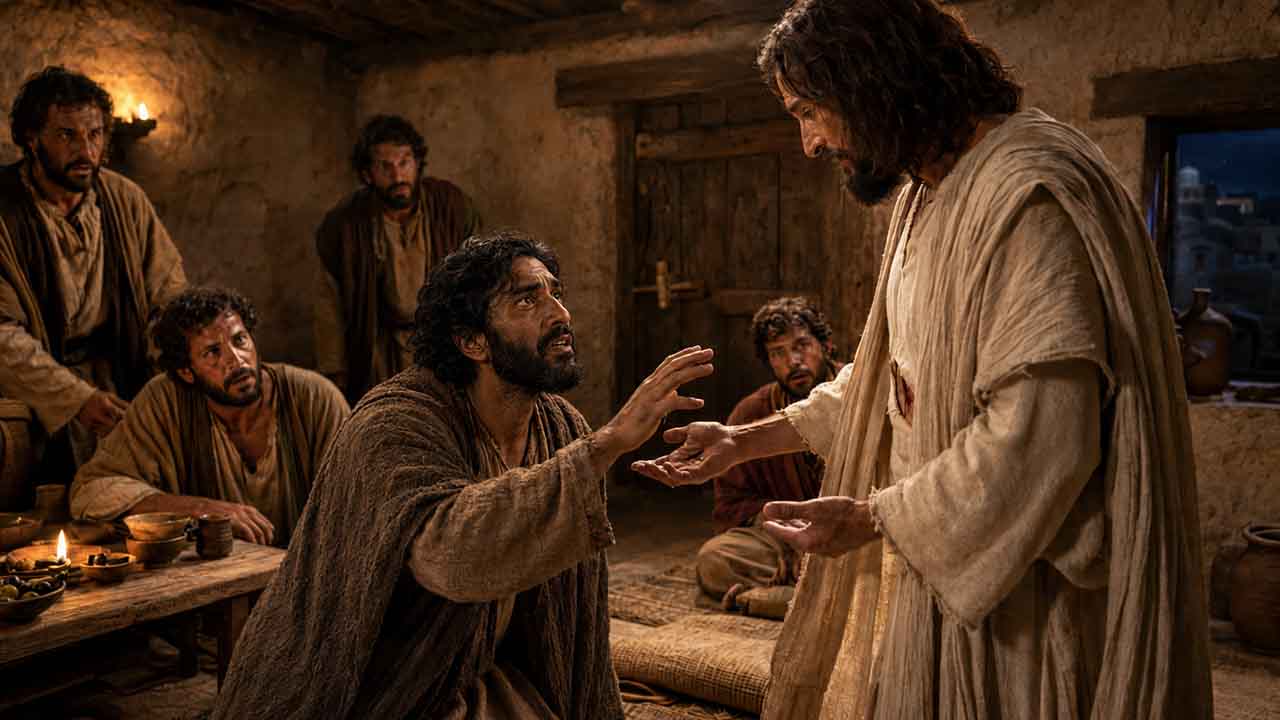
Thomas
Thomas reaches toward the risen Jesus with trembling awe, and the locked room becomes the place where honest doubt is met by wounded mercy. In that holy moment, his guarded heart breaks into worship: “My Lord and my God!”
Listen to this Bible Exhibit
The Twin Among the Twelve
Thomas stands before the risen Christ with wounded questions and open eyes. The hands he demanded to see are the hands that were pierced for sinners. The side he wanted to touch is the side opened at the cross. In Thomas, doubt is not celebrated, but it is met by the mercy of Jesus and led into one of the clearest confessions in Scripture.
Thomas was one of the Twelve apostles chosen by Jesus. His name means “twin,” and John also calls him Didymus, the Greek word for “twin” [John 11:1-16]. Scripture does not tell us who his twin was. Later writings sought to fill that silence, but the Bible does not invite us to build Thomas’s story on guesswork.
In Matthew, Mark, and Luke, Thomas appears only in the lists of the apostles [Matthew 10:1-4]. John gives him a fuller portrait. There, we meet a disciple who is loyal, honest, slow to understand, and finally brought to worship.
Thomas should not be reduced to the nickname “Doubting Thomas.” His doubt is real, but it is not the whole man. Scripture also shows his courage, his candor, and his final confession of Jesus as Lord and God.
Loyal on the Road to Danger
Thomas first speaks when Jesus decides to return to Judea after Lazarus has died. The disciples know the danger. The religious leaders had recently tried to stone Jesus, and returning near Jerusalem seemed like walking toward death.
Thomas does not understand everything Jesus is about to do. He does not yet know that Lazarus’s tomb will become a stage for the glory of God. Yet he says to the other disciples, “Let us also go, that we may die with him.”
Those words are shadowed by gloom, but they are also marked by loyalty. Thomas expects death, but he is willing to stay with Jesus. His courage is not bright or cheerful. It is heavy, sober, and costly. Still, it is real.
This matters for understanding Thomas. The same man who later struggles to believe in the resurrection is first shown as one willing to die with his Master. His faith is troubled, but his love is not absent.
The Question That Opened the Way
Thomas speaks again in the upper room. Jesus tells His disciples that He is going to prepare a place for them and that they know the way. Thomas answers with plain honesty: “Lord, we don’t know where you are going, so how can we know the way?”
His question draws out one of Jesus’ greatest revelations: “I am the way and the truth and the life. No one comes to the Father except through me” [John 14:1-7].
Thomas thought he needed a route. Jesus gave him Himself. The way to the Father is not a hidden path for the clever, a secret map for the strong, or a religious system for the worthy. The way is Christ. He is the truth who reveals God, and He is the life who brings sinners home.
Thomas’s confusion becomes a gift to the Church. Because he dared to ask what he did not understand, Jesus gave words that still steady the faith of His people.
Absent from the First Appearance
Thomas was not with the disciples when Jesus first appeared to them after the resurrection. The others had seen the Lord. They had heard His words of peace. They had seen His hands and side. But Thomas had missed the moment.
When they told him, he refused to believe unless he saw the marks of the nails and placed his hand into Jesus’ side [John 20:19-29]. His demand was serious. He did not want a vague hope, a rumor, or a comforting idea. He wanted to know whether the crucified Jesus was truly alive.
Thomas was wrong to reject the testimony of the other disciples. Jesus had promised His resurrection, and the witnesses were trustworthy. Yet his doubt was not casual unbelief. It was the struggle of a man who knew the horror of the cross and could not yet grasp the glory of resurrection.
Jesus did not leave him there.
“My Lord and My God”
Seven days later, Jesus came again. The doors were locked, but the risen Christ stood among His disciples and spoke peace. Then he turned to Thomas.
Jesus offered the very evidence Thomas had demanded. “Put your finger here,” He said. “Reach out your hand and put it into my side.” Then came the command: “Stop doubting and believe.”
Thomas answered, “My Lord and my God!”
This confession is one of the great high points of John’s Gospel. Thomas does not merely say that Jesus is alive. He not only admits that the miracle is true. He confesses the crucified and risen Jesus as his Lord and his God.
John’s Gospel begins by declaring that the Word was God. Near its end, Thomas stands before the risen Word and speaks that truth personally [John 1:1-18]. The doctrine becomes worship. The truth becomes surrender. The doubter becomes a confessor.
Jesus then blesses those who have not seen and yet have believed. That blessing reaches beyond Thomas to every generation of believers who receive the apostolic witness and trust the risen Christ without seeing Him with their eyes.
A Witness to the Risen Christ
Thomas appears again by the Sea of Tiberias, where Jesus revealed Himself to several disciples after the resurrection [John 21:1-14]. He was there when empty nets were filled, when the risen Lord stood on the shore, and when the disciples ate with Him.
After the ascension, Thomas was gathered with the apostles in Jerusalem, praying and waiting for the promised Spirit [Acts 1:12-14]. The man who once demanded sight now stood with the witnesses who would carry the gospel into the world.
Early church tradition connects Thomas with missionary work in Parthia and India. Some traditions remember him as a martyr. These reports differ, and they are not the foundation of his biblical portrait, but they show that the Church long remembered Thomas as a witness whose confession did not remain private.
Why Thomas Matters
Thomas matters because he shows that Jesus is patient with troubled disciples, but He does not leave them in unbelief. The Lord meets Thomas in mercy, gives him what he needs, and calls him to faith.
His life also teaches us that honest questions can become doorways to deeper truth when they are brought to Christ. Thomas asked how the disciples could know the way, and Jesus revealed Himself as the way. Thomas demanded the wounds, and Jesus showed him the risen body that still bore the marks of redeeming love.
Most of all, Thomas helps us see the goal of John’s Gospel. Jesus is not merely a teacher, healer, or prophet. He is the crucified and risen Lord. He is God the Son, worthy of worship and trust.
Thomas should not be remembered only as the doubter. He was loyal, honest, correct, and finally worshipful. His story calls every reader to move from uncertainty to faith, from questions to confession, and from hearing the witness of others to saying with Thomas: “My Lord and my God.”
What is a Disciple?
A disciple is a follower and learner of Jesus. During his earthly ministry, Jesus called many to follow him, but he chose twelve to be his closest companions and witnesses.
These men walked with Jesus, heard his teaching, saw his miracles, and were formed by his presence. He sent them to proclaim the Kingdom of God, heal the sick, and bear witness to his authority.
The disciples were not flawless heroes. They misunderstood, doubted, argued, and failed. Yet Jesus patiently shaped them by grace. After his resurrection, and through the gift of the Holy Spirit, these once-fearful followers became bold witnesses to the risen Christ.
Their lives show the heart of discipleship: to be called by Christ, formed by Christ, and sent by Christ. A disciple does not merely admire Jesus from a distance, but follows him in faith, obedience, and love.
