


James, Son of Alphaeus
The Quiet Apostle Known by Christ
Carousel of images for this Bible Exhibit
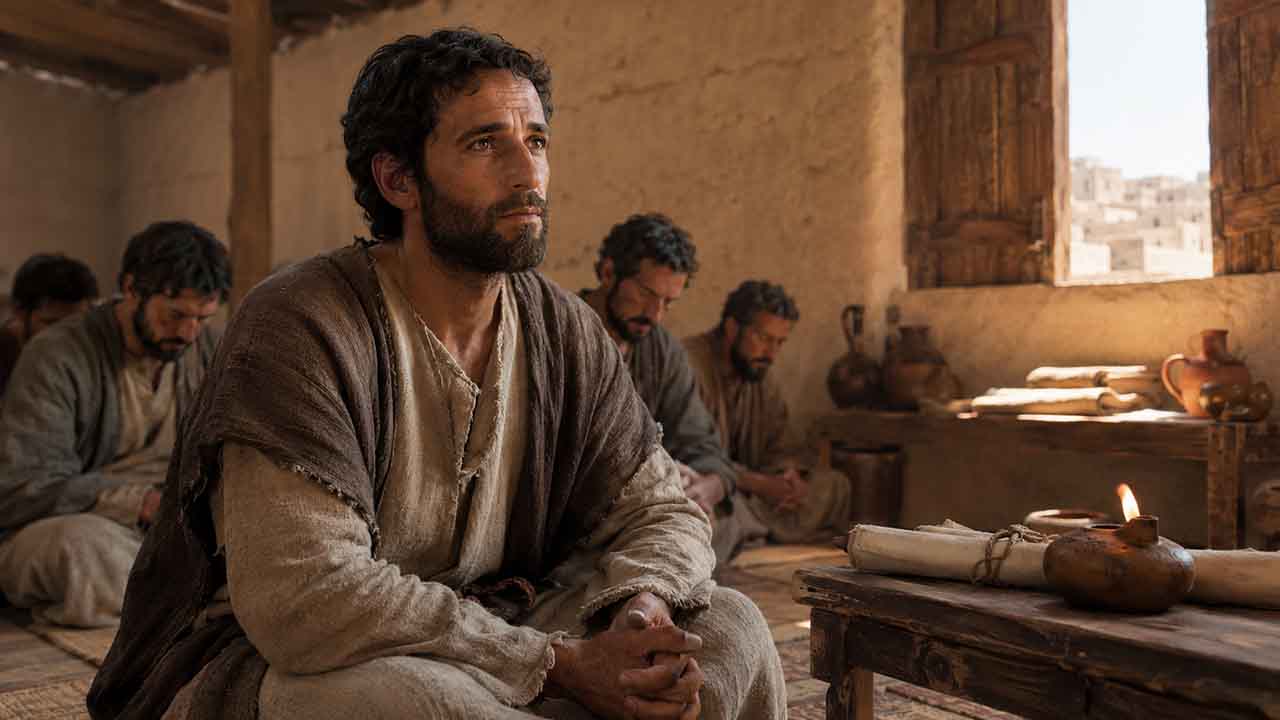
James, Son of Alphaeus
In the quiet upper room of Jerusalem, James, the son of Alphaeus, waits in prayer among the apostles—unknown to fame, yet known to Christ, steady in the hidden faithfulness that helped form the first witness-bearing church. His bowed hands and lifted eyes remind us that the kingdom is carried not only by thunderous voices, but by humble disciples who remain, pray, and obey.
Listen to this Bible Exhibit
One James Among Several
James, son of Alphaeus, stands among the Twelve with quiet dignity. Scripture preserves his name, but it does not record his words. No miracle is attached to him. No private conversation with Jesus is given. Yet his place in the Gospel story is not small, because Jesus Himself chose him.
The New Testament names several men called James, so we must read carefully. This James is not James, son of Zebedee, the brother of John. He is not James, the brother of the Lord, who later became a leader in the Jerusalem church. He is James, son of Alphaeus, one of the apostles Jesus called and sent [Matthew 10:1-4].
That careful identification matters. Scripture does not invite us to conflate the different men named James into a single person. James of Alphaeus must be understood from the few places where Scripture actually names him, and from the larger meaning of his call.
Chosen to Be With Jesus
Mark tells us that Jesus appointed the Twelve first “to be with him” and then to be sent out to preach [Mark 3:13-19]. That order is important. Before James carried Christ’s message, he was brought into Christ’s presence. Before he served publicly, he belonged to the Lord.
This is the heart of discipleship. Jesus does not merely recruit workers. He forms witnesses. James heard Jesus teach, watched His kingdom break into the world, saw His compassion for sinners, and learned the way of the cross with the other apostles. Scripture may not record James speaking, but it places him where every true disciple must be, with Jesus.
Faithful in the Background
James is usually found near the end of the apostolic lists, at the head of the final group of four [Luke 6:12-16]. This suggests he was not one of the most visible disciples. Peter, James, and John often stand near the center of the story. James, son of Alphaeus, stands nearer the edge.
But the edge of public attention is not the edge of Christ’s kingdom. Jesus chose him, kept him among the Twelve, and gave him a place in the apostolic witness. His life reminds us that the kingdom is not built only by the well-known. Christ also works through servants whose names are remembered, though their deeds remain hidden.
What We Can Say, and What We Cannot
Several connections have been suggested, but none should be treated as certain. Levi, also called Matthew, is described as a son of Alphaeus, so some have wondered whether Matthew and James were brothers [Mark 2:13-14]. Yet the Gospels clearly identify other apostolic brothers, such as Peter and Andrew and the sons of Zebedee, while never linking Matthew and James in that way.
James, son of Alphaeus, is also often associated with “James the younger,” whose mother, Mary, stood near the cross [Mark 15:40-41]. If that connection is correct, his mother was among the faithful women who saw Jesus’ death and later came to the tomb [Mark 16:1-8]. Some have also connected this Mary with Mary of Clopas, but Scripture never plainly says Alphaeus and Clopas are the same man [John 19:25].
These possibilities are worth noting, but they must not become the foundation of his story. Faithful Bible reading knows the difference between what Scripture says, what may be possible, and what cannot be proved.
Present in Prayer
After Jesus rose and ascended, James was still with the apostles in Jerusalem. Acts names him among those gathered in prayer, waiting for the promised work of God [Acts 1:12-14]. His final biblical appearance is not a scene of personal glory, but of faithful dependence.
That is fitting. James belonged to the church’s praying foundation. He waited with the others for the Spirit who would empower their witness. The quiet apostle was not absent when the risen Christ prepared His people for mission.
Later traditions speak of James preaching Christ and dying for his faith, but these reports differ and cannot be confirmed. Scripture gives us enough. Jesus chose him, formed him in His presence, sent him under His authority, and found him among the praying apostles.
Why James, Son of Alphaeus, Matters
James teaches us that discipleship is not measured by visibility. Some servants of Christ are known by many. Few know others. But the question that matters most is not whether the world remembers the disciple. It is whether the disciple belongs to Jesus.
Christ promised His apostles honor in His kingdom [Matthew 19:28]. Revelation later pictures the names of the twelve apostles written on the foundations of the New Jerusalem [Revelation 21:14]. James may have been little noticed on earth, but heaven does not forget him.
His life speaks with quiet force. The Lord sees hidden faithfulness. The kingdom needs obedient servants as much as public leaders. James, son of Alphaeus, shows us that a true disciple does not need a famous story to have a faithful one. Christ knew him, kept him among Christ’s witnesses, and gave him a place in the story of God’s redeeming work.
What is a Disciple?
A disciple is a follower and learner of Jesus. During his earthly ministry, Jesus called many to follow him, but he chose twelve to be his closest companions and witnesses.
These men walked with Jesus, heard his teaching, saw his miracles, and were formed by his presence. He sent them to proclaim the Kingdom of God, heal the sick, and bear witness to his authority.
The disciples were not flawless heroes. They misunderstood, doubted, argued, and failed. Yet Jesus patiently shaped them by grace. After his resurrection, and through the gift of the Holy Spirit, these once-fearful followers became bold witnesses to the risen Christ.
Their lives show the heart of discipleship: to be called by Christ, formed by Christ, and sent by Christ. A disciple does not merely admire Jesus from a distance, but follows him in faith, obedience, and love.