


Jesus enters Jerusalem
Sunday, March 29, AD 33
Carousel of images for this Bible Exhibit
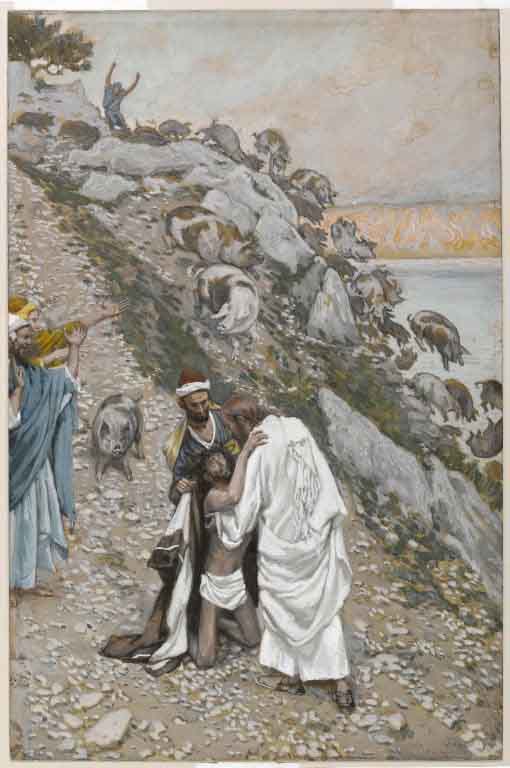
Swine Driven into the Sea
This vivid scene portrays the moment when Jesus cast a legion of demons out of a man and into a herd of swine, which then rushed down a steep bank into the sea. It reveals Christ’s absolute authority over the spiritual realm and His power to restore what evil had shattered, showing that even the darkest bondage cannot stand against the mercy of the Son of God.
Jesus Enters Jerusalem: The King Who Comes to Save
Before the road filled with “Hosanna,” a house in Bethany had filled with the fragrance of costly devotion, and Jesus had named that act as preparation for his burial. Now the story moves from hidden devotion to public acclaim as Jesus draws near to Jerusalem as King.
The Road Rising Toward the Holy City
Jesus made his way to Jerusalem from the east, near Bethphage and Bethany, by the Mount of Olives. Bethany was close to Jerusalem, and the Mount of Olives overlooked the city and the temple area. Passover pilgrims traveled this road with hope and memory in their hearts. They remembered the Lord’s deliverance from Egypt. They longed for God to act again. The city was crowded, watchful, and tense.
At this point, Jesus sent two disciples to bring a donkey and a colt. He told them exactly what they would find and what they should say if anyone asked why they were untying the animal: “The Lord needs them” [Matthew 21:1-11]. This reveals both his authority and his humility. Jesus is Lord enough to command the moment, yet humble enough to borrow a beast of burden. He receives what he needs without threats. He rules without grasping. The King owns all things, but he enters the city on what is loaned to him.
Mark and Luke tell us that the colt had never been ridden [Mark 11:1-10] [Luke 19:29-44]. This gives the act a sacred weight. The animal is set apart for this one purpose. Matthew mentions both the donkey and the colt, while the other Gospels focus on the colt itself. The mother likely accompanied the young animal, calming it amid the crowd’s noise. But Matthew also shows the event as a living fulfillment of Scripture. Jesus is not merely using transport. He is enacting prophecy before Israel’s eyes.
The King on a Donkey
The donkey is the key to the scene. Zechariah had promised that Zion’s king would come righteous and victorious, lowly and riding on a donkey. This king would speak peace to the nations, and his rule would stretch far beyond Jerusalem [Zechariah 9:9-10]. Jesus takes that promise into his own hands. He enters Jerusalem as King, but he also defines what kind of King he is.
He does not come on a war horse. He does not lead soldiers. He does not stir up armed revolt. He comes gently, lowly, and peacefully. Yet this humility is not weakness. It is royal strength under the will of God. Jesus is no less kingly because he rides a donkey. He is showing that his kingdom is not built on the pride and violence of earthly power.
Other royal memories gather around the moment. Jacob had spoken long before of the ruler from Judah, with the image of a colt tied to the vine [Genesis 49:10-11]. Solomon rode David’s mule when he was publicly declared king [1 Kings 1:32-40]. The crowd’s cloaks on the road recall the honor shown to Jehu when he was proclaimed king [2 Kings 9:13]. These echoes are not random. They tell the reader that Jesus is the promised Son of David. But they also show a holy reversal. The royal figure of Genesis is surrounded by abundance. Jesus borrows a colt and rides toward rejection. The true King does not use his power to serve himself. He gives himself to save others.
Hosanna, Save Now
As Jesus rode down the Mount of Olives, the crowd spread cloaks and branches along the road. John tells us they took palm branches, symbols that carried the feel of victory, national hope, and royal welcome. The people cried out with words from Psalm 118: “Hosanna,” meaning “save now,” and “Blessed is he who comes in the name of the Lord” [Psalm 118:25-26].
The crowd was right to praise him. Jesus did not reject the words. Matthew records the cry, “Hosanna to the Son of David.” Mark includes, “Blessed is the coming kingdom of our father David.” Luke says the disciples praised God for the mighty works they had seen and cried, “Blessed is the king who comes in the name of the Lord.” John records the title, “King of Israel” [John 12:12-19].
Yet true words can be spoken with shallow understanding. The crowd wanted salvation, and that desire was right. But many did not understand the salvation Jesus came to bring. They expected victory in the form of national deliverance. Jesus came to make peace with God. They wanted the kingdom to arrive with visible force. Jesus brought the kingdom through humility, suffering, and the cross.
John makes this especially clear. Many came because they had heard about Lazarus. The sign had stirred the city. But signs can awaken excitement without creating true faith. John also says that the disciples did not understand these things at first. Only after Jesus was glorified did they remember that Scripture had spoken about him. That is one of the deepest truths in this event. Jesus’ entry into Jerusalem can only be understood rightly in the light of his death, resurrection, and exaltation.
The King Who Wept While Others Sang
Luke gives us the most painful turn in the story. As Jesus came near and saw the city, he wept over it [Luke 19:29-44]. The crowd was praising. The disciples were rejoicing. The Pharisees were alarmed. But Jesus wept.
He saw what the city could not see. Jerusalem had the temple, the Scriptures, the feasts, and the promises. Yet many did not recognize the time of God’s coming to them. They did not know what would bring peace. Jesus warned that enemies would surround the city and tear it down. The city that should have received her King would reject him, and the rejection of peace would become judgment.
The tears of Jesus reveal the heart of God. He does not delight in judgment or gloat over blind sinners. He grieves. The King who has authority to judge also has compassion deep enough to weep. His sorrow is not weakness. It is holy love. He sees the ruin that sin brings, and he mourns over those who refuse the peace he came to give.
Even the Pharisees’ protest adds to the meaning. They tell Jesus to rebuke his disciples. Jesus answers that if they keep quiet, the stones will cry out. Creation itself must bear witness when the King comes. But soon Jesus speaks of stones again, the stones of Jerusalem that will not remain one on another. The city’s stones would either cry out in praise or stand as witnesses to judgment.
The Kingdom Hidden in Plain Sight
Here we see how the kingdom of God comes. The King has arrived, so the kingdom has arrived. Yet it comes in a form the world easily misreads. It is not weak, but hidden in meekness. It is not uncertain, but it is not yet complete. It is present in Jesus, but its victory passes through suffering before glory.
This is why the entry into Jerusalem is both triumph and tragedy. It is a triumph because Jesus is truly the King. Scripture is fulfilled. The Son of David comes to his city. The crowd’s praise is fitting. The Pharisees cannot stop it. The stones themselves would bear witness if human voices fell silent.
But it is a tragedy because the King is not truly understood. Matthew says the whole city was stirred and asked, “Who is this?” That question hangs over the event. The crowd answers that he is Jesus, the prophet from Nazareth in Galilee. That answer is true, but too small. He is a prophet, but more than a prophet. He is from Nazareth, but more than a Galilean teacher. He is the Christ, the Son of David, the King of Israel, the Lord who comes in the name of the Lord.
Mark’s Gospel keeps this tension sharp. The praise is loud, but the understanding is thin. The messianic signs are present, but Jesus’ glory remains veiled. In Mark, Jesus is not fully understood in the parade. He will be recognized most clearly at the cross. The King’s majesty is hidden under humility until suffering reveals what worldly triumph never could.
The Cross Behind the Palms
Jesus’ entry into Jerusalem is not a detour from the cross. It is the doorway to it. By entering this way, Jesus publicly presents himself as King. By riding a donkey, he declares that his reign is peaceful. By receiving “Hosanna,” he accepts the cry for salvation. By weeping, he reveals the grief of God over unbelief. By entering Jerusalem, he steps fully into the hour for which he came.
The crowd cries, “Save now.” Jesus will answer that prayer, but not in the way many expected. He will save by giving himself. He will not defeat sin by avoiding death. He will defeat sin by bearing it. He will not bring the kingdom by killing his enemies. He will make peace through his own blood. His throne will first look like a cross.
This is the biblical theology of the event. The promises to Judah, David, Zion, and the nations meet in Jesus. The hope of Israel is fulfilled, but fulfilled through suffering. The kingdom has come, but it comes in the King who gives his life. The new exodus begins, but its deliverance is deeper than escape from Rome. The true Passover is drawing near, and the Lamb is walking willingly toward sacrifice.
The Question Jerusalem Still Asks
This event still asks every reader the question Jerusalem asked: “Who is this?” It is possible to admire Jesus and still misunderstand him. It is possible to sing true words and still resist his rule. It is possible to want his help without yielding to his kingship.
Jesus must be received as he is, not as we imagine him to be. He is not merely a teacher, a prophet, an example, or a miracle worker. He is the King who comes in the name of the Lord. He brings peace with God. He calls for repentance, faith, worship, and obedience. He is gentle, but never optional. He is humble, but not weak. He weeps, but he also reigns. He comes to save, and the path of his saving work leads from the palms toward the cross.
The crowd laid cloaks before him, but Jesus sought more than a moment of public honor. He came to claim the whole heart. As the story moves forward, the praise of the road will be weighed before the King.