


The Tribe of Asher
Blessed with Plenty, Tested by Comfort
Carousel of images for this Bible Exhibit
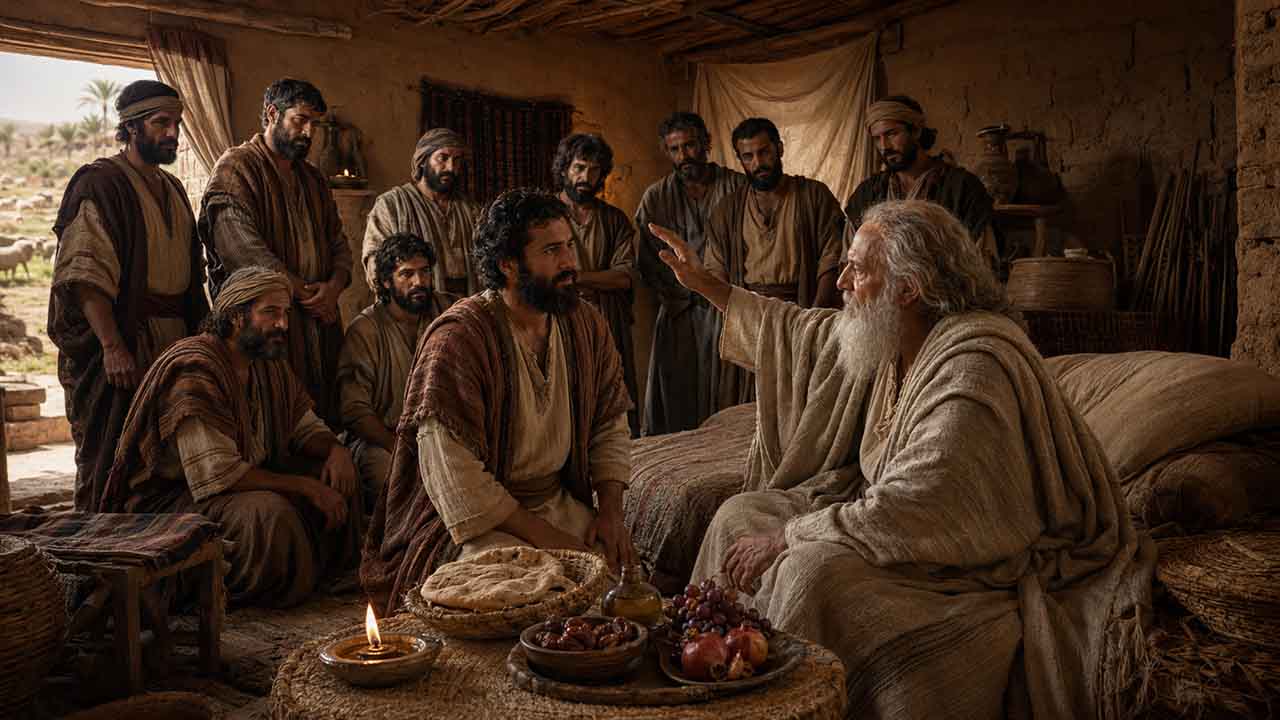
Asher’s Portion: Bread Fit for Kings
In the quiet weight of Jacob’s final blessings, Asher kneels before his father as bread, oil, and fruit echo the promise that his food would be rich and his descendants would yield royal delicacies. Around him, the sons of Israel listen in reverent silence as a dying patriarch’s words become a tribe’s destiny.
Listen to this Bible Exhibit
A Tribe of Abundance and Warning
The Tribe of Asher came from Asher, Jacob’s eighth son, born to Zilpah, Leah’s servant [Genesis 30:12-13]. His name is tied to happiness and blessing, and the tribe that bore his name would receive one of the richest portions of land in Israel. Jacob’s final blessing over Asher looked ahead to abundance: “Asher’s food will be rich; he will provide delicacies fit for a king” [Genesis 49:20].
Yet the story of Asher is not only a story of rich land. It is also a warning about what can happen when God’s gifts are enjoyed without full obedience. Asher received fertile territory, coastal access, and the promise of oil and strength. But the tribe failed to drive out key Canaanite cities, stayed by the shore when others fought, and often remained quiet in Israel’s national life. Still, Scripture does not let Asher disappear. The tribe appears in the wilderness, in the land, in the kingdom, in remnant worship, in prophetic hope, and finally in the New Testament through Anna, a faithful daughter of Asher who saw the infant Jesus.
Asher teaches us that blessing is never a substitute for faithfulness. Rich soil, secure harbors, strong gates, and full barns cannot keep God’s people safe if their hearts drift from the Lord. But Asher also teaches hope. The Lord remembers quiet tribes, preserves humble worshipers, and brings his promises to fulfillment in Christ.
From Jacob’s Son to a Covenant Tribe
Asher was first a person before he was a tribe. He entered Egypt with Jacob’s family as the father of sons and a daughter: Imnah, Ishvah, Ishvi, Beriah, and Serah [Genesis 46:17]. From that family line came the clans of Asher. By the second wilderness census, Scripture names the Imnite, Ishvite, Beriite, Heberite, and Malkielite clans, and it again remembers Serah by name [Numbers 26:44-47].
This matters because Israel’s tribes were not invented political units. They were rooted in God’s covenant dealings with Abraham, Isaac, and Jacob. The Lord had promised to make Abraham into a great nation, and the tribes of Israel show that promise taking shape through real families and real generations. Asher’s later story must therefore be read as covenant history. Its land, numbers, failures, and hopes were not random events. They belonged to the people whom God had brought near to Himself.
The tribe of Asher may not be as prominent as Judah, Levi, Ephraim, or Benjamin. No judge, prophet, king, or major Old Testament leader is clearly identified as coming from Asher. But Asher still belonged fully to Israel. The tribe stood under the same law, shared the same wilderness journey, received an inheritance in the same land, and was called to the same holiness.
Counted Around the Presence of God
At Mount Sinai, Asher was counted among Israel’s fighting men. The tribe numbered 41,500 men able to serve in the army [Numbers 1:40-41]. This shows how far God had brought the line of one son. Asher had gone down to Egypt as one of Jacob’s family branches, but his descendants emerged as a strong tribe.
Asher was also ordered around the tabernacle. It camped on the north side with Dan and Naphtali, under the standard of Dan’s division [Numbers 2:25-31]. When Israel moved through the wilderness, Asher marched with that same division as part of the rear guard [Numbers 10:25-28]. This detail is easy to miss, but it is important. Israel’s life was arranged around the presence of God. Even the position of a tribe in the camp showed that the Lord, not geography or strength, stood at the center of the nation.
Asher also shared in Israel’s worship. Pagiel, son of Okran, the leader from Asher, brought the tribe’s offering at the dedication of the altar [Numbers 7:72-77]. The tribe was not merely counted for war. It was represented before the Lord in worship.
Yet Asher also shared in Israel’s testing in the wilderness. Sethur from Asher was one of the men sent to explore Canaan [Numbers 13:13]. When Israel refused to trust the Lord and would not enter the land, that generation came under judgment and wandered until it died in the wilderness [Numbers 14:26-35]. Asher’s numbers were real, but numbers alone did not equal faithfulness.
Before Israel entered the land, Asher also stood on Mount Ebal among the tribes appointed for the covenant curses [Deuteronomy 27:13]. This placed Asher under the seriousness of covenant obedience. The tribe would receive a blessing, but a blessing would never remove the call to hear and obey the Lord.
Blessed with a Rich Inheritance
Moses’ blessing over Asher pictured favor, oil, strong gates, and strength for each day [Deuteronomy 33:24-25]. The image of feet bathed in oil fits the olive-rich character of Asher’s land. This was a region suited to olives, agriculture, and abundance.
When Joshua divided the land, Asher received territory in the northwest of Canaan [Joshua 19:24-31]. Its inheritance reached along the Mediterranean coast and into the western slopes of Galilee. It lay near Mount Carmel, toward Sidon, with Zebulun and Naphtali to the east and the sea to the west. This placed Asher beside fertile fields, coastal trade, and the powerful Phoenician cities.
The land itself was a gift from God. Asher did not create its richness. The tribe received it by allotment, according to the Lord’s promise. Ahihud, son of Shelomi, was appointed to help assign the inheritance to Asher [Numbers 34:27]. Even the practical work of land distribution was part of God’s covenant order.
Asher’s inheritance also included Levitical cities. The Gershonite Levites received towns from Asher, including Mishal, Abdon, Helkath, and Rehob [Joshua 21:27-31]. That means Asher’s land was not meant to be only a place of crops, oil, and trade. It was to be a place shaped by worship, instruction, and covenant faithfulness.
This is one of the great tensions in Asher’s story. The tribe received a rich place from the Lord, but such places can become dangerous when comfort outweighs obedience.
The Danger of Incomplete Obedience
The great failure of Asher appears in the book of Judges. The tribe did not drive out the inhabitants of Acco, Sidon, Ahlab, Achzib, Helbah, Aphik, or Rehob. Instead, the Asherites lived among the Canaanites [Judges 1:31-32].
This was not a minor detail in the unfinished warfare. It was a spiritual danger. Israel had been commanded not to settle into the worship and practices of the nations. The problem was not that Asher had neighbors. The problem was that Asher failed to possess what God had given and settled into life among peoples whose gods and customs would pull Israel away from the Lord.
Asher’s geography made the temptation stronger. The tribe lived near coastal cities and under Phoenician influence. Trade, harbors, and fertile soil could bring wealth, but they could also make compromise feel useful. A tribe that should have trusted the Lord could begin to trust peaceful coexistence, economic advantage, and secure coastlands.
The Bible often shows that prosperity is a test. Need can expose unbelief, but abundance can do the same. Asher’s land was a blessing, but the tribe’s incomplete obedience turned blessing into danger.
At the Shoreline of Israel’s Battles
Asher’s weakness becomes even clearer in the Song of Deborah. When Israel fought against Canaanite oppression, Deborah praised tribes that risked their lives, especially Zebulun and Naphtali. But Asher stayed by the coast and remained in its coves [Judges 5:17-18].
This is one of the sharpest pictures of Asher in Scripture. The tribe blessed with coastal land stayed near the coast. The tribe that harbored stayed in its harbors. When the call came for costly action, Asher remained in the place of safety.
Yet the Bible does not make Asher’s story one long failure. In Gideon’s day, Asher answered the call against Midian [Judges 6:35]. After the Lord gave victory, Asher also joined the pursuit of the enemy [Judges 7:23]. This matters. Asher was not always absent. The tribe had moments of courage and shared in Israel’s deliverance.
Still, Asher’s record remains mixed. It was blessed, but often passive. It was counted, but not often leading. It could answer when summoned, but it did not stand out as a tribe that shaped Israel’s faith. No judge is recorded from Asher. No great Old Testament hero from Asher dominates the story. The tribe often lived on the edge of Israel’s national life, just as its land lay near the northern coast.
Not Forgotten in the Kingdom
The books of Chronicles preserve Asher’s genealogy and fighting strength. The record lists the descendants of Asher and notes that 26,000 able men were ready for battle [1 Chronicles 7:30-40]. Later, when David was made king at Hebron, Asher sent 40,000 experienced soldiers prepared for battle [1 Chronicles 12:36-38]. That is one of Asher’s brighter moments. The tribe stood with the Lord’s chosen king when the kingdom was being united.
At the same time, Asher remained a quiet tribe. Its presence in Scripture is real, but its public prominence is limited. Asher was counted, remembered, and useful, yet rarely placed at the center of Israel’s national story.
During Solomon’s reign, the land of Asher was included in one of the king’s administrative districts [1 Kings 4:16]. Solomon’s later dealings with Hiram of Tyre also show how closely the northern borderlands were tied to Phoenician power and commerce [1 Kings 9:10-14]. For Asher, this old tension remained: the tribe lived where Israel’s inheritance touched the wealth and influence of the nations.
After the kingdom was divided, Asher belonged to the northern kingdom of Israel. When the northern kingdom fell under judgment, the whole region was shaken by exile, scattering, and loss [2 Kings 17:6-23]. The tribe that had once failed to drive out the nations now lived within the sorrow of Israel’s own covenant unfaithfulness.
Of Asher he said, “Most blessed of sons is Asher; may he be favored by his brothers, and may he dip his foot in oil. The bars of your gates will be iron and bronze, and your strength will equal your days.”
Deuteronomy 33:24–25
A Remnant That Humbled Itself
Even after a deep decline, Scripture gives Asher a note of hope. In the days of Hezekiah, the king sent messengers through the northern territories, calling the people to come to Jerusalem for the Passover. Many mocked and scorned the invitation. But some from Asher humbled themselves and came [2 Chronicles 30:10-11].
That sentence is one of the most beautiful moments in Asher’s story. The tribe had known compromise. It had lived among the Canaanites. It had stayed by the coast when others fought. It had belonged to the northern world that fell under judgment. Yet not everyone in Asher mocked the call to worship. Some humbled themselves.
This is the mercy of God within the history of Israel. The Lord does not treat remnant faithfulness as a small thing. A few humble worshipers matter. In Asher, the Bible shows that a compromised history does not prevent repentance. The way back to the Lord is not pride, memory, land, or numbers. It is humility before him.
Anna, A Daughter of Asher
Asher’s most beautiful New Testament appearance comes through Anna, the daughter of Phanuel, from the tribe of Asher. She was an aged prophetess who worshiped in the temple with fasting and prayer. When Mary and Joseph brought the infant Jesus, Anna saw Him, gave thanks to God, and spoke of Him to all who were waiting for the redemption of Jerusalem [Luke 2:36-38].
This is a fitting grace in Asher’s story. A quiet tribe, often on the edge of Israel’s public life, is represented at the coming of Christ by a faithful woman who waited, worshiped, and bore witness. Asher’s richest inheritance was not oil, bread, or coastal plenty. It was that a daughter of the tribe would rejoice in the Redeemer.
Asher in Prophetic Hope
The Lord did not erase Asher from Israel’s future hope. In Ezekiel’s vision of restored tribal portions, Asher is named again among the tribes in the land [Ezekiel 48:2-3]. Later in the same vision, one of the gates of the future city bears the name of Asher [Ezekiel 48:34]. In Revelation, Asher also appears among the tribes sealed by God [Revelation 7:6].
This is important for biblical theology. Asher’s failures in Judges did not remove the tribe from God’s memory. Its low profile in the kingdom did not erase its name. Its association with the northern collapse did not end its place in prophetic hope. God remembers the tribes He named.
The point is not that Asher was faithful enough to secure its own future. The point is that the Lord remains faithful to His covenant purposes. Judgment is real, but judgment is not the final word for those whom God restores.
Why the Tribe of Asher Matters
The Tribe of Asher matters because it shows both the goodness and the danger of blessing. Asher received rich land, fertile soil, coastal opportunity, oil, strength, and a place among the tribes of Israel. These were gifts from God. But gifts must lead to obedience, not comfort. Asher’s failure to drive out the Canaanites shows how easily blessing can become compromise when God’s people make peace with what the Lord has commanded them to resist.
Asher also matters because it shows that weakness is not the whole story. The tribe stayed by the shore in Deborah’s day, but it answered Gideon’s call. It was often quiet, but it sent soldiers to David. It belonged to the compromised north, but some from Asher humbled themselves for Hezekiah’s Passover. It carried a troubled history, but from Asher came Anna, who welcomed the Messiah in the temple.
The story of Asher helps us read Scripture with wisdom. The Bible does not flatter God’s people. It tells the truth about their failures. But it also tells the truth about God’s mercy. The Lord blesses, warns, disciplines, preserves, and restores. He remembers quiet tribes and hidden worshipers. He carries his covenant purpose through uneven histories until the hope of Israel is fulfilled in Jesus Christ.
The Tribe of Asher is therefore a warning and a comfort. It warns us that abundance without obedience is spiritually dangerous. It comforts us that the Lord can preserve faithful witnesses even in places marked by compromise. Asher’s name means happiness, but the tribe’s deepest joy is not found in rich land, oil, or harbors. It is found in the God who remembers his people and brings redemption through Christ.