


The Tribe of Zebulun

The Tribe of Zebulun
The Tribe of Courage and Light
Carousel of images for this Bible Exhibit
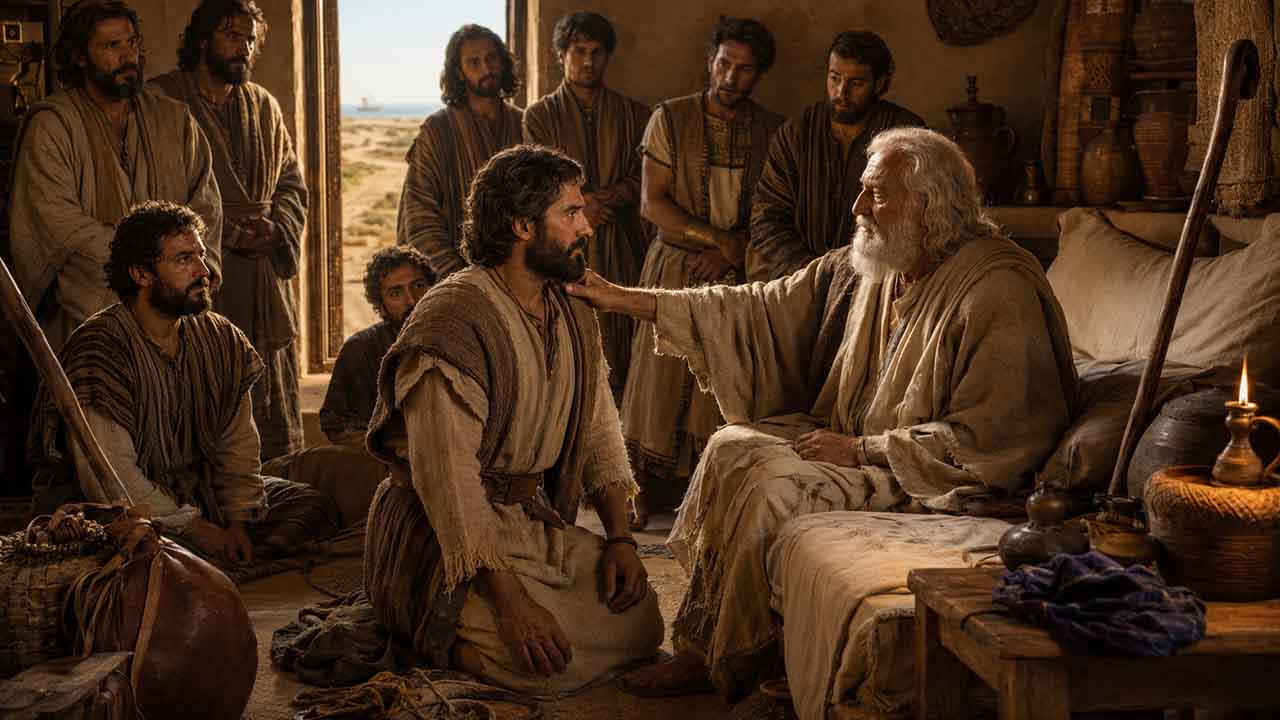
Toward the Distant Shore
Zebulun kneels beneath Jacob’s hand as the doorway opens toward trade roads, far waters, and the horizon of his descendants. In this quiet blessing, a son of Israel receives a future that reaches beyond the family room toward ships, shorelands, and the wider world.
Listen to this Bible Exhibit
Zebulun in the Hills of Galilee
Zebulun stands among the hills and valleys of lower Galilee, near the roads of trade, the fields of harvest, and the shadow of Mount Tabor. Blessed with a calling that looked outward, tested by incomplete obedience, brave in Israel’s battles, and later honored by the dawn of Christ’s ministry, Zebulun teaches that God can bring great light to a land that has known both courage and darkness.
A Son Named Honor
The tribe takes its name from Zebulun, Jacob’s tenth son and the sixth son born to Leah. When he was born, Leah spoke of God’s gift and hoped that Jacob would honor her or dwell with her because she had borne him six sons [Genesis 30:19-20]. Zebulun’s name is therefore tied to gift, honor, and dwelling.
Scripture tells us little about Zebulun as a man. He went down to Egypt with Jacob’s household, and his three sons, Sered, Elon, and Jahleel, are named in his line [Genesis 46:14]. Like many of Jacob’s sons, he quickly becomes the story of the people who bear his name.
That shift matters. Zebulun was not merely a name in a genealogy. The son became a tribe, the tribe received an inheritance, and the inheritance became part of the great story of judgment, mercy, and redemption.
By the Sea, Going Out
Jacob’s blessing over Zebulun is brief but memorable. Zebulun is pictured as dwelling by the sea, with his border stretching toward Sidon [Genesis 49:13]. Moses later blessed Zebulun together with Issachar, calling Zebulun to rejoice in going out and Issachar in his tents [Deuteronomy 33:18-19].
These blessings should be handled with care. The sea language matters, but it should not be forced beyond what Scripture’s later boundary description gives. Zebulun’s location in lower Galilee placed the tribe near important routes of travel, trade, and outward movement. The blessing invites us to see Zebulun as a tribe connected to movement, provision, and the wider world.
Zebulun and Issachar are often remembered together. Issachar is associated with tents and settled wisdom. Zebulun is associated with going out. The two images belong together. God’s people need both rootedness and movement, both faithful homes and faithful public action.
Counted at the Front of the Camp
In the wilderness, Zebulun was a substantial tribe. At the first census, it numbered 57,400 fighting men [Numbers 1:30-31]. At the second census, Zebulun had grown to 60,500 [Numbers 26:26-27].
Zebulun camped on the east side of the tabernacle under the standard of Judah, together with Issachar [Numbers 2:3-9]. When Israel marched, this camp went first [Numbers 10:14-16]. Zebulun’s earliest tribal identity was therefore formed near the Lord’s presence and in the forward movement of Israel’s journey.
The tribe also stood in Israel’s public worship and covenant life. Eliab, son of Helon, brought Zebulun’s offering at the dedication of the altar [Numbers 7:24-29]. Gaddiel, son of Sodi, represented Zebulun among the spies [Numbers 13:10]. Elizaphan, son of Parnach, later helped oversee the division of the land [Numbers 34:25]. At Mount Ebal, Zebulun stood among the tribes appointed to pronounce the covenant curses [Deuteronomy 27:13].
Before Zebulun had fields, towns, or roads, it had a place around the tabernacle. The tribe’s calling began with worship and covenant order.
A Fertile Inheritance in Galilee
Zebulun received its inheritance in northern Canaan, in the region later known as Lower Galilee [Joshua 19:10-16]. Its borders are difficult to trace in every detail, but the general picture is clear. Zebulun lay near Issachar, Asher, Naphtali, and Manasseh, in a fruitful region of hills, valleys, and important approaches.
The tribe also gave cities to the Levites, including Jokneam, Kartah, Dimnah, and Nahalal [Joshua 21:34-35]. Gath-hepher, a town in Zebulun’s region, later became known as the hometown of Jonah, son of Amittai [2 Kings 14:25].
Zebulun’s inheritance was good land, but good land is never spiritually neutral. Fertile fields, trade routes, and strategic location can become gifts used for God’s glory or comforts that dull obedience. Zebulun’s land was a blessing, but it was also a test.
Partial Obedience
Judges records Zebulun’s early failure plainly. The tribe did not drive out the inhabitants of Kitron and Nahalol. Instead, the Canaanites remained and were subjected to forced labor [Judges 1:30].
That may have looked practical. It may even have looked successful. But it was not full obedience. Israel had been called to receive the land in faith and purge the idolatrous practices that would corrupt covenant life. Leaving Canaanite strongholds in place meant leaving spiritual danger close to home.
This is one of Zebulun’s warnings. God’s people can be brave in one season and compromised in another. They can possess much and still obey only halfway. The Lord’s gifts must be received with whole-hearted faithfulness, not managed according to convenience.
Courage With Deborah and Barak
Zebulun’s story is not defined by compromise alone. In the days of Deborah and Barak, the tribe answered the call to battle. Deborah told Barak to gather men from Naphtali and Zebulun against Sisera, and Zebulun came [Judges 4:6-10].
Deborah’s song remembers the tribe with honor. From Zebulun came those who bore the commander’s staff. The people of Zebulun also risked their lives on the heights of the field [Judges 5:14-18].
This is one of the tribe’s brightest moments. In an age when many tribes hesitated, Zebulun acted. The same tribe that had failed to drive out some Canaanites later stood courageously when the Lord brought deliverance.
Scripture is honest like this. Zebulun is neither flattered nor dismissed. Its failures are named, and its courage is honored. God’s word teaches us to see both the seriousness of sin and the beauty of faithful action.
Gideon, Elon, and David’s King
Zebulun also answered Gideon’s call against Midian [Judges 6:35]. The tribe was not passive in Israel’s struggle for deliverance. It continued to appear when courage and public action were needed.
Later, Elon the Zebulunite judged Israel for ten years [Judges 12:11-12]. Scripture gives few details about his rule, but even the brief notice matters. Zebulun gave Israel not only warriors, but a judge who helped govern the covenant people.
In David’s day, Zebulun again appears with honor. The tribe sent 50,000 seasoned warriors to Hebron, men equipped for battle and described as not double-hearted [1 Chronicles 12:33]. Zebulun also helped provide abundant food for the great celebration as Israel gathered around David [1 Chronicles 12:40]. In David’s administration, Ishmaiah, son of Obadiah, served as officer over Zebulun [1 Chronicles 27:19].
This pattern is striking. Zebulun showed up. In battle, in leadership, in provision, and in support of the Lord’s chosen king, the tribe brought what was needed.
A Remnant That Returned to Worship
After the kingdom was divided, Zebulun belonged to the northern realm, where idolatry and spiritual decline wounded the people for generations. Yet the Lord did not leave Zebulun without a witness.
In Hezekiah’s day, messengers went through the northern regions calling the people to return to Jerusalem for the Passover. Many mocked, but some from Zebulun humbled themselves and came. Some were not ceremonially prepared as they should have been, but Hezekiah prayed for them, and the Lord heard and healed the people because they had set their hearts to seek Him [2 Chronicles 30:10-20].
This is a beautiful moment in Zebulun’s story. The tribe appears not in military courage, but in repentance. After decline and division, some still heard the call to worship. The Lord met humbled hearts with mercy.
The land of Zebulun and the land of Naphtali, the way by the sea, beyond the Jordan, Galilee of the Gentiles, the people who were sitting in darkness have seen a great light, and on those living in the land and shadow of death a light has dawned.
Matthew 4:15–16
From Humbled Land to Great Light
Isaiah spoke of the land of Zebulun and the land of Naphtali as a region once humbled, yet destined to see great light [Isaiah 9:1-2].
Matthew tells us that this hope was fulfilled when Jesus withdrew to Galilee and lived in Capernaum by the sea, in the territory of Zebulun and Naphtali [Matthew 4:12-16]. The region associated with northern weakness, foreign pressure, and darkness became one of the first great theaters of the Messiah’s public ministry.
This is Zebulun’s greatest honor. Not its warriors. Not its fields. Not its trade routes. Not even its courage in Deborah’s day. The highest glory of Zebulun’s land is that Christ brought the light of the kingdom there.
God did not choose only prestigious places for the beginning of Jesus’ public ministry. He brought light to Galilee. He honored a humbled region with the presence and preaching of the Son of God.
Remembered in Hope
Zebulun is not erased from Scripture’s future-facing visions. In Ezekiel’s vision of restored tribal portions, Zebulun receives a place in the renewed land [Ezekiel 48:26-33]. One of the gates of the restored city also bears Zebulun’s name.
Revelation also names Zebulun among the sealed tribes of Israel [Revelation 7:8]. Scripture does not invite speculation beyond what is written. The point is clear enough: the Lord remembers His people.
Zebulun’s story runs from Leah’s longing for honor to Galilee’s honor in Christ. It moves through gift, calling, partial obedience, courage, remnant mercy, and gospel light. The tribe that once went out in battle becomes part of the land where the Savior went out preaching the kingdom.
Why Zebulun Matters
Zebulun teaches that outward strength must be joined to inward obedience. The tribe had numbers, land, courage, and usefulness, yet it still failed to obey fully in the land. Partial obedience remained dangerous.
Zebulun also teaches that God remembers courage. The tribe risked its life with Deborah and Barak, answered Gideon, gave Israel Elon, supported David with undivided warriors, and brought provision for the kingdom’s joy.
Most of all, Zebulun points us to Christ. The land once humbled by darkness saw the light of the Messiah. The Lord can turn places marked by weakness into places of holy visitation.
Zebulun calls us to receive God’s gifts with humility, reject the ease of half-obedience, show up when faithfulness is costly, and rejoice that Christ’s light shines where human history has grown dark.