


The Tribe of Issachar
The Tribe That Understood the Times
Carousel of images for this Bible Exhibit
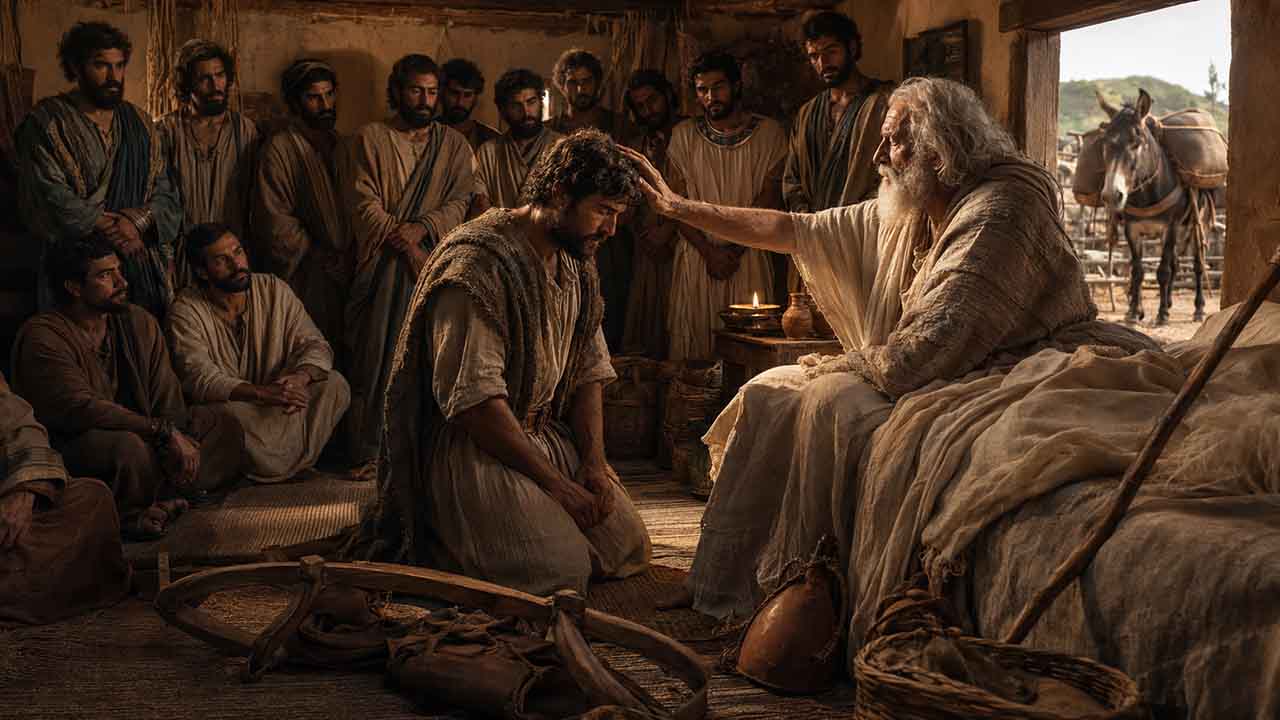
Strength Beneath the Burden
Issachar kneels beneath Jacob’s hand as a son marked for strength, labor, and quiet endurance. The resting donkey beyond the doorway echoes his blessing, a future of humble service, pleasant land, and shoulders bent to the burden.
Listen to this Bible Exhibit
Issachar Among the Fields of Jezreel
Issachar stands among the fertile fields and low hills of northern Israel, where the Valley of Jezreel opens beneath Mount Tabor and the work of ordinary life becomes a test of covenant faithfulness. Blessed with a pleasant land, called to bear burdens, courageous in battle, and remembered for discerning what Israel ought to do, Issachar teaches that wisdom is not merely knowing the times, but obeying the Lord within them.
A Son Named Reward
Issachar was Jacob’s ninth son and the fifth born to Leah. His birth followed the strange contest between Leah and Rachel over mandrakes, and Leah named him with language tied to hire, wages, or reward, saying that God had given her recompense [Genesis 30:14-18]. He later went down to Egypt with Jacob’s household, and his sons Tola, Puah, Jashub, and Shimron are named in his line [Genesis 46:13].
Scripture says little else about Issachar himself. Like many of Jacob’s sons, his personal story quickly becomes the story of the people who came from him. That is fitting. The tribe bearing his name would live out the meaning of reward, labor, and burden-bearing in the land God gave.
A Strong Donkey in a Pleasant Land
Jacob’s blessing over Issachar is one of the most memorable tribal sayings in Genesis. Issachar is pictured as a strong donkey crouching between the sheepfolds. He sees that rest is good and the land is pleasant, so he bends his shoulder to the burden and becomes a servant at forced labor [Genesis 49:14-15].
The image is not simple flattery. It speaks of strength, land, labor, and temptation. Issachar would be sturdy enough to bear weight, but a pleasant land could also lure a tribe into submission if comfort became dearer than obedience.
This ambiguity is part of the text’s wisdom. A good inheritance can make God’s people fruitful, or it can make them passive. Blessing must be received with gratitude, but also with vigilance.
Counted Near the Front of the Camp
In the wilderness, Issachar was numerous and ordered. At Sinai, the tribe numbered 54,400 fighting men [Numbers 1:28-29]. By the second census, Issachar had grown to 64,300 [Numbers 26:23-25]. Issachar camped on the east side of the tabernacle with Judah and Zebulun [Numbers 2:3-9]. When Israel marched, it moved with Judah’s standard near the front of Israel’s procession [Numbers 10:14-15].
The tribe’s leaders also appear in important moments. Nethanel, son of Zuar, brought Issachar’s offering at the dedication of the altar [Numbers 7:18-23]. Igal, son of Joseph, represented Issachar among the spies sent into Canaan [Numbers 13:7]. Paltiel, son of Azzan, later helped oversee the division of the land [Numbers 34:26]. At Mount Gerizim, Issachar stood among the tribes appointed to bless the people [Deuteronomy 27:12].
Before Issachar had fields, it had a place around the tabernacle. Its identity was formed by worship, covenant order, and the presence of the Lord.
Rejoicing With Zebulun
Moses blessed Issachar together with Zebulun: “Rejoice, Zebulun, in your going out, and Issachar, in your tents.” The blessing speaks of people called to the mountain, righteous sacrifices, and abundance from the seas and hidden treasures of the sand [Deuteronomy 33:18-19].
Issachar and Zebulun were brothers and neighbors, and Scripture often remembers them together. Moses’ words connect household life, public worship, partnership, and abundance. Issachar’s calling was not to hoard comfort, but to rejoice in the Lord’s gifts and draw others toward righteous worship. Tents and mountains, home and sanctuary, work and worship belonged together.
An Inheritance in the Valley of Jezreel
Issachar’s inheritance stretched across fertile northern country associated with Jezreel, Shunem, En-gannim, Mount Tabor, and the Jordan [Joshua 19:17-23]. It bordered Manasseh to the south and west, and Zebulun and Naphtali to the north. Issachar also gave cities to the Levites, including Kishion, Daberath, Jarmuth, and En-gannim [Joshua 21:28-29].
This land helps explain Jacob’s blessing. Issachar received a pleasant place, rich enough for crops and flocks. But valleys that feed families also attract armies, taxes, and chariots. Scripture notes Canaanite strongholds in the broader region, including Beth-shean, Taanach, and Megiddo, that were not fully possessed at first [Joshua 17:11-13].
Issachar’s good land was therefore both a gift and a test. Blessing did not remove the need for courage.
Courage in the Days of Deborah
Issachar was not only a tribe of tents and fields. In Deborah’s song, “the princes of Issachar came with Deborah,” and Issachar followed Barak into the valley [Judges 5:15]. That was no easy place to fight. The lowlands favored Canaanite power and iron chariots. Yet Issachar stood with the covenant people in a decisive hour.
Later, Tola, a man of Issachar, rose to save Israel after Abimelech’s bloodshed. He judged Israel for twenty-three years from Shamir in the hill country of Ephraim [Judges 10:1-2]. Scripture says little about him, but silence here sounds like stability. Issachar gave Israel not only brave warriors, but a quiet judge who helped steady the nation after chaos.
Men Who Understood the Times
Chronicles remembers Issachar as organized, numerous, and strong. Its genealogies name the clans of Issachar and speak of mighty warriors, numbering 87,000 by family record [1 Chronicles 7:1-5].
Yet the tribe’s most famous description is not about size. At Hebron, when Israel turned to David, the men of Issachar are described as men who had “understanding of the times, to know what Israel ought to do.” There were two hundred chiefs, and their kinsmen followed their command [1 Chronicles 12:32].
This was not vague cleverness. They understood the moment in covenant history. Saul’s house was fading. David was the Lord’s chosen king. Issachar knew what Israel should do and acted with discernment. Other tribes brought thousands of armed men. Issachar brought chiefs whose wisdom guided their households.
That is one of the tribe’s great legacies: not intelligence for self-protection, but discernment in the service of God’s purposes. Issachar also shared in the joy of David’s coronation. Along with Zebulun and Naphtali, the tribe helped provide abundant food for the feast at Hebron [1 Chronicles 12:40]. Wisdom in Scripture is not detached calculation. It knows when to stand, when to serve, and when to rejoice.
Of the sons of Issachar, men who understood the times, with knowledge of what Israel should do, 200 chiefs, and all their kinsmen under their command.
1 Chronicles 12:32
A Warning From the Northern Kingdom
Issachar’s story is not spotless. Baasha, from the house of Issachar, conspired against Nadab, seized the throne of Israel, and continued in the sins of Jeroboam [1 Kings 15:25-34]. His rise reminds us that tribal heritage cannot sanctify ambition. A man may belong to a tribe known for discernment and still use power destructively.
During Solomon’s reign, Issachar had its own administrative officer, Jehoshaphat, son of Paruah [1 Kings 4:17]. In David’s administration, Omri, son of Michael, served as an officer over the tribe [1 Chronicles 27:18]. These notices show that Issachar remained woven into Israel’s public life.
After the kingdom was divided, Issachar belonged to the northern realm and came under its long spiritual instability. Yet grace still appears. In Hezekiah’s day, some from Issachar came to Jerusalem for the Passover. They were not ceremonially prepared as they should have been, but they had set their hearts to seek God, and the Lord heard Hezekiah’s prayer for them [2 Chronicles 30:18-20]. Even after division and decline, a remnant from Issachar came home to worship.
Remembered in Hope
Issachar does not vanish from the Lord’s memory. Ezekiel’s vision of restored tribal portions gives Issachar a place in the renewed land, and one of the gates of the restored city bears Issachar’s name [Ezekiel 48:25-33]. In Revelation, Issachar appears among the sealed tribes of Israel [Revelation 7:7].
The tribe bore burdens in the pleasant land, stood with Deborah, discerned David’s hour, and suffered the history of the north, yet it is still named before God.
Why Issachar Matters
Issachar teaches that comfort is never neutral. Pleasant land is a gift from the Lord, but rich fields can become a school of gratitude or a cradle of compromise. The same tribe that could bow its shoulder to labor could also be tempted to bow under the wrong yoke.
Issachar also teaches that God’s people need discernment. The men of Issachar did not merely read events. They knew what Israel should do. Biblical wisdom sees the moment under God, recognizes His purposes, and leads others toward faithful action.
Most of all, Issachar shows that ordinary faithfulness matters. Much of the tribe’s story is not spectacular. It is census, camp, tents, fields, offerings, family lines, work, and worship. Yet in those ordinary places, God formed a tribe capable of courage, wisdom, generosity, and return.
The church still needs Issachar’s lesson: receive God’s gifts with gratitude, refuse the sleep of comfort, bear the burdens God assigns, and seek the wisdom to obey in the time He gives.