


An Overview of the Book of Romans


Surveying the land is the first step in any great discovery. Before any excavation begins, explorers must study the unknown terrain, map the surroundings, and gain a sense of the landscape. In your study of the Bible, surveying the land means stepping back to understand how a particular book fits into the larger story God is telling. Like using a compass and a map, this equips us with the tools we need to navigate Scripture faithfully.
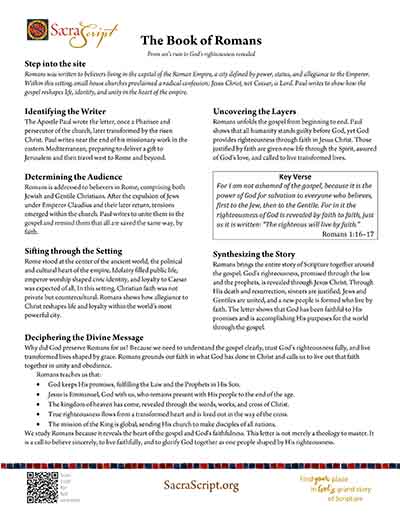
The Book of Romans
From sin’s ruin to God’s righteousness revealed
You have arrived in first-century Rome, the heart of a vast empire. Marble temples gleam above crowded marketplaces, senators argue in the Forum, and soldiers march through streets lined with idols. Power, wealth, and status define life here, yet beneath the grandeur lies a deep spiritual hunger. Across the city, small gatherings of believers meet quietly in homes, proclaiming that a crucified Jew named Jesus is Lord.
Into this world comes a letter from Paul of Tarsus, written from Corinth near the end of his journeys. Though he has never visited Rome, he writes to prepare the believers for his coming and to unite them in the gospel that he proclaims. His words are not a detached essay but a passionate declaration of the good news that transforms both people and nations.
As you unroll the scroll of Romans, you encounter the most complete explanation of the gospel ever written. It reveals the righteousness of God through faith in Christ, calling both Jew and Gentile to one redeemed family and one mission. In the city where Caesar claims to rule the world, Paul proclaims a greater power: the saving righteousness of God, revealed in the gospel.
Identifying the Writer
The author
The letter to the Romans bears the unmistakable mark of the Apostle Paul. Once a zealous Pharisee and fierce opponent of Jesus’ followers, Paul was transformed by a face-to-face encounter with the risen Christ on the road to Damascus. From that moment, he became Christ’s chosen instrument to carry the gospel to the Gentile world. By the time he wrote to the believers in Rome, Paul had completed years of missionary travel across Asia Minor and Greece, planting churches, enduring persecution, and proclaiming that salvation comes by faith alone.
He likely wrote the letter while staying in Corinth around AD 57. The names mentioned in his closing greetings, Gaius, Erastus, and Phoebe, confirm the Corinthian setting. Phoebe, a trusted servant of the church in nearby Cenchreae, likely carried the scroll to Rome, entrusted with delivering what would become one of the most influential theological documents ever written.
Paul’s heart for the Roman believers burned with both pastoral care and missionary vision. Though he had never visited them, he longed for mutual encouragement and partnership in taking the gospel westward to Spain. Through Romans, Paul offers the clearest and most comprehensive presentation of the gospel: the righteousness of God revealed through faith in Jesus Christ for all who believe.
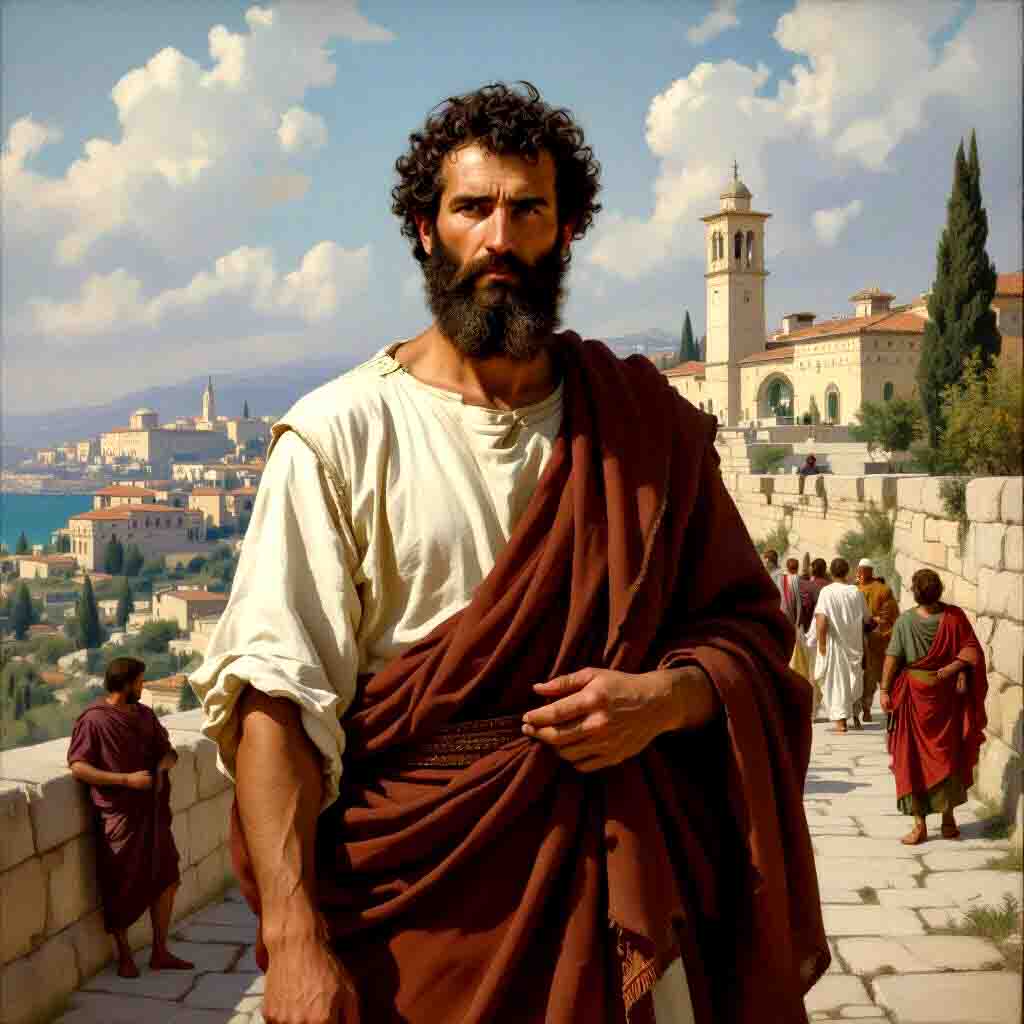
The Apostle Paul
Once a zealous Pharisee and persecutor of Christians, Paul was transformed by an encounter with the risen Christ. From Corinth, near the end of his missionary journeys, he writes to the believers in Rome, a church he did not plant but longed to visit, to unite them in the gospel and prepare them to join his mission to the nations.
Determining the Audience
The original recipients
The believers in Rome formed one of the most remarkable congregations of the first century. No apostle had founded their church. The gospel had likely arrived through Jewish pilgrims who witnessed the events of Pentecost in Jerusalem and carried the good news back to the imperial capital. From those early beginnings, small house gatherings spread throughout the city, comprising both Jews and Gentiles who had come to believe in Jesus as the Messiah.
By the time Paul wrote, the church in Rome had already existed for many years. Yet its unity had been tested by the policies of emperors. In AD 49, Emperor Claudius expelled all Jews from Rome after unrest broke out over disputes concerning “Chrestus,” a likely reference to Christ. When the edict was lifted several years later, Jewish believers returned to find predominantly Gentile congregations leading the assemblies. The resulting tensions over customs, dietary laws, and the role of the Mosaic law created deep divisions that Paul sought to heal.
Paul wrote to remind the Roman believers that all stand equally in need of grace and all are justified in the same way, through faith in Jesus Christ. He wanted them to see that the gospel not only reconciles sinners to God but also unites diverse peoples into one body. The church in Rome stood at the crossroads of the empire. If they could live out the gospel there, it could take root anywhere.
Sifting through the Setting
The historical background
First-century Rome stood as the center of the known world. More than a million people crowded its streets. Senators, soldiers, freedmen, and slaves all lived within sight of the imperial palace. Its marble temples honored countless gods, yet behind the splendor lay moral decay and spiritual emptiness. The empire promised peace through power, but only Christ could bring peace with God.
For believers, Rome was both a mission field and a testing ground. The temptation to conform to Roman customs was constant. Idols filled the marketplaces, emperor worship shaped civic life, and loyalty to Caesar was considered the highest virtue. Within this culture, the Christian confession that “Jesus is Lord” was not a private belief but a public declaration that could invite ridicule or even death.
Despite the danger, the gospel spread through the city in quiet strength. The believers met in homes scattered across the districts of Rome, often gathering around meals, prayers, and the reading of letters from the apostles. Names like Priscilla and Aquila, Andronicus and Junia, Urbanus and Tryphena show a diverse and vibrant network of men and women who labored for the sake of the gospel. These small assemblies shone as lights in the heart of the empire, embodying a kingdom that would one day outlast Rome itself.
Uncovering the Layers
The meaning
Romans is Paul’s most comprehensive presentation of the gospel. It unfolds with precision and passion, moving from the depths of human sin to the heights of God’s redeeming grace. Every layer reveals the righteousness of God at work, fulfilling His promises and forming a new humanity in Christ.
Paul begins by showing that all people, both Jew and Gentile, stand guilty before a holy God. The Gentiles have rejected the truth revealed in creation, and the Jews, though possessing the law, have failed to keep it. “There is no one righteous, not even one” [Romans 3:10]. Into this hopelessness, Paul declares the good news that God has provided a righteousness apart from the law, a righteousness given through faith in Jesus Christ to all who believe [Romans 3:21–22].
Through the obedience and death of Christ, the second Adam, God justifies sinners and reconciles them to Himself. Those who are united with Christ share in His death and resurrection and are set free from sin’s dominion. The Spirit now dwells within believers, enabling them to live new lives and assuring them that nothing can separate them from the love of God [Romans 8:38–39].
Yet Paul’s letter is not only about personal salvation. It reveals God’s faithfulness to His covenant promises. In chapters 9 through 11, Paul explains the mystery of Israel’s unbelief and the inclusion of the Gentiles. God’s plan has not failed. In His mercy, He is forming one people from every nation who together glorify Him.
The final chapters turn from doctrine to daily life. Those who have been justified by faith must live as living sacrifices, transformed in mind and heart. They are called to humility, to genuine love, to submission to authority, and to unity in the church. The strong must bear with the weak, and all must welcome one another as Christ has welcomed them, for the glory of God.
Through every layer, Romans reveals the saving righteousness of God, His just and merciful character displayed in the gospel of Jesus Christ.
How to Read
the Book of Romans
A quick guide to
its writing style and structure
What kind of book is this?
Paul writes this letter to believers in Rome to explain the gospel and strengthen their faith. It is both pastoral and deeply theological.
Why is it written this way?
Paul uses the form of a letter to teach clearly and personally. He aims to unite Jews and Gentiles and prepare the church for future mission.
How is it organized?
Romans moves from sin to salvation to service.
- 1–4 Guilt and God’s gift of righteousness
- 5–8 New Life in the Spirit
- 9–11 God’s faithfulness to Israel
- 12–16 Transformed living in unity
What should I look for?
Key themes include righteousness, faith, grace, the Spirit, and unity. Watch Paul quote the Old Testament to show that justification is by faith. Note the pivot from doctrine to practice at Romans 12:1.
How should I read it?
Read slowly and in sections. Trace the logic paragraph by paragraph. Mark Old Testament citations and “therefore” connections. Let teaching lead to worship and obedience. Pray the truths into life, then practice them in community.
Synthesizing the Story
Fitting into scripture
Romans gathers the entire story of Scripture into one sweeping vision of redemption. From the opening chapters that expose the sin of all humanity to the closing doxology that exalts God’s glory, Paul reveals how the gospel fulfills every promise of God and brings His plan of salvation to completion in Christ.
The letter begins in the ruins of human rebellion. All have sinned, and all stand under the just judgment of God. But into this darkness, the light of the gospel shines. God reveals His righteousness through Jesus Christ, who bore sin’s penalty and offers His righteousness to all who believe. The cross is the meeting place of divine justice and mercy, where God remains just and yet becomes the justifier of those who have faith in Jesus [Romans 3:26].
Through faith, believers are united with Christ in His death and resurrection. They are no longer enslaved to sin but live under grace. The Spirit of God dwells within them, assuring them of adoption as children of God and guaranteeing the glory that is to come [Romans 8:15–17].
Paul then broadens the lens to reveal the story of Israel and the nations. God’s covenant faithfulness has not failed. Israel’s unbelief has made possible the inclusion of the Gentiles, and the mercy shown to the Gentiles will one day lead to Israel’s restoration. In all of this, God is weaving a single plan of salvation that displays the depth of His wisdom and the riches of His grace.
The story concludes where it began, with worship. Those who have been justified by faith are called to present their bodies as living sacrifices. They live in humility, love, and unity, no longer conformed to the world but transformed by the renewing work of God’s Spirit. The gospel that saves also sanctifies, shaping a people whose lives proclaim the glory of the One who saved them.
Romans is the story of God’s righteousness revealed, sin condemned, grace extended, and creation renewed. It is the story of a God who keeps His promises and a gospel that changes everything.
Key Verse
For I am not ashamed of the gospel, because it is the power of God for salvation to everyone who believes, first to the Jew, then to the Gentile. For in it the righteousness of God is revealed by faith to faith, just as it is written: “The righteous will live by faith.”
Romans 1:16–17
Deciphering the Divine Message
What we learn
Romans reveals the heart of God and the power of His gospel more clearly than any other book of Scripture. Every chapter displays the faithfulness of a God who both judges sin and saves sinners, who remains just while justifying those who trust in His Son.
What Romans teaches about God
God is righteous in all His ways. His wrath against sin shows His holiness, and His mercy in Christ shows His love. He keeps His covenant promises and fulfills them in Jesus, the true Son of Abraham and the Lord of all nations. The righteousness that God requires, He Himself provides through faith in Christ.
What Romans teaches about the gospel
The gospel is not advice for living but news of what God has done. It announces that through the death and resurrection of Jesus, sinners can be forgiven, declared righteous, and brought into a new creation. This good news is the power of God for salvation to everyone who believes, first to the Jew and then to the Gentile [Romans 1:16].
What Romans teaches about the believer
Those who are justified by faith are set free from the tyranny of sin and empowered by the Spirit to walk in newness of life. They are no longer condemned but live as adopted sons and daughters who cry, “Abba, Father.” They live not for themselves but for the glory of God, offering their lives in grateful obedience.
What Romans teaches about the church
The gospel forms one people out of many. Jew and Gentile, slave and free, man and woman are united in Christ as one body. The church in every generation must live out this unity in humility, patience, and love so that the world may see the wisdom of God displayed in the redeemed community of His people.
What Romans teaches about hope
The letter ends with praise because the story of redemption is not finished. The same God who justifies will also glorify. The creation that now groans under sin will be set free, and every knee will bow before the King whose gospel has triumphed. Until that day, believers live by faith, standing in grace, rejoicing in the hope of the glory of God.
Romans proclaims that the righteousness of God has been revealed, that grace reigns through righteousness, and that the gospel of Jesus Christ changes everything forever.
Want your own copy of the overview of Romans?