


Zebulun, Son of Jacob
Leah’s Gift, Galilee’s Light
Carousel of images for this Bible Exhibit
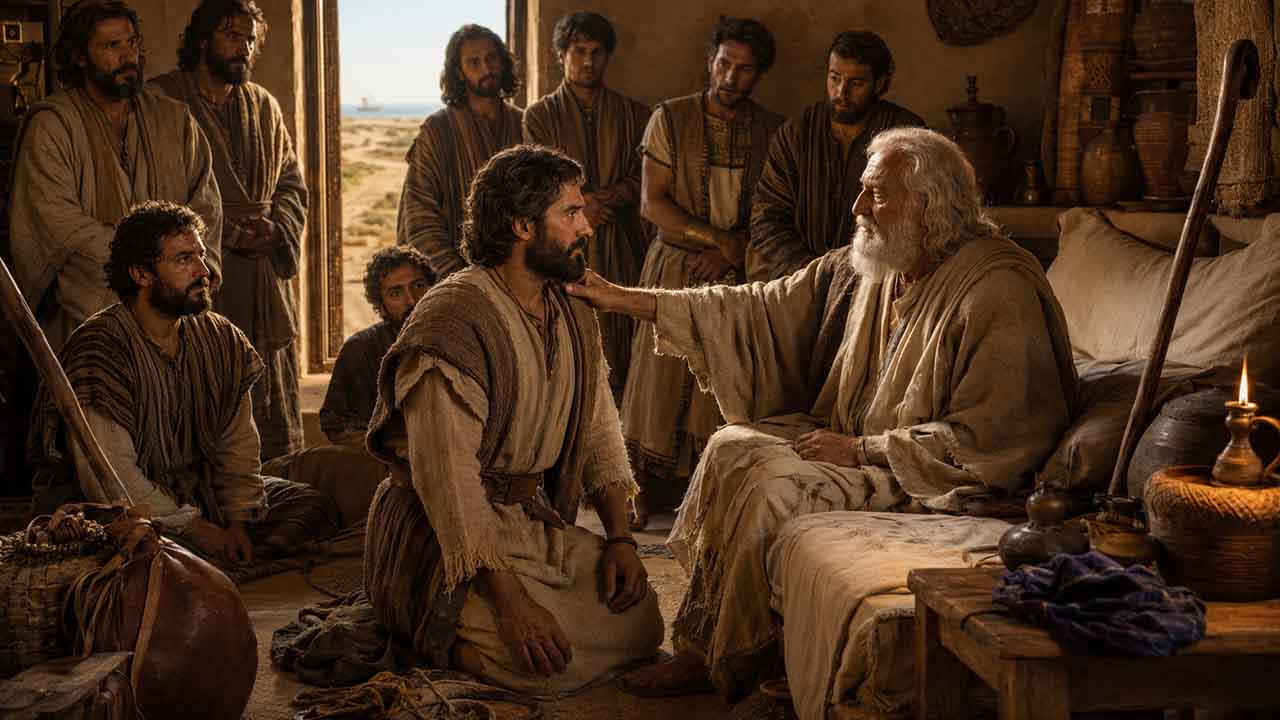
Toward the Distant Shore
Zebulun kneels beneath Jacob’s hand as the doorway opens toward trade roads, far waters, and the horizon of his descendants. In this quiet blessing, a son of Israel receives a future that reaches beyond the family room toward ships, shorelands, and the wider world.
Listen to this Bible Exhibit
Leah’s Gift, Galilee’s Light
Zebulun was Jacob’s tenth son and Leah’s sixth and final son [Genesis 30:19-20]. He was born in a household marked by rivalry, pain, and longing. Leah had borne sons while Rachel remained barren, yet Leah still lived with the ache of being less loved by Jacob. When Zebulun was born, Leah called him a good gift from God and hoped that Jacob would now honor her or dwell with her.
Scripture gives very few details about Zebulun’s personal life. He does not speak in Genesis. No separate act is recorded under his name. Yet the Bible remembers him as a true son of Jacob, a father of three sons, and the ancestor of one of Israel’s twelve tribes.
Jacob’s final blessing over Zebulun looked beyond the man to the tribe that would bear his name. Zebulun would dwell near the sea, become a haven for ships, and have a border toward Sidon. Later, the tribe of Zebulun would settle in the north, in the region that became closely tied to Galilee. There, Zebulun’s descendants knew fruitful land, incomplete obedience, brave service, Assyrian darkness, and finally the great light of Christ.
Zebulun’s life is quiet, but not small. He teaches us that God works through overlooked sons, wounded homes, and promises that unfold slowly across generations.
Born as Leah’s Good Gift
Zebulun’s birth must be read inside Leah’s sorrow. Jacob loved Rachel more than Leah, and Leah knew the pain of being unwanted [Genesis 29:30-30:20]. Yet the Lord saw Leah and gave her children. Her sons were not simply pieces in a family struggle. They were living signs that God saw, heard, and cared.
By the time Zebulun was born, Leah had already borne Reuben, Simeon, Levi, Judah, and Issachar. Her home was still tangled in competition with Rachel, but the Lord continued His covenant work even through the weakness of Jacob’s family.
When Leah bore Zebulun, she said, “God has endowed me with a good endowment; now my husband will honor me, because I have borne him six sons.” Her words play on the ideas of gift, honor, and dwelling. The exact meaning of Zebulun’s name is debated, but Genesis clearly connects it to Leah’s sense that God had given her a good gift and to her hope for a more honored place in Jacob’s house.
This is a tender beginning. Zebulun’s name is not born from triumphal pride, but from the heart of a woman longing to be loved. Leah’s desire for Jacob’s honor remained painful, but God’s gift was real. Zebulun began as a son given in mercy.
A Quiet Son, Fully Counted
Zebulun is one of the twelve sons of Jacob. Scripture records no personal speech from him, no moment of leadership, and no scene focused on his choices. That silence matters. A faithful reading should not invent what God has not revealed.
Yet silence is not absence. Zebulun is named among Jacob’s sons [Genesis 35:23]. He is listed with the family that went down to Egypt [Exodus 1:1-4]. He appears in the genealogical memory of Israel [1 Chronicles 2:1]. Scripture does not place him at the edge of the covenant family. He belongs to the twelve.
This matters because the Bible’s story is not built only through the most visible people. Some lives are long on the page. Others are remembered by name, lineage, and blessing. Zebulun’s importance does not come from a dramatic biography. It comes from God’s covenant ordering of history. He was a son through whom the Lord would help form Israel.
Zebulun reminds readers that hiddenness is not the same as insignificance. God knows the quiet names. He keeps the people whom history barely pauses to describe. A life may be brief in the record and still be held within a great promise.
Father of a Continuing Line
When Jacob’s family went down to Egypt, Zebulun had three sons: Sered, Elon, and Jahleel [Genesis 46:14]. Those names become the roots of Zebulun’s later clans. This simple genealogy is important. It shows that Zebulun’s household continued, and that his name would not vanish within the larger family.
The move to Egypt was a turning point for all Israel. The family of promise went there because of famine, but God used Egypt to preserve them through Joseph [Genesis 45:5-8]. Zebulun shared in that descent. He belonged to the family that would multiply, suffer, and later be redeemed by the Lord’s mighty hand.
Genesis does not tell us how Zebulun responded to Joseph’s suffering or to the later revelation that Joseph was alive. He was part of the family story, but he is not singled out. That restraint is useful. Zebulun’s page teaches us to honor what Scripture says and to stop where Scripture stops.
What we can say is enough: Zebulun was born from Leah, counted among Jacob’s sons, fathered a line, and went down to Egypt with the covenant family. God carried his name forward.
Jacob’s Final Blessing
The most distinctive word about Zebulun comes from Jacob’s final blessing. As Jacob spoke over his sons, he said, “Zebulun shall dwell at the shore of the sea; he shall become a haven for ships, and his border shall be at Sidon” [Genesis 49:13].
This blessing looks beyond Zebulun’s private life to the future of his descendants. The language is full of shorelands, ships, trade, and the northern world near Sidon. It gives Zebulun a horizon of movement and exchange. His name is not locked inside one tent. It stretches toward people, roads, waters, and commerce.
At the same time, this blessing must be read with care. Joshua’s later boundary description does not clearly place Zebulun directly on the Mediterranean coast. Moses’ blessing also joins Zebulun with Issachar and speaks of rejoicing, going out, worship on the mountain, and abundance from the seas [Deuteronomy 33:18-19]. Taken together, these texts suggest that Zebulun’s future would be tied to northern trade, travel, and access to the region’s riches, even if the exact geography is difficult to map.
The point is not merely cartographic. It is covenantal. Jacob’s word shows that Zebulun’s future was in God’s hand. A quiet son received a prophetic word whose meaning would unfold through generations.
The Tribe That Bore His Name
Zebulun’s descendants became a strong tribe in Israel. In the wilderness, the tribe numbered 57,400 fighting men in the first census and 60,500 in the second [Numbers 1:30-31] [Numbers 26:26-27]. Zebulun camped on the east side of the tabernacle with Judah and Issachar, under Judah’s standard, and marched near the front of Israel [Numbers 2:3-9] [Numbers 10:14-16].
Its leaders also appear in key moments. Eliab, son of Helon, represented Zebulun in the census and brought the tribe’s offering at the altar dedication [Numbers 1:9] [Numbers 7:24-29]. Gaddiel, son of Sodi, represented Zebulun among the spies sent into Canaan [Numbers 13:10]. Elizaphan, son of Parnach, helped with the division of the land [Numbers 34:25].
Zebulun also stood on Mount Ebal for the covenant ceremony of blessing and curse [Deuteronomy 27:13]. That scene reminds us that tribal identity was not merely ancestry. It involved covenant responsibility. To belong to Israel was to stand under the word of the Lord.
Fruitful Land and Incomplete Obedience
Zebulun’s inheritance fell in the north, in a region connected with lower Galilee and near the lands of Issachar, Asher, and Naphtali [Joshua 19:10-16]. The land was fruitful and strategic, near valleys, routes, and peoples. This setting fits the broad shape of Jacob’s blessing: Zebulun would live where movement and trade mattered.
But good land still required obedient hearts. The book of Judges says Zebulun did not drive out the inhabitants of Kitron or Nahalol. Instead, the Canaanites lived among them and were forced into labor [Judges 1:30]. This was not full obedience. Like many tribes, Zebulun received an inheritance but did not complete the work God had commanded.
That failure should not be softened. The Bible’s honesty protects us from romantic tribal memory. Zebulun was gifted, placed, and blessed, but still needed faithfulness. Inheritance was grace, but obedience was required.
Courage in the Days of the Judges
Zebulun’s story is not only about failure. In the days of Deborah and Barak, Zebulun answered the call to battle. Barak gathered men from Naphtali and Zebulun at Mount Tabor to fight Sisera [Judges 4:6-10]. Deborah’s song praises Zebulun as a people who risked their lives to the death [Judges 5:18]. That is one of the strongest words of honor given to any tribe in the period of the judges.
Zebulun also responded to Gideon’s call against Midian [Judges 6:35]. Later, Elon the Zebulunite judged Israel for ten years and was buried in Aijalon in the land of Zebulun [Judges 12:11-12].
These scenes show that Zebulun’s descendants were not passive. The tribe that failed in one area of obedience still displayed courage when Israel was oppressed. Its legacy is mixed, as Israel’s story often is. Sin and service stand close together. The faithful reader should see both.
Zebulun will dwell by the seashore and become a harbor for ships; his border shall be toward Sidon.
Genesis 49:13
From David to Hezekiah
In David’s day, Zebulun sent 50,000 seasoned warriors to Hebron. They came with undivided hearts to make David king over all Israel, and the region also provided food for the celebration [1 Chronicles 12:33-40]. Zebulun’s support of David matters because David’s throne would carry the promise that leads to Christ [2 Samuel 7:12-16].
Later, during Hezekiah’s reign, some from Zebulun humbled themselves and came to Jerusalem for the Passover [2 Chronicles 30:10-11]. Some had not cleansed themselves according to the sanctuary rule, yet Hezekiah prayed for them, and the Lord healed the people [2 Chronicles 30:18-20]. Zebulun’s name appears here in mercy. The northern tribes had suffered spiritual decline, but God still welcomed those who sought Him.
The prophet Jonah also came from Gath-hepher, a town within Zebulun’s region [2 Kings 14:25]. Even this detail reminds us that God’s word could arise from the north, from places some might overlook.
A Land Humbled, Then Filled with Light
Zebulun’s greatest biblical significance comes through the prophets and the gospel. The northern lands suffered under foreign powers. Isaiah speaks of the land of Zebulun and the land of Naphtali as humbled, yet he promises that this same region would later be made glorious [Isaiah 9:1-2]. The people who walked in darkness would see a great light.
Matthew says this was fulfilled when Jesus began His ministry in Galilee. After John was arrested, Jesus withdrew to Galilee and lived in Capernaum, in the territory of Zebulun and Naphtali [Matthew 4:12-17]. There, He began to preach, “Repent, for the kingdom of heaven is at hand.”
This is the holy center of Zebulun’s legacy. Leah hoped that Zebulun’s birth would bring honor. Centuries later, the region tied to Zebulun was honored beyond anything Leah could have imagined. The light of the Messiah shone there. The kingdom was announced there. Galilee, once shadowed by conquest, became the dawn-place of Christ’s public ministry.
Zebulun’s name, therefore, carries a movement from longing to light. A son born from Leah’s ache becomes a name attached to the land where Jesus begins to call sinners home.
Remembered in the End
Zebulun is not forgotten in Scripture’s final visions. Ezekiel gives Zebulun a portion in the restored land and names a gate of the renewed city for Zebulun [Ezekiel 48:26-27] [Ezekiel 48:33]. Revelation includes Zebulun among the sealed tribes of Israel [Revelation 7:8].
These references belong to the tribe rather than to Zebulun as a private individual, but that is how his legacy lives in Scripture. His name is carried by his descendants, judged in history, honored by Christ’s light, and remembered in restoration.
The quiet patriarch is not erased. The son Leah called a gift remains part of God’s completed story.
Why Zebulun Matters
Zebulun matters because he shows that God’s covenant work is often larger than one person’s visible story. We know little about the man, yet we know enough. He was born in sorrow, named as a gift, counted among Jacob’s sons, and carried into the future through his children.
He also matters because his story warns and comforts. Zebulun’s tribe received good land but did not fully obey. Yet the same tribe later risked life in battle, supported David, responded to Hezekiah’s call, and stood in the region where Jesus brought light. God does not excuse sin, but He is rich in mercy.
Most of all, Zebulun matters because his name bends toward Christ. Leah wanted honor in Jacob’s house. Isaiah promised honor for Zebulun’s humbled land. Matthew shows the true honor: Jesus Christ came preaching the kingdom in the territory of Zebulun and Naphtali. The son named in longing points, at last, to the Son who brings light.