


The Tribe of Benjamin
Fierce Strength, Preserved by Mercy
Carousel of images for this Bible Exhibit
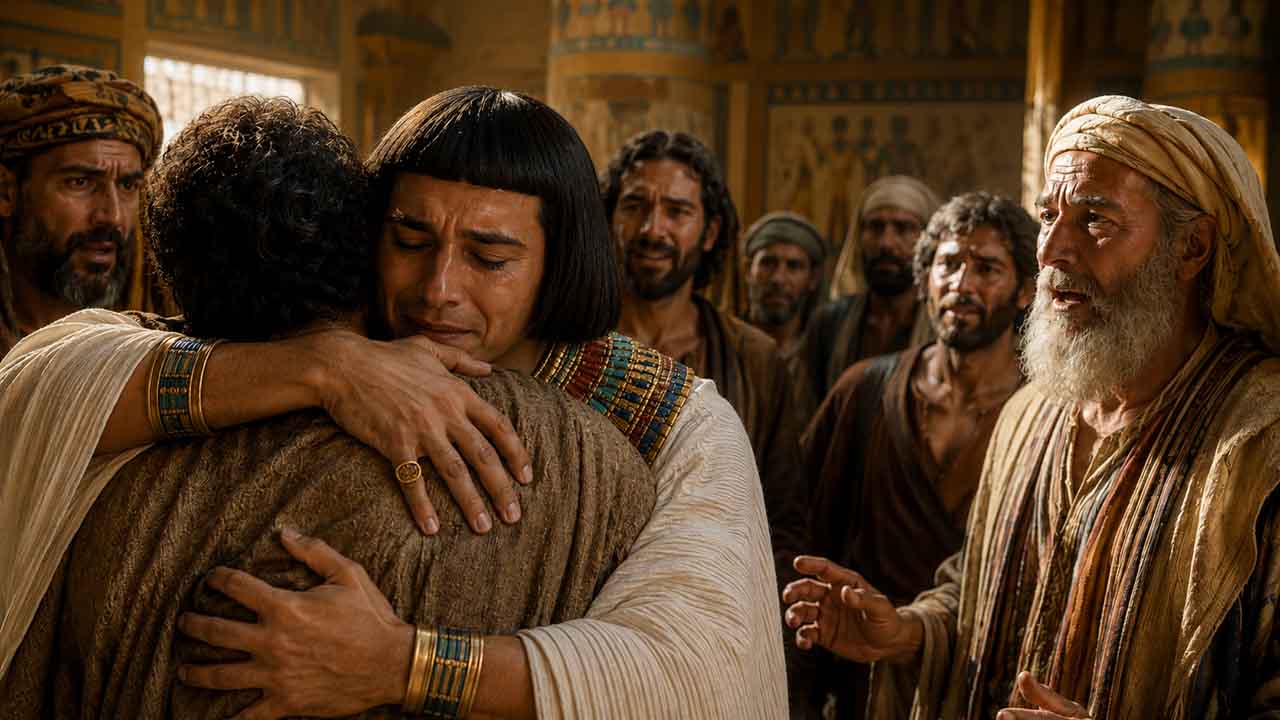
Benjamin: Rachel’s Sons Reunited
In Joseph’s tearful embrace of Benjamin, Rachel’s two sons stand together again after years of betrayal, exile, and hidden sorrow. Before the watching brothers, the Lord begins to turn guilt into mercy and a fractured family toward restoration.
Listen to this Bible Exhibit
A Small Tribe with Great Weight
The Tribe of Benjamin descended from Benjamin, Jacob’s youngest son and Rachel’s second son. Jacob’s final blessing pictured Benjamin as a ravenous wolf, devouring prey and dividing plunder [Genesis 49:27]. That image fits much of the tribe’s later story. Benjamin was small, but fierce. It was often troubled, but never forgotten. It could serve the Lord with courage, yet it could also defend evil with deadly stubbornness.
Benjamin’s story is one of the clearest examples in Scripture of strength that must be governed by holiness. The tribe gave Israel a deliverer, warriors, and its first king. It also nearly destroyed itself through moral blindness at Gibeah. Later, Benjamin was closely associated with Judah and Jerusalem, preserved after the exile, and remembered in the New Testament through the apostle Paul. The tribe’s history is therefore both warning and grace. God judged Benjamin’s sin, but He did not erase Benjamin from His covenant purpose.
Counted Among the Lord’s People
Benjamin was one of the smaller tribes in the wilderness. At the first census, it numbered 35,400 fighting men [Numbers 1:36-37]. Yet smallness did not mean insignificance. Benjamin was counted with the rest of Israel, ordered around the tabernacle, and given a place in the camp of God’s people.
During the wilderness journey, Benjamin camped on the west side of the tabernacle with Ephraim and Manasseh [Numbers 2:18-24]. This placement kept Rachel’s descendants together and showed that Benjamin belonged fully within Israel’s covenant life. The tribe did not stand apart as an isolated clan. It marched, worshiped, and waited under the Lord’s presence and command.
By the second census, Benjamin had grown to 45,600 fighting men and was organized by clans [Numbers 26:38-41]. The line of Jacob’s youngest son had been preserved through Egypt and the wilderness. God had kept Benjamin alive for a purpose.
Beloved and Strategically Placed
Moses blessed Benjamin with tenderness: “Let the beloved of the Lord rest secure in him.” He pictured the tribe as shielded by the Lord and resting close to Him [Deuteronomy 33:12]. This blessing is striking because Benjamin’s later story is not always gentle. The tribe would be fierce, but before Scripture shows its strength, Moses reminds us that Benjamin’s security must come from the Lord.
Joshua gave Benjamin a compact but strategic inheritance between Ephraim to the north and Judah to the south, including towns such as Jericho, Bethel, Gibeon, Gibeah, Mizpah, and Jebus (Jerusalem) [Joshua 18:11-28]. The land was small, but it sat at the heart of Israel’s life. Major routes passed through it. Armies would move across it. Worship and kingship would eventually rise near it.
This location was a gift and a test. Benjamin lived near the place where Jerusalem would become central to Israel’s worship and the kingdom of David. Yet nearness to holy places is not the same as obedience. The Benjamites did not dislodge the Jebusites from Jerusalem [Judges 1:21]. Benjamin’s land was full of promise, but promise always called for faithfulness.
Fierce Warriors and a Fierce Warning
Benjamin became known for courage and skill in battle. Ehud, a left-handed Benjaminite, was raised by God to deliver Israel from Moabite oppression [Judges 3:15-30]. Benjaminites also joined the battle in the days of Deborah and Barak [Judges 5:14]. Later, the tribe was known for warriors who could use either the right or left hand with sling and bow [1 Chronicles 12:2].
But the tribe’s fierce strength became dangerous when separated from righteousness. The darkest moment in Benjamin’s history came at Gibeah. Men of that city committed a terrible act of wickedness, and the tribe defended the guilty instead of seeking justice. The result was civil war, and Benjamin was nearly wiped out [Judges 19:1-21:25].
This is one of the Bible’s strongest warnings against misplaced loyalty. Family, tribe, and nation are gifts, but they become idols when they are used to protect evil. Benjamin’s courage could not save it when courage served sin. The tribe that was strong in battle became weak in holiness.
Saul and the Failure of Human Kingship
Benjamin later rose to national honor when Saul, Israel’s first king, came from the tribe [1 Samuel 9:1-2]. This was a surprising mercy. The tribe nearly destroyed in Judges was not erased from Israel. It was lifted into prominence at the beginning of the monarchy. Chronicles later preserves Benjamin’s genealogies in detail, including the line that leads to Saul, showing that the tribe’s identity and royal memory were not lost [1 Chronicles 8:1-40].
Yet Saul’s story also exposed Israel’s deeper need. The people wanted a king who looked strong, but Israel needed a ruler who would obey the Lord. Saul’s failure showed that tribal strength, military ability, and royal status could not replace covenant faithfulness [1 Samuel 15:10-23].
After Saul’s death, many Benjaminites remained loyal to his house and supported Ish-Bosheth against David [2 Samuel 2:8-11]. Some from Benjamin later came to David and pledged themselves to him [1 Chronicles 12:16-18]. Still, the old tension did not vanish quickly. Shimei, a Benjamite from Saul’s family, cursed David during Absalom’s rebellion [2 Samuel 16:5-14]. Sheba, another Benjamite, later led a revolt against David [2 Samuel 20:1-2].
Benjamin’s royal history teaches a sober lesson. The tribe’s loyalty could be admirable, but loyalty had to bow before the Lord’s chosen king. In Scripture, faithfulness is never measured by devotion to our own group alone. It is measured by submission to God.
Joined to Judah and Preserved After Exile
When the kingdom was divided after Solomon, Benjamin remained tied to Judah and Jerusalem [1 Kings 12:21-24]. This decision shaped the rest of the tribe’s history. Benjamin did not disappear into Judah, but its future became closely bound to the southern kingdom, the temple, and the Davidic line.
That closeness was both political and theological. Benjamin’s land lay beside Judah, and Jerusalem stood at the center of the divided nation’s worship and royal life. The tribe once nearly destroyed by civil war was now preserved near the place where the Lord made His name known.
After the exile, people from Benjamin returned with Judah to rebuild and resettle the land [Ezra 1:5]. Benjamites lived again in Jerusalem and in their towns [Nehemiah 11:4-9]. This return was not just a historical detail. It was covenant mercy. God preserved real families, real tribes, and real names through judgment.
Benjamin’s land also appears in the ministry of Jeremiah. Jeremiah was a priest from Anathoth in the territory of Benjamin, and his purchase of a field there became a sign that the Lord would restore His people after judgment [Jeremiah 32:6-15]. Even Benjamin’s soil became a witness that exile would not have the final word.
Of Benjamin he said, “May the beloved of the Lord dwell in safety by him; he shields him all day long, and rests between his shoulders.”
Deuteronomy 33:12
Mordecai, Paul, and the Mercy That Remembers
Benjamin also appears in one of Scripture’s great preservation stories. Mordecai was a Benjaminite, and through his household, Esther was raised in Persia [Esther 2:5-7]. In a foreign empire, when the Jewish people faced destruction, God used members of Benjamin’s line in a decisive moment of deliverance. The tribe once associated with near ruin in Judges is later connected with the preservation of the Jews in exile.
In the New Testament, Paul identified himself as an Israelite from the Tribe of Benjamin [Romans 11:1]. He used his own ancestry as evidence that God had not rejected His people. Yet Paul also learned that tribal privilege could not save him. He counted his credentials, including his descent from Benjamin, as loss compared with knowing Christ [Philippians 3:4-9].
This is one of the most beautiful turns in Benjamin’s story. The tribe that produced Saul, who failed as king, also produced Saul of Tarsus, who was converted by Christ and became the apostle Paul. Benjamin’s strength was finally seen at its best when he surrendered to Jesus.
Benjamin in the Future Hope
The Lord does not forget Benjamin in the prophetic hope of Scripture. Ezekiel names Benjamin in the future arrangement of the land [Ezekiel 48:23] and includes a gate bearing Benjamin’s name in the restored city [Ezekiel 48:32]. Revelation also names Benjamin among the sealed servants of God [Revelation 7:8].
These passages matter because Benjamin’s history could have ended in shame. The tribe had been nearly destroyed in the book of Judges. Its first king failed. Some of its sons resisted David. Yet God preserved Benjamin’s name. Judgment was real, but mercy was stronger.
Benjamin’s future hope is not rooted in Benjamin’s greatness. It is rooted in the faithfulness of the Lord. God disciplines His people, but He also remembers His covenant. He can carry a broken tribe through judgment and still give it a place in His redemptive purpose.
Why the Tribe of Benjamin Matters
The Tribe of Benjamin matters because it shows the danger of strength without holiness. Benjamin was fierce, skilled, loyal, and strategic. But none of those gifts could protect the tribe when it defended wickedness. Gibeah stands as a lasting warning that God’s people must never protect sin in the name of loyalty.
Benjamin also matters because it shows God’s mercy toward a deeply flawed people. The tribe was nearly destroyed, yet preserved. It gave Israel Saul, yet later gave the church Paul. It resisted David, yet was joined to Judah. It endured exile, yet returned. Its name appears in prophetic hope because the Lord remembers those whom He has named.
The story of Benjamin helps us understand Scripture because it holds together warning and grace. Covenant privilege does not excuse sin. Human strength cannot replace obedience. Tribal identity cannot save. Yet the Lord can preserve, restore, and use a people who deserve judgment.
Benjamin’s deepest hope is not in its warriors, kings, land, or ancestry. Its hope is in the God who keeps His promises. That hope finds its fullness in Jesus Christ, the true King who succeeds where Saul failed, reigns where David pointed, and saves people from every tribe by grace.