


Ephraim, Son of Joseph
Fruitful in the Land of Affliction
Carousel of images for this Bible Exhibit
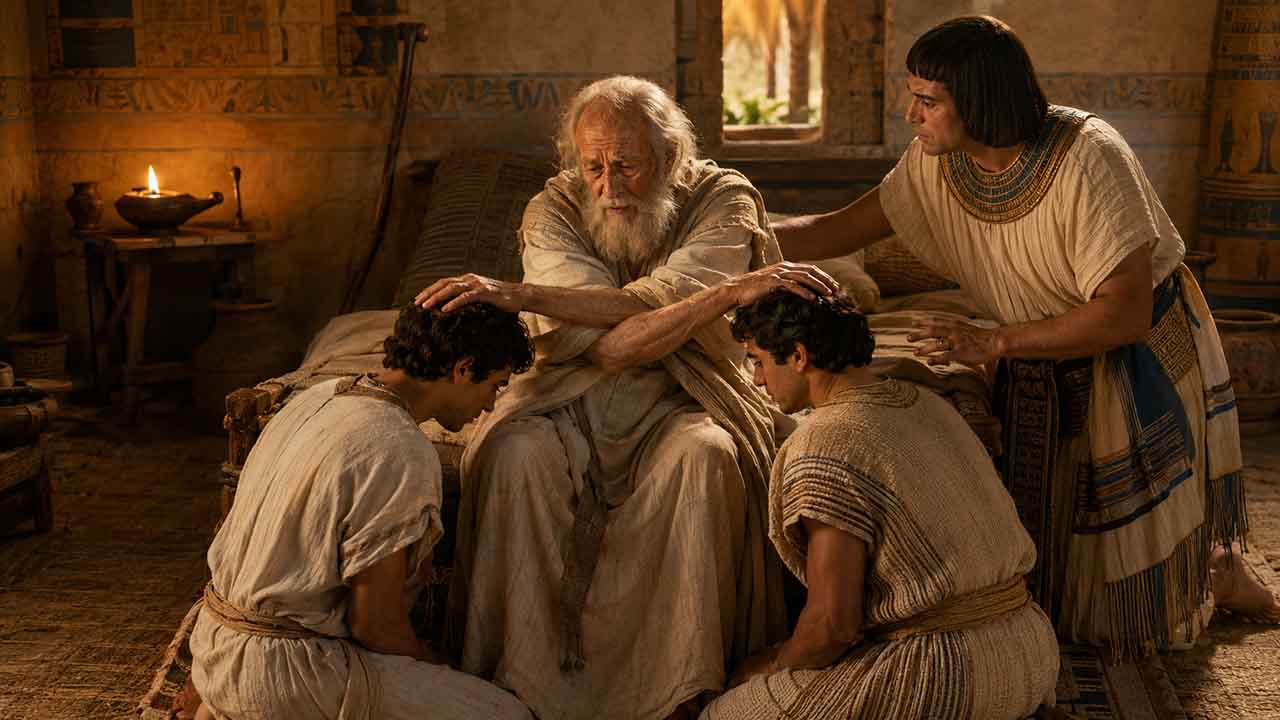
The Younger Receives the Greater Blessing
With deliberate crossed hands, Jacob blesses Ephraim above Manasseh, overturning the expected order while Joseph watches in astonishment. In this quiet room in Egypt, the dying patriarch shows that the covenant future rests not on human custom, but on the Lord’s sovereign purpose.
Listen to this Bible Exhibit
Born in Egypt, Named for Fruitfulness
Ephraim stands beside Manasseh at the bedside of Jacob, a son born in Egypt and brought into Israel by a dying patriarch’s blessing. He is the younger brother, yet Jacob’s crossed hands place him first. His life is quiet in Scripture, but his name becomes large in Israel’s story: a testimony of fruitfulness, adoption, surprising grace, and the mercy of God toward a wayward people.
Ephraim was the second son of Joseph and Asenath, the daughter of Potiphera, priest of On. He was born in Egypt before the years of famine, during the season when Joseph had been raised from suffering to authority [Genesis 41:50-52].
Joseph named him Ephraim because God had made him fruitful in the land of his affliction. That name matters. Ephraim’s story begins outside Canaan, far from the land promised to Abraham, Isaac, and Jacob. Yet the Lord was not absent from Egypt. The God who preserved Joseph in slavery and prison also gave him a household in a foreign land.
Ephraim’s name does not erase Joseph’s pain. It shows that God can make fruit grow from the soil of affliction. Joseph had suffered deeply, but suffering did not have the final word. The Lord made him fruitful in the very place where he had once been humbled.
Adopted Into Israel
Ephraim was Joseph’s son and Jacob’s grandson, not one of Jacob’s biological sons. Yet Genesis gives him a remarkable place. When Jacob neared death, he adopted Ephraim and Manasseh as his own, saying that they would belong to him like Reuben and Simeon [Genesis 48:1-6].
This was more than family affection. It gave Joseph a double share in Israel through his two sons. Ephraim and Manasseh would not stand at the edge of the covenant family. They would be counted among the tribal fathers of Israel.
That is grace. Ephraim was born in Egypt to an Egyptian mother, yet he was brought near and given a place among the people of promise. His identity was not finally determined by birthplace, status, or human expectation. The covenant mercy of God determined it.
The Younger Blessed Before the Elder
When Joseph brought his sons to Jacob, he placed Manasseh, the firstborn, near Jacob’s right hand. But Jacob crossed his hands and placed the right hand on Ephraim, the younger son [Genesis 48:13-20]. Joseph tried to correct him, but Jacob refused. He knew what he was doing.
This moment belongs to a pattern that runs through Genesis. God often overturns the order people expect. Isaac is chosen, not Ishmael. Jacob is chosen, not Esau. Joseph is lifted above his brothers. Now Ephraim is blessed before Manasseh.
Ephraim did not earn this place. He received it. His blessing was not the reward of achievement, but the gift of God’s purpose spoken through Jacob. The future of God’s people would not be ruled by age, custom, or natural privilege. It would be ruled by the Lord’s wise and surprising grace.
Yet Ephraim’s honor was real, not ultimate. Chronicles later reminds us that the birthright belonged to Joseph, but the ruler would come from Judah [1 Chronicles 5:1-2]. Psalm 78 says the Lord refused the tent of Joseph, did not choose the tribe of Ephraim, but chose Judah, Mount Zion, and David, His servant [Psalm 78:67-72]. Ephraim received a true inheritance, but he was not the royal hope of Israel. His blessing had to serve the greater promise that would lead to David and finally to the Messiah.
A Family Marked by Sorrow and Hope
Scripture says little about Ephraim’s personal actions. No speech of his is recorded. No public deed is preserved. Yet his family line is remembered.
Joseph lived to see Ephraim’s children to the third generation [Genesis 50:23]. Later, Chronicles gives a sobering glimpse into Ephraim’s house. Men of Gath killed some of his sons, and Ephraim mourned for many days. Afterward, another son was born and named Beriah. The same record remembers his daughter Sheerah, who built cities, and it traces the line forward to Joshua, son of Nun [1 Chronicles 7:20-27].
This is a deeply human portrait. Fruitfulness did not mean a life free from grief. Ephraim’s family knew sorrow, burial, rebuilding, and continuation. The Lord’s promises moved forward through real families who suffered and endured.
The Tribe That Carried His Name
After Genesis, Scripture speaks far more often of Ephraim’s descendants than of Ephraim himself. The tribe camped on the west side of the tabernacle with Manasseh and Benjamin [Numbers 2:18-24]. Joshua, the faithful spy and successor of Moses, came from Ephraim [Numbers 13:8]. Ephraim’s inheritance lay in the central hill country of Canaan, and Shiloh, where the tabernacle stood for generations, was within Ephraim’s region [Joshua 16:1-10] [Joshua 18:1].
The tribe became influential, but also troubled. Ephraim did not fully drive out the Canaanites from Gezer. In Judges, the Ephraimites could be proud and easily offended, first confronting Gideon and later clashing violently with Jephthah [Judges 8:1-3] [Judges 12:1-6].
Ephraim’s story warns us that privilege can become pride. A place near the center of worship does not guarantee a faithful heart. Great inheritance brings great responsibility.
A Name for the Northern Kingdom
Over time, Ephraim became so prominent that the name often stood for the northern kingdom of Israel. Jeroboam, the first king of the divided northern kingdom, was an Ephraimite [1 Kings 11:26]. The prophets often used “Ephraim” as a name for Israel in its rebellion, idolatry, and political pride [Hosea 4:17] [Hosea 5:3-5].
This is one of the great tensions of Ephraim’s story. The name that began as “fruitfulness” came to be associated with spiritual unfaithfulness. Hosea grieves over Ephraim’s sin. Isaiah looks toward the day when Ephraim’s jealousy and Judah’s hostility will be healed [Isaiah 11:13]. Jeremiah speaks with astonishing tenderness, calling Ephraim God’s dear son and promising mercy [Jeremiah 31:18-20]. Ezekiel pictures the divided people made one again, with the stick of Joseph, identified with Ephraim, joined to the stick of Judah under one shepherd-king [Ezekiel 37:15-28].
Ephraim’s story, therefore, does not end with failure. The prophets hold judgment and mercy together. The Lord disciplines the son He loves, but He does not forget His covenant compassion.
Why Ephraim Matters
Ephraim matters because his life gathers some of the deepest themes of Scripture. He shows that God can make His people fruitful in affliction. He shows that covenant belonging is received by grace. He shows that God is free to overturn human expectations and bless the younger before the elder.
But Ephraim also warns us. Blessing can be abused. Privilege can harden into pride. A person with a great name can still wander from the Lord.
In the full story of Scripture, Ephraim points beyond himself. The younger son blessed by grace prepares us to recognize the God who gives inheritance by mercy, not merit. The divided tribes waiting for restoration prepare us to long for the true King who gathers God’s people into one. That hope is fulfilled in Jesus Christ, the Son of Judah and the Savior of all who are brought near by grace.
Ephraim was fruitful in the land of affliction. In Christ, God brings even greater fruitfulness from suffering, turning the cross into salvation and giving His people an inheritance that cannot be taken away.
But his father refused and said, “I know, my son, I know. He also will become a people and he also will be great. Nevertheless, his younger brother shall be greater than he, and his descendants shall become a multitude of nations.” So he blessed them that day, saying, “By you Israel will pronounce blessing, saying, ‘May God make you like Ephraim and Manasseh.’” Thus he put Ephraim before Manasseh.
Genesis 48:19–20