


The Tribe of Reuben
The Firstborn Tribe Remembered by Mercy
Carousel of images for this Bible Exhibit
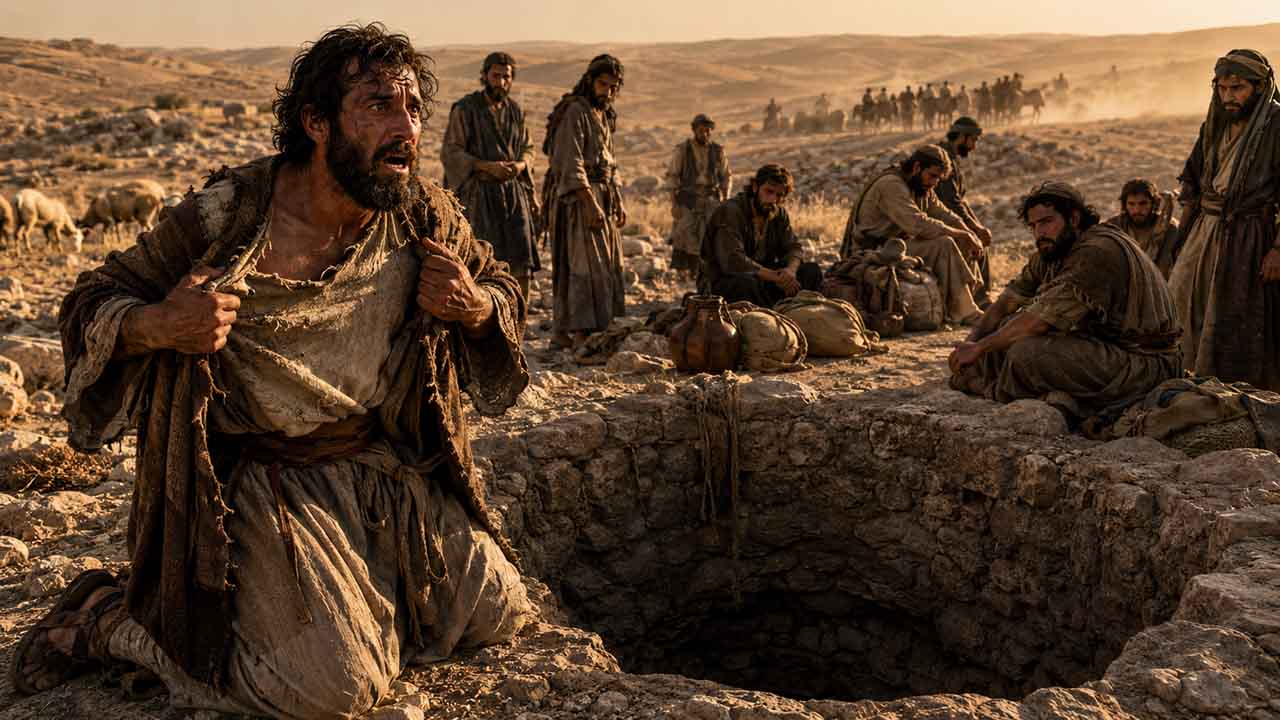
The Empty Cistern
Reuben tears his garment beside the pit, realizing too late that Joseph is gone and his half-formed rescue has failed. Around him, the silent brothers and fading caravan turn the desert into a place of guilt, fear, and irreversible loss.
Listen to this Bible Exhibit
Reuben Beyond the Jordan
Reuben stands east of the Jordan, near the pasturelands and tableland above the Dead Sea, carrying the name of Jacob’s firstborn but not the rule of the firstborn. Blessed with place, warned by failure, tested by distance, and later wounded by exile, Reuben becomes a solemn witness that status cannot replace faithfulness, comfort cannot replace obedience, and God remembers even a diminished tribe.
A Son Named “See, a Son”
The tribe takes its name from Reuben, the firstborn son of Jacob and Leah. When he was born, Leah said that the Lord had seen her affliction, and she hoped that Jacob would now love her [Genesis 29:31-32]. Reuben’s name carries the cry of a wounded wife and the honor of a firstborn son.
As a man, Reuben’s story is mixed. He found mandrakes and brought them to Leah, an event tied to the birth of Issachar [Genesis 30:14-18]. He later tried to spare Joseph when the brothers plotted murder, intending to rescue him from the pit [Genesis 37:18-30]. In Egypt, he remembered their guilt against Joseph and offered his own sons as a pledge for Benjamin’s safety [Genesis 42:21-38].
Yet Reuben also sinned grievously by lying with Bilhah, his father’s concubine [Genesis 35:22]. Jacob did not forget. On his deathbed, he called Reuben his firstborn, his might, and the firstfruits of his strength, yet described him as turbulent like water, a son who would not excel because he had defiled his father’s bed [Genesis 49:3-4].
Reuben, the patriarch, and the tribe that bore his name must be distinguished, but the ancestor’s story casts a long shadow over his descendants.
Firstborn, Yet Not Preeminent
Reuben kept the title of firstborn, but he lost the blessing of the firstborn rule. Chronicles explains the matter plainly: Reuben was the firstborn, but because he defiled his father’s couch, his birthright was given to the sons of Joseph. Yet the chief ruler would come through Judah [1 Chronicles 5:1-2].
That distinction helps us read Reuben’s whole story. Joseph received the double portion through Ephraim and Manasseh. Judah received the royal line. Reuben remained a true tribe in Israel, but not the leading tribe.
Moses’ blessing over Reuben is brief and tender: “Let Reuben live, and not die” [Deuteronomy 33:6]. It sounds less like triumph and more like mercy. Reuben did not need applause. Reuben needed preservation.
Counted Around the Tabernacle
In the wilderness, Reuben was not erased. At the first census, the tribe numbered 46,500 fighting men [Numbers 1:20-21]. At the second census, Reuben numbered 43,730 [Numbers 26:5-7]. Reuben camped on the south side of the tabernacle with Simeon and Gad [Numbers 2:10-16]. When Israel marched, Reuben moved in ordered formation with that camp [Numbers 10:18-20].
The tribe also had named leaders. Elizur, son of Shedeur, served as chief in the wilderness [Numbers 1:5]. He brought Reuben’s offering at the dedication of the altar [Numbers 7:30-35]. Shammua, son of Zaccur, represented Reuben among the spies [Numbers 13:4].
These details matter. Reuben’s lost preeminence did not mean a loss of belonging. The tribe still stood around the Lord’s dwelling. It still had a place in the camp, a place in the march, and a place among the people God redeemed.
A Rebellion From Reuben’s Line
One of the darkest moments in Reuben’s history came through Dathan and Abiram, men from the tribe of Reuben, who joined Korah’s rebellion against Moses and Aaron [Numbers 16:1-35]. Scripture does not say the whole tribe rebelled, and we should not make Dathan and Abiram define every Reubenite. But their place in the story is sobering.
Their rebellion challenged the order God had appointed. Whether the old firstborn claims contributed to their resentment is not stated directly. What is clear is that wounded status can become dangerous when it hardens into pride. Deuteronomy later remembers the judgment as a warning to Israel [Deuteronomy 11:6].
Reuben’s warning is sharp: past honor never permits present rebellion. A great name cannot sanctify a proud heart.
An Inheritance East of the Jordan
Before Israel crossed into Canaan, Reuben and Gad saw that the lands east of the Jordan were good for livestock. Their request made practical sense, but Moses heard a spiritual danger. Would they settle down while their brothers still had battles ahead? Would they discourage Israel as the unbelieving spies once had done? Reuben and Gad answered by promising to cross armed before Israel until the other tribes received their inheritance, and Moses accepted the request with a sober warning that failure would be sin against the Lord [Numbers 32:1-42].
Under Joshua, the eastern tribes kept their word. The Reubenites crossed the Jordan armed with their brothers [Joshua 4:12-13]. Joshua later released them to return home with his blessing [Joshua 22:1-9]. This is one of Reuben’s honorable moments. The tribe received an eastern inheritance, but it did not abandon the common task.
Reuben’s land lay east of the Jordan, south of Gad, in territory associated with the former kingdom of Sihon, including places such as Aroer, Dibon, Heshbon, Nebo, and Beth-peor [Joshua 13:15-23]. Bezer in the wilderness, in Reuben’s region, became a city of refuge [Deuteronomy 4:43] [Joshua 20:8].
The land was a gift, but it was also a test. Reuben lived on the frontier, separated from much of Israel by the Jordan and exposed to pressures from surrounding peoples.
The Altar of Witness
After the conquest, Reuben, Gad, and the half-tribe of Manasseh built a large altar near the Jordan. The western tribes feared rebellion. If the altar were for rival sacrifice, Israel’s worship would be torn apart.
But the eastern tribes explained that the altar was not for burnt offerings or sacrifices. It was a witness. They feared that future generations might say they had no portion in the Lord. The altar testified that the eastern tribes belonged to the same God and the same covenant people [Joshua 22:10-34].
This moment is central to Reuben’s story. Geography could have led to division. Distance could have become forgetfulness. The altar was not a replacement for true worship. It was a testimony that the Jordan River must not cut the people of God in two.
May Reuben live and not die, nor his people be few.
Deuteronomy 33:6
Searchings of Heart
In Deborah’s song, Reuben is remembered painfully. Reuben remained among the sheepfolds while the song speaks of great searchings of heart and asks why the tribe stayed with the flocks [Judges 5:15-16].
This was not an open rebellion like Dathan and Abiram. It was hesitation. Reuben had concerns to weigh, animals to tend, and local life to preserve. But the hour called for costly obedience.
That is one of Reuben’s clearest warnings. God’s people can fail by defiance, but they can also fail by delay. The divided heart may sound thoughtful, but when obedience is required, endless deliberation can become disobedience.
Strength on the Frontier
Reuben’s later story also includes moments of courage and faith. Chronicles remembers the eastern tribes as valiant men who carried shields and swords, drew bows, and were skilled in war. Reuben, Gad, and the half-tribe of Manasseh fought the Hagrites, Jetur, Naphish, and Nodab, and prevailed because they cried out to God and trusted Him [1 Chronicles 5:18-22].
Reuben also appears in David’s kingdom. Adina, a Reubenite, was counted among David’s mighty men [1 Chronicles 11:42]. The eastern tribes also sent a great force to Hebron to make David king [1 Chronicles 12:37-38]. David’s administration included oversight for the Reubenites and their eastern neighbors [1 Chronicles 26:32] [1 Chronicles 27:16].
These passages keep us from flattening Reuben into failure. The tribe could fight. It could serve. It could trust the Lord in battle. Yet strength on the frontier had to remain joined to faithfulness.
Decline, Exile, and Remembrance
Reuben’s frontier location brought danger. During Jehu’s reign, Hazael of Aram struck Israel east of the Jordan, including the lands of the Reubenites, Gadites, and Manassites [2 Kings 10:32-33]. Later, Chronicles offers a deeper spiritual diagnosis: the eastern tribes broke faith with the God of their fathers and turned to the gods of the peoples of the land. Judgment came through Assyria, and they were carried away [1 Chronicles 5:25-26].
Reuben’s story is therefore a warning about exposed places and exposed hearts. Living on the edge requires nearness to God. A good inheritance becomes spiritually dangerous when distance from God’s people becomes distance from God’s worship.
Yet Reuben is not erased. Ezekiel’s vision of restored tribal portions gives Reuben a place in the renewed land [Ezekiel 48:6-7]. One of the gates of the city also bears Reuben’s name [Ezekiel 48:31]. Revelation names Reuben among the sealed tribes of Israel [Revelation 7:5].
The firstborn tribe lost preeminence, suffered judgment, and faded from prominence, but it did not fall from God’s memory.
Why Reuben Matters
Reuben teaches that status is not faithfulness. The tribe carried the name of Jacob’s firstborn, but birth order could not overcome sin, instability, rebellion, or divided loyalty.
Reuben also teaches that comfort can dull obedience. The tribe chose good pastureland, and that choice was not condemned once joined to shared duty. But the same settled life later became a picture of hesitation when Israel needed courage.
Most of all, Reuben teaches that mercy remembers what failure has diminished. Moses prayed that Reuben would live and not die. Ezekiel named Reuben in hope. Revelation included Reuben among the sealed. The Lord does not pretend that sin is small, but He also does not forget the people He has named.
Reuben’s story finally points beyond every failed firstborn to Christ, the faithful Firstborn who never forfeits His inheritance and holds first place in everything [Colossians 1:15-18]. In Him, mercy does more than preserve a name. It makes people whole.