


Andrew
The Quiet Disciple Who Brought People to Jesus
Carousel of images for this Bible Exhibit
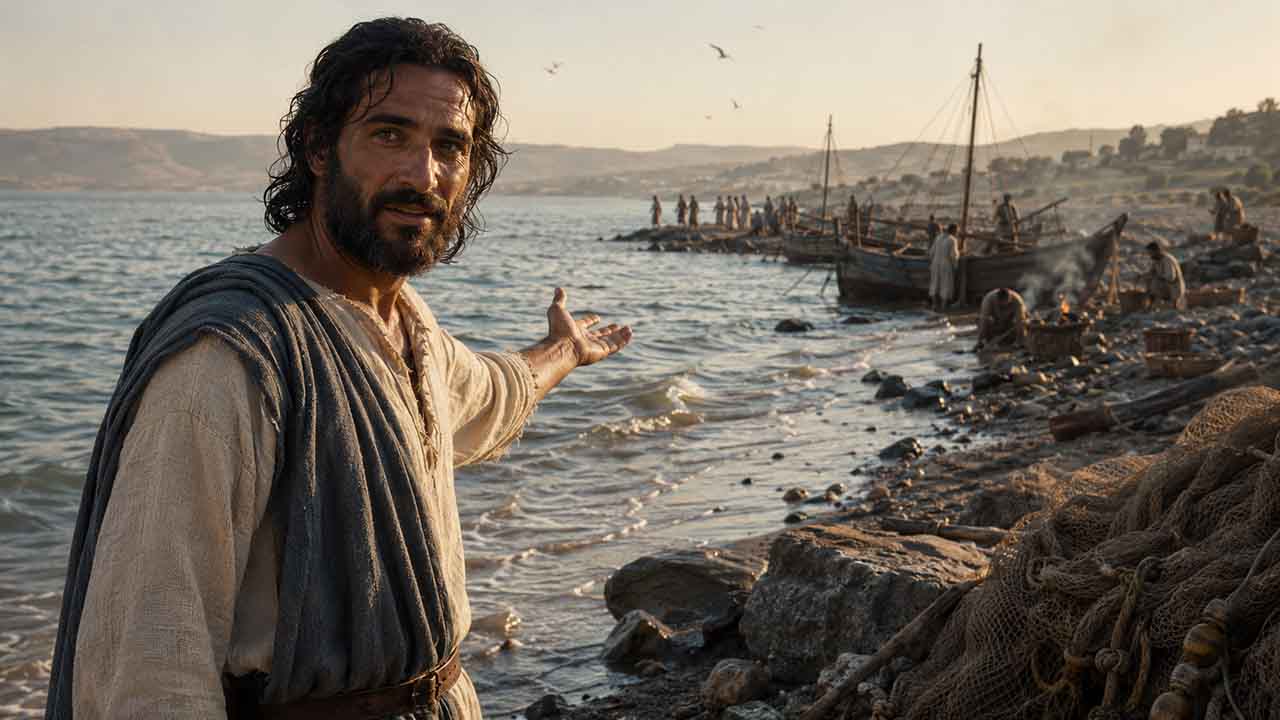
Andrew
Andrew stands on the shore of Galilee with the quiet faithfulness of a disciple who does not seek the spotlight, but points others to Jesus. His open hand and weathered face tell the story of a fisherman transformed into a guide, inviting the curious to come and see the Christ who changes everything.
Listen to this Bible Exhibit
A Fisherman Ready for the Messiah
Andrew never stands in the spotlight for long, but again and again the story moves forward because he brings someone to Jesus. He was the brother of Simon Peter, a fisherman from Bethsaida in Galilee, and one of the earliest followers of Christ. His Greek name means “manly,” and his Galilean background placed him in a region where Jewish faith and Gentile culture often met.
Before Andrew followed Jesus, he had been a disciple of John the Baptist. That already tells us something important about him. Andrew was spiritually awake. He was waiting for the Messiah, listening to the call of repentance, and ready to respond when God’s promised work appeared. When John pointed his followers to Jesus, Andrew followed Him, spent time with Him, and became convinced that He was the Christ. His first recorded act was to find his brother Simon and bring him to Jesus, where Simon received the name Peter [John 1:35-44].
That moment quietly shaped the future of the church. Andrew did not become as publicly prominent as Peter, but he brought Peter to Christ. A simple invitation became a doorway into one of the most important apostolic lives in Scripture.
He first found his brother Simon and told him, “We have found the Messiah” (which is translated Christ). And he brought him to Jesus. Jesus looked at him and said, “You are Simon son of John; you will be called Cephas” (which, when translated, is Peter).
John 1:41–42
Called from the Nets
Andrew later returned to fishing with Peter on the Sea of Galilee. When Jesus formally called them, they left their nets and followed Him. Jesus took the language of their ordinary labor and gave it kingdom meaning. They would no longer merely gather fish from the lake. They would gather people into the kingdom of God. Soon after, Jesus entered the home shared by Peter and Andrew in Capernaum and healed Peter’s mother-in-law [Mark 1:16-31].
Andrew’s calling shows that Jesus does not waste ordinary work. Nets, boats, patience, teamwork, and endurance all became part of Andrew’s preparation. The Lord often turns common labor into kingdom service.
Among the Twelve
Andrew was chosen as one of the Twelve apostles, the group Jesus appointed as witnesses to His kingdom. In the apostolic lists, Andrew is always named among the first disciples called into Jesus’ service [Matthew 10:2-4].
Though Peter, James, and John formed the closest inner circle, Andrew remained near them. On the Mount of Olives, he joined those three to privately ask Jesus about the temple’s coming destruction and future events [Mark 13:3-4]. Andrew was close enough to ask, learn, and receive instruction, but Scripture does not present him as one who needed to dominate the scene.
Bringing What He Had to Jesus
The Gospel of John gives the clearest picture of Andrew’s character. At the feeding of the five thousand, Andrew noticed a boy with five loaves and two fish. He did not pretend the food was enough, but he brought what was available to Jesus. The Lord then used that small gift to feed a vast crowd [John 6:5-13].
This is Andrew’s pattern. He does not perform the miracle. He places the small thing before the One who can. The kingdom does not advance because disciples possess enough in themselves. It advances because Jesus receives what is weak, small, and insufficient, then multiplies it by His power.
A Bridge Toward the Nations
Andrew appears again during Jesus’ final week in Jerusalem. Some Greeks wanted to see Jesus. They approached Philip, who went to Andrew, and together they brought the request to the Lord. Jesus’ response pointed toward His coming death and the wider harvest that would follow [John 12:20-26].
This brief scene carries great weight. Andrew helped bring Gentile seekers near to Jesus, and that moment pointed forward to the gospel moving beyond Israel to the nations. He was not the main preacher of the Gentile mission, but he stood at the doorway as outsiders came seeking Christ.
Present in Prayer
Andrew’s final appearance in Scripture comes after Jesus’ ascension. He is named among the apostles gathered in Jerusalem, praying and waiting with the women, Mary, the mother of Jesus, and Jesus’ brothers [Acts 1:12-14].
Scripture tells us nothing more about Andrew’s later ministry. That silence is not a failure. The biblical portrait gives us what we need: Andrew was faithful, attentive, practical, and ready to bring others to the Lord.
Why Andrew Matters
Andrew teaches that faithful witness does not require fame. He brought Peter to Jesus. He brought a boy’s small lunch to Jesus. He helped bring the Greeks to Jesus. In each case, his work was simple but significant.
God wants disciples who notice people, recognize needs, and bring both to Christ. Andrew’s life reminds us that the kingdom often advances through quiet servants who open doors others will walk through.
What is a Disciple?
A disciple is a follower and learner of Jesus. During his earthly ministry, Jesus called many to follow him, but he chose twelve to be his closest companions and witnesses.
These men walked with Jesus, heard his teaching, saw his miracles, and were formed by his presence. He sent them to proclaim the Kingdom of God, heal the sick, and bear witness to his authority.
The disciples were not flawless heroes. They misunderstood, doubted, argued, and failed. Yet Jesus patiently shaped them by grace. After his resurrection, and through the gift of the Holy Spirit, these once-fearful followers became bold witnesses to the risen Christ.
Their lives show the heart of discipleship: to be called by Christ, formed by Christ, and sent by Christ. A disciple does not merely admire Jesus from a distance, but follows him in faith, obedience, and love.