


The Walls and Gates of Jerusalem Before the Exile
Chosen, Guarded, Warned, and Judged
Carousel of images for this Bible Exhibit
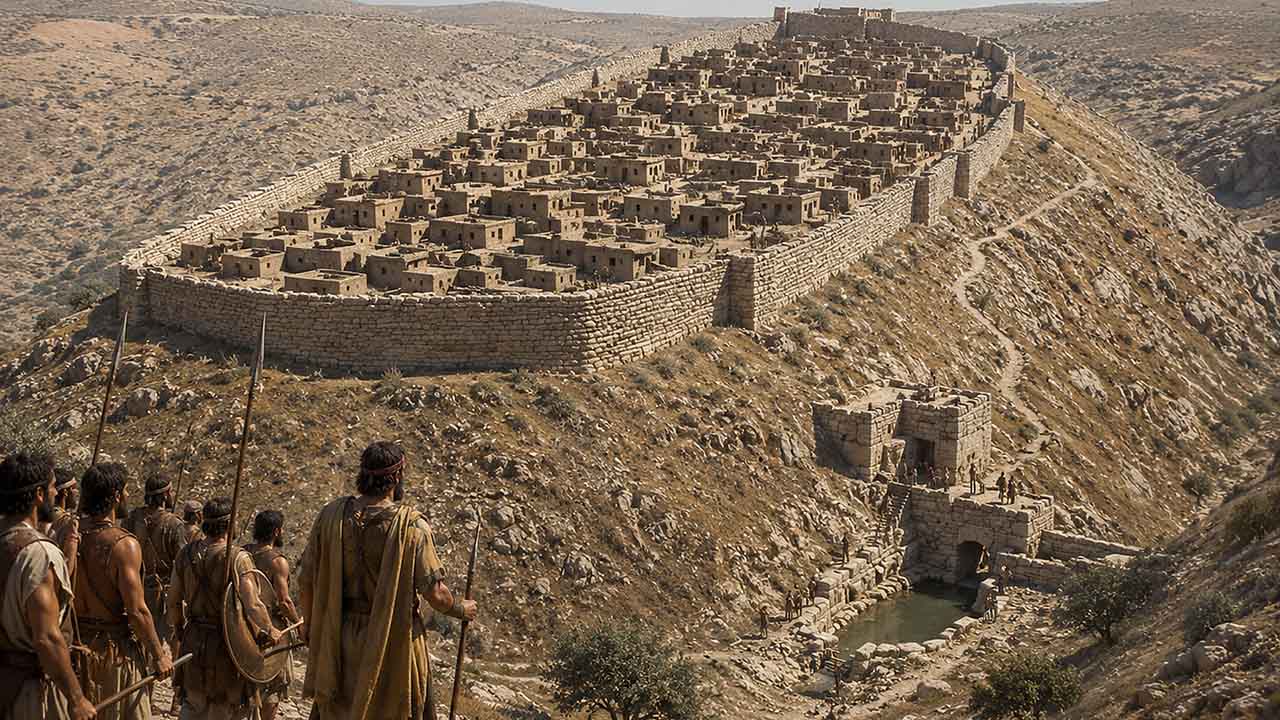
David Conquers Ancient Jebus
David and his men stand before the steep Jebusite stronghold, a small but fiercely defended Jebus rising from the rocky ridge above the Gihon Spring. In this rugged hill city, God begins to establish the throne of David in Zion, turning a fortified Canaanite city into Jerusalem, the City of David.
The City God Chose
Before Babylon broke Jerusalem’s walls, they told the story of a city chosen by God, strengthened by kings, warned by prophets, and judged for covenant rebellion. Jerusalem was not holy because its stones were strong. It was holy because the Lord set his name there and tied the city to his promises.
The psalmist later called God’s people to walk around Zion, count her towers, and consider her ramparts so the next generation would know the Lord [Psalm 48:12-14]. That is why the walls and gates matter. They help us read Scripture as history that happened in real streets, before real kings, among real people, under the rule of the living God.
David and the City of the King
Jerusalem first entered Israel’s royal story when David captured Jebus, the stronghold of Zion, and made it the City of David [2 Samuel 5:6-10]. The city was small compared with later Jerusalem, but its place was strategic. It stood on high ground, guarded by valleys, and became the throne city of the king God had chosen.
This was more than politics. God had promised David a kingdom, a throne, and a son who would reign after him. Jerusalem became the place where that royal promise was seen in stone. The walls guarded the city, but the true security of Jerusalem was the covenant faithfulness of God.
Solomon and the Temple City
Solomon expanded Jerusalem’s significance by building the temple and strengthening the city. Scripture says he built the house of the Lord, his own house, the Millo, and the wall of Jerusalem [1 Kings 9:15]. The city of the king became the city of the temple.
This union of throne and temple is central to biblical theology. Jerusalem was meant to show life under God’s rule. The king was not free to govern by pride. The priests were not free to worship by invention. The people were not free to live as the nations lived. The walls gathered them, and the gates opened their public life before the Lord.
Where the Life of the City Stood
In the ancient world, a gate was not only an opening in a wall. It was a place of defense, watchfulness, business, justice, news, and public witness. A strong gate protected the city, but it also gathered the city. Elders sat there. Merchants passed through. Kings appeared there. Prophets spoke there. Legal cases could be heard there.
God’s law could bring hard matters to the city gate because sin was never merely private. It damaged families, neighbors, and the covenant community [Deuteronomy 21:18-21]. The story of Boaz shows the same pattern in a scene of mercy. He redeemed Ruth’s family line at the gate before elders and witnesses, and that public act of covenant faithfulness led to David and, finally, to Christ [Ruth 4:1-11].
To understand Jerusalem’s gates before the exile is to see that Israel’s faith was never meant to be hidden away. God’s truth belonged in homes, courts, markets, royal decisions, and public speech.
Gates Named Before the Exile
Some pre-exilic gates are difficult to locate with certainty. That should make us careful, not doubtful. Scripture gives us enough to see their importance.
The Gate of Ephraim and the Corner Gate appear during a painful moment in Judah’s history, when Jehoash of Israel broke down a long section of Jerusalem’s wall [2 Kings 14:13-14]. The damage showed that Jerusalem could be humbled. A city chosen by God was not protected from discipline when kings and people walked in sin.
Uzziah later built towers at the Corner Gate, the Valley Gate, and the angle of the wall [2 Chronicles 26:9]. His work reminds us that wise leadership strengthens what has been weakened. Yet Uzziah’s later pride also warns us that building strong defenses does not make a king safe from God.
Hezekiah and the Test of Trust
Hezekiah’s day brought one of Jerusalem’s great tests. Assyria threatened Judah, and Jerusalem needed real defenses. Hezekiah repaired broken walls, built another wall outside, strengthened the Millo, made weapons, and encouraged the people [2 Chronicles 32:2-8]. He also protected the city’s water supply, bringing water into Jerusalem so the enemy could not easily cut it off [2 Kings 20:20].
Yet Hezekiah did not tell the people to trust the wall. He told them to trust the Lord. This is the right way to understand every wall in Scripture. God may use stone, strategy, courage, and labor, but none of them can replace him. Jerusalem’s defenses were gifts. They were never saviors.
Walk about Zion and go around her; count her towers; consider well her ramparts; go through her citadels, so that you may tell the next generation. For this is God, our God forever and ever; he will guide us until death.
Psalm 48:12–14
Manasseh, Mercy, and Rebuilding
Manasseh shows the danger and mercy surrounding Jerusalem’s walls. He sinned greatly and led Judah into evil, but after God humbled him, he sought the Lord. Scripture says that afterward he built an outer wall near Gihon, around Ophel, and as far as the entrance of the Fish Gate [2 Chronicles 33:12-14].
That rebuilding matters. It does not erase Manasseh’s sin, but it shows that God’s mercy can bring a ruined man to repentance and a damaged city to repair. Still, Judah’s deeper problem remained. Walls could be rebuilt faster than hearts could be healed.
Prophets at the Gates
As Judah moved toward exile, Jerusalem’s gates became stages for prophetic warning. Jeremiah was beaten and put in stocks at the upper Benjamin Gate, near the house of the Lord [Jeremiah 20:1-2]. Later, officials sat at the New Gate of the Lord’s house to hear the case against him [Jeremiah 26:10]. Near the Potsherd Gate by the Valley of Ben-hinnom, Jeremiah shattered a clay jar as a sign that Jerusalem itself would be shattered [Jeremiah 19:1-3].
This is one of the great lessons of the pre-exilic gates. The place where justice should have been guarded became the place where God’s prophet was rejected. The place where the covenant order should have stood became the place where judgment was announced.
Josiah’s reforms also show that gates could become spiritually corrupt. He broke down the high places at the gates, because false worship had entered the public life of the people [2 Kings 23:8]. The gates revealed the heart of the city. What happened there showed whether Judah feared the Lord or followed idols.
When the Walls Fell
At last, Babylon came. The house of the Lord was burned. The king’s house was burned. The great houses were burned. The wall of Jerusalem was broken down [2 Kings 25:8-10]. The fall was not a failure of architecture. It was the judgment of God on covenant rebellion.
This explains why the later story of Nehemiah begins with grief over broken walls and burned gates. The ruins were not merely the result of military damage. They were the visible sign of exile, shame, and sin. Jerusalem did not need stonework only. It needed mercy.
Why This Matters
The walls and gates of Jerusalem before the exile teach us to read the Bible with clearer eyes. They show that God cares about public life, not only private belief. Justice at the gate mattered. Worship near the temple mattered. Royal decisions mattered. Business, speech, reform, courage, repentance, and warning all stood before God.
They also teach us not to put final trust in earthly strength. Walls can be gifts from God, but they cannot save those who reject God. Gates can guard a city, but they cannot keep out judgment. “Unless the LORD watches over the city, the watchman stays awake in vain” [Psalm 127:1].
Before the exile, Jerusalem’s walls and gates preached a living sermon. God had chosen the city, guarded it, warned it, and finally judged it. Yet judgment was not the end of the story. The broken walls prepared the way for the later hope of restoration, and that hope teaches us to look beyond every earthly city to the Lord himself, the true refuge of his people.