


The Tribe of Dan
Strong Hands, Restless Hearts
Carousel of images for this Bible Exhibit
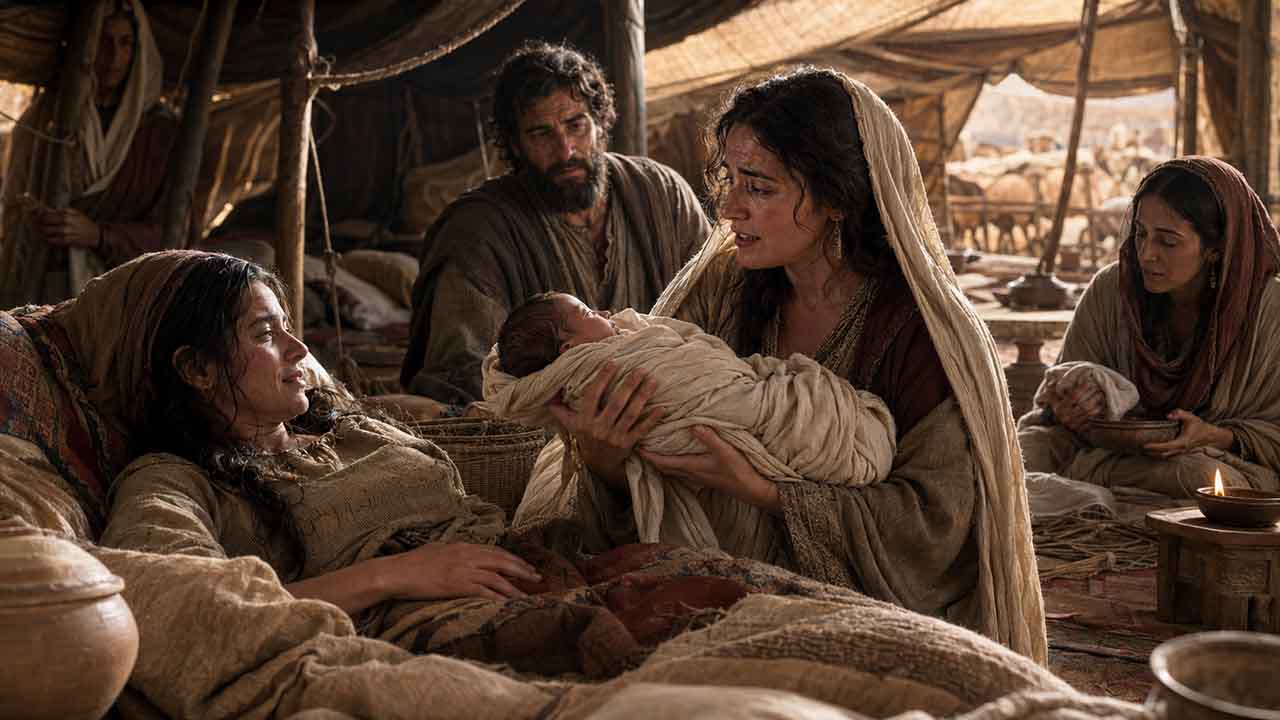
The Child of Vindication
Rachel receives Bilhah’s newborn son with tearful wonder, naming him Dan because God has heard her cry and judged her cause. In the fragile warmth of this birth, the Lord is forming Israel’s future even through sorrow, rivalry, and longing.
Listen to this Bible Exhibit
A Tribe of Strength and Warning
The Tribe of Dan stands in Scripture as one of Israel’s most sobering tribes. It began with size, strength, skill, and a clear place in the camp of Israel. It guarded the rear when the nation marched. It produced Oholiab, a craftsman for the tabernacle, and Samson, the mighty judge who struck the Philistines. Yet Dan also became a warning about restless hearts and corrupted worship.
Dan’s story is not simple. The tribe was not weak, forgotten, or useless. God counted it, ordered it, gifted it, and gave it an inheritance. But Dan struggled to possess what God had allotted to him. Later, a group of Danites moved north, captured Laish, renamed it Dan, and established false worship there. In the divided kingdom, Jeroboam made Dan one of the centers of golden-calf worship.
The Tribe of Dan teaches that strength without faithfulness becomes danger. Covenant privilege, numbers, skill, and opportunity cannot protect a people who turn from the Lord. Dan’s history leads us to the same cry Jacob spoke after blessing Dan: the Lord alone must save.
From Jacob’s Son to a Large Tribe
The tribe took its name from Dan, Jacob’s fifth son and the first son born to Bilhah, Rachel’s servant [Genesis 30:1-6]. Dan himself is briefly described in Genesis, and only one son, Hushim, is named from his line [Genesis 46:23]. Yet from that small beginning came one of Israel’s largest tribes in the wilderness.
At the first census, Dan numbered 62,700 fighting men, second only to Judah [Numbers 1:38-39]. At the second census, the tribe had grown to 64,400 [Numbers 26:42-43]. These numbers show God’s kindness in preserving and multiplying Dan’s line. But they also prepare us for the main lesson of Dan’s history: outward strength does not guarantee inward faithfulness.
Dan had a real place among the people of God. It was not a fringe tribe. It was counted, ordered, named, and given responsibility. That makes its later failures more serious, not less.
Ordered Around the Presence of God
In the wilderness camp, Dan was placed on the north side of the tabernacle with Asher and Naphtali [Numbers 2:25-31]. When Israel set out, Dan served as the rear guard for the whole camp [Numbers 10:25-28]. That role mattered. The rear guard protected the vulnerable and helped hold the nation together as it moved through the wilderness.
Dan’s early story also includes real service to true worship. Oholiab, from the tribe of Dan, was chosen and gifted by God to help Bezalel make the tabernacle and its furnishings [Exodus 31:1-6]. This is one of the brightest notes in Dan’s record. A Danite used skill, design, and craftsmanship for the dwelling place of the Lord.
Yet the wilderness record also includes a warning. A man whose mother was from Dan blasphemed the Name and came under judgment [Leviticus 24:10-16]. The tribe, like all Israel, stood under the holiness of God. Dan’s gifts were real, but gifts had to be governed by reverence.
The Blessing of the Lion and the Weight of the Covenant
Jacob’s blessing over Dan had already pictured both dignity and danger. Dan would “provide justice” for his people, but he was also compared to a serpent beside the road, striking suddenly and bringing down the rider [Genesis 49:16-18]. The image is sharp and searching. It suggests strength, suddenness, and danger.
Moses later blessed Dan as a lion’s cub springing out of Bashan [Deuteronomy 33:22]. That picture again speaks of energy and force. Dan was not portrayed as passive or powerless. Yet Dan also stood on Mount Ebal among the tribes appointed for the covenant curses [Deuteronomy 27:13]. The lesson is plain: strength must live under the word of God. A lion that does not obey the Lord becomes a threat, not a blessing.
Dan’s future would prove this tension. The tribe had strength, but that strength was often coupled with restlessness and compromise.
A Good Inheritance, Hard to Possess
When Israel entered Canaan, Joshua assigned Dan a western inheritance near the coastal plain [Joshua 19:40-48]. The land was fertile and strategic, with access to the sea. But it was also difficult. Strong enemies pressed the tribe, and the Amorites forced the Danites into the hill country [Judges 1:34-35].
This became a turning point. Dan had an allotment from the Lord, but the tribe struggled to possess it. The problem was not that God had failed to give Dan a place. The problem was that Dan did not fully take hold of the place God gave.
The Song of Deborah gives another troubling glimpse. While other tribes fought, Dan is remembered for lingering by the ships [Judges 5:17]. The wording suggests a tribe pulled toward the coast, trade, or safety, while others entered the battle. Dan’s inheritance placed the tribe in a difficult setting, but difficulty was not an excuse for disobedience.
This is one of Dan’s great warnings. When God’s people grow restless with the place He assigns them, they are tempted to seek easier paths. Easier paths often lead to greater danger.
Samson the Danite
The most famous Danite in Scripture is Samson. He came from Zorah, from the clan of the Danites, at a time when Israel was under Philistine oppression. His birth, calling, conflicts, downfall, and final act are told across the Samson narrative [Judges 13:1-16:31]. The Spirit of the Lord began to stir him, and God used him to strike Israel’s enemies.
Samson’s life shows both mercy and disorder. He was chosen before birth and given great strength, yet his life was marked by conflict, desire, revenge, and weakness. The Lord truly used him, but Samson was not a picture of settled covenant faithfulness. He reflected the brokenness of the days when Israel had no king, and everyone did as they saw fit.
For Dan, Samson is both hope and warning. Hope, because God had not abandoned the tribe or the people. Warning, because even extraordinary strength could not heal Israel’s deepest problem. Dan did not merely need a strong man. Israel needed faithful worship, righteous rule, and the Lord’s salvation.
The Move North to Laish
Dan’s darkest turn came when some Danites looked for another place to live. Judges says that in those days Dan was seeking a place of its own, because it had not yet come into the inheritance among the tribes of Israel [Judges 18:1-31]. The tribe sent spies north. They found Laish, a peaceful and unsuspecting city, and returned with a favorable report.
Six hundred Danite warriors then marched north from Zorah and Eshtaol. On the way, they took Micah’s carved image, household gods, and priest. They captured Laish, burned it, rebuilt it, and renamed it Dan.
This was not merely a relocation story. It was the founding of a new Danite center in spiritual corruption. The tribe did not enter its new home with purified worship. It carried stolen idols and a compromised priesthood into the city. The Danites gained land, but they did so while establishing false worship.
Judges presents this as a tragedy. Dan found an easier inheritance but lost the center of obedience. The tribe that once helped build the tabernacle now helped build a rival shrine.
From Border City to False Worship Center
The city of Dan later became a famous marker of Israel’s northern boundary. The phrase “from Dan to Beersheba” came to describe the whole land from north to south [Judges 20:1]. But Dan’s name also became tied to one of Israel’s great religious sins.
After the kingdom was divided, Jeroboam feared that the northern tribes would return to Jerusalem to worship. So he made two golden calves, placing one in Bethel and the other in Dan [1 Kings 12:26-33]. Dan became a center of counterfeit worship, a religious alternative to the temple God had chosen.
This was not a small mistake. Jeroboam’s worship system shaped the northern kingdom for generations. Later Scripture remembers that Israel continued in the sins of Jeroboam, including the calf worship connected with Dan [2 Kings 10:29]. What began in Judges as a tribal compromise became, in the monarchy, a public system of idolatry.
This is how false worship often grows. It begins as convenience. It becomes tradition. Then it hardens into rebellion.
Dan shall judge his people as one of the tribes of Israel. Dan will be a snake by the roadside, a viper by the path, that bites the horse’s heels so that its rider falls backward.
Genesis 49:16–17
Dan in the Prophets
The prophets remembered Dan as a place connected with danger and judgment. Jeremiah speaks of disaster announced from Dan, as judgment comes from the north [Jeremiah 4:15]. Amos condemns those who swear by the shameful gods connected with Samaria, Dan, and Beersheba [Amos 8:14].
These prophetic warnings show how far Dan’s name had fallen. A tribe that once surrounded the tabernacle became associated with corrupted worship. A city once taken as a new beginning became a sign of northern apostasy.
Yet the prophets do not present Dan’s problem as Dan’s alone. Dan becomes a mirror for all false religions. Whenever God’s people replace His word with convenience or His worship with human invention, they walk the path of Dan.
Dan in Hope and Silence
Dan’s story does not end only in a warning. Ezekiel’s vision of the restored land names Dan first in the northern portion [Ezekiel 48:1-2]. Later, one of the gates of the restored city bears Dan’s name [Ezekiel 48:32]. This matters. God does not erase Dan from Ezekiel’s vision of ordered restoration.
At the same time, Revelation lists the sealed servants from the tribes of Israel, and Dan is not named [Revelation 7:4-8]. Scripture does not explain the omission. Because God has not given the reason, we should not speak more confidently than the text allows. Dan’s absence is serious and worth noticing, but it should be handled with humility.
Ezekiel and Revelation together teach reverence. Dan’s history warns us against idolatry. Ezekiel’s vision reminds us that God can restore. Revelation’s silence reminds us not to presume.
Why the Tribe of Dan Matters
The Tribe of Dan matters because it shows the danger of strength without faithfulness. Dan had numbers, skill, territory, responsibility, and famous sons. But none of these could protect the tribe when worship became corrupt.
Dan also shows the danger of restless obedience. The tribe struggled to possess its assigned inheritance, looked elsewhere, and found a path that seemed easier. But the easier path led to stolen gods, false priesthood, and a city that later became a center of golden-calf worship.
Yet Dan’s story is not meant to leave us in despair. It drives us to the Lord’s salvation. Jacob’s cry after blessing Dan is the deepest answer to the tribe’s whole history: “I look for your deliverance, Lord.” Dan could judge, strike, migrate, fight, and build, but Dan could not save itself.
The same is true for all God’s people. We need more than strength. We need more than religious activity. We need more than a place in the camp. We need the Lord who saves. Dan’s history warns us to reject false worship, receive God’s assigned calling with faith, and look to Jesus Christ, the true Savior who brings His people to the Father in truth.