


Levi, Son of Jacob

Levi, Son of Jacob
Joined, Judged, Set Apart
Carousel of images for this Bible Exhibit
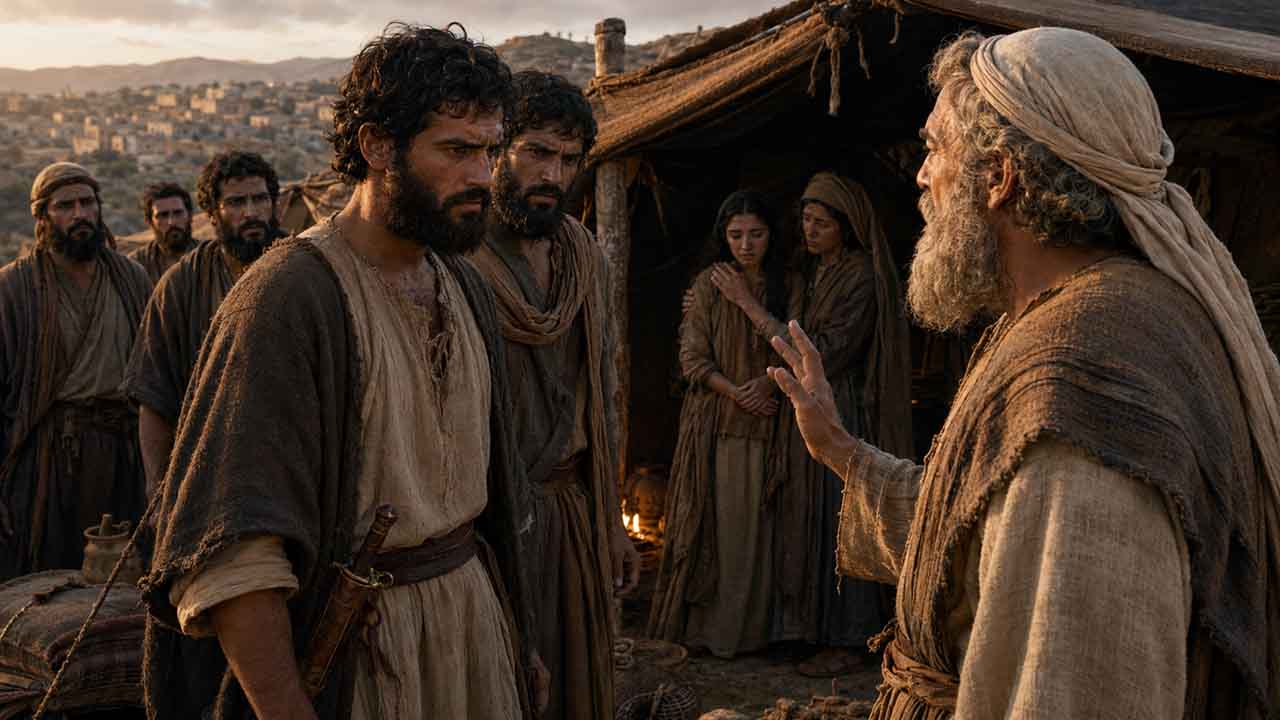
Zeal Without Wisdom
Levi stands before Jacob in the heavy silence after vengeance, fierce and unyielding, while his father confronts the danger his anger has brought upon the family. Behind them, Dinah’s sorrow lingers in the shadows, reminding every son of Israel that loyalty without righteousness can become a wound of its own.
Listen to this Bible Exhibit
Joined, Judged, Set Apart
Levi stands among Jacob’s sons, a name born of longing and a legacy marked by both judgment and mercy. He was Jacob’s third son and Leah’s third son, born into a wounded household where love, rivalry, and sorrow were deeply tangled. His mother named him with the hope that Jacob would now be joined to her. Yet Levi’s own story is remembered most for violent zeal at Shechem. Jacob’s final words over him were not a blessing of praise, but a judgment of cruel anger. Still, Levi’s story does not end in ruin. From his line came Moses, Aaron, and the tribe set apart for the service of the Lord. Levi teaches us that covenant nearness is not the same as personal holiness, and that God can judge sin truthfully while still carrying out His saving purpose.
Born from Leah’s Longing
Levi was born in a home full of pain. Leah was Jacob’s wife, but she lived under the grief of being unloved in the way Rachel was loved. The Lord saw Leah’s affliction and opened her womb. She bore Reuben, then Simeon, and then Levi [Genesis 29:31-34].
When Levi was born, Leah said, “Now this time my husband will be joined to me, because I have borne him three sons.” His name is tied in Genesis to the idea of being joined or attached. That meaning matters. Levi’s name carries the sound of a woman longing to be loved, seen, and held close.
Yet Scripture is honest. Leah’s hope was real, but Jacob’s house was still divided. Levi was born into a family where God’s promise was present, but human hearts were still full of favoritism, rivalry, and sorrow. This is how Genesis often works. It does not polish the covenant family into something neat. It shows the Lord working through real people who need mercy.
Levi’s birth reminds us that God sees wounded people. He hears the ache inside broken households. He keeps His promises even when the family carrying those promises is far from whole.
Counted Among Jacob’s Sons
Levi was fully counted among the sons of Jacob. He appears in the family lists beside his brothers, especially among the sons of Leah: Reuben, Simeon, Levi, Judah, Issachar, and Zebulun [Genesis 35:22-26] [Exodus 1:1-5] [1 Chronicles 2:1-2].
This matters because Levi is often remembered either for his sin at Shechem or for the later priestly tribe that bore his name. Both are important, but before either of those, he was simply a son in Jacob’s covenant house. He belonged to the family through whom God would build Israel.
But belonging did not make him righteous. Levi stood near the promises of God, yet his heart still needed God’s rule. This is one of Scripture’s clearest warnings. A person may be close to holy things and still be ruled by unholy anger. Family heritage, spiritual privilege, and covenant position are not substitutes for obedience.
The Violence at Shechem
The main event attached to Levi’s personal story is the tragedy at Shechem. Dinah, his sister, was violated by Shechem, the son of Hamor the Hivite. The wrong done to her was real and grievous. Scripture does not minimize it [Genesis 34:1-31].
But Levi and Simeon answered one evil with another. They spoke deceitfully to Hamor and Shechem, using circumcision as a condition for intermarriage. When the men of the city were weak from circumcision, Levi and Simeon took their swords, killed the males of the city, and brought Dinah out. Then Jacob’s sons plundered the city.
The passage is morally serious on every side. Dinah was sinned against. Shechem’s act was evil. But Levi’s revenge was not holy justice. He used deception, misused the covenant sign, and turned family outrage into bloodshed.
This is why Levi’s story must be read with care. The Bible does not ask us to choose between compassion for Dinah and condemnation of Levi’s cruelty. Both must be held together. A true grievance does not permit God’s people to sin in response. Zeal without holiness becomes violence. Anger without obedience becomes destruction.
Jacob saw the danger immediately. He rebuked Simeon and Levi because they had brought trouble on his household and made the family offensive to the people of the land. Their answer, “Should he treat our sister like a prostitute?” shows the heat of their outrage. But outrage alone cannot justify what God condemns.
Levi’s sin warns us that even anger over real evil must be placed under the Lord. Righteousness is not measured only by what we oppose, but by whether we obey God while opposing it.
Jacob’s Judgment Over Levi
Jacob did not forget Shechem. Near the end of his life, when he gathered his sons and spoke over their future, he joined Simeon and Levi together in a severe word:
“Simeon and Levi are brothers; weapons of violence are their swords” [Genesis 49:5-7].
Jacob refused to enter their council. He remembered their anger, their cruelty, and their bloodshed. Then he pronounced the sentence: “I will divide them in Jacob and scatter them in Israel.”
These are among the heaviest words spoken over any son of Jacob. Levi does not receive a glowing blessing here. His anger is cursed. His violence is named. His future is marked by scattering.
Yet even here, Scripture is careful. Jacob curses Levi’s anger, not God’s covenant promise. The Lord’s purpose is not destroyed. Levi’s sin is judged, but Levi’s line is not erased.
This is the moral depth of the Bible. God does not pretend sin is small because it happens inside the chosen family. But He also does not lose His redemptive plan because His servants are weak. Levi’s judgment is real. So is God’s mercy.
A Line Preserved in Egypt
When Jacob’s household went down to Egypt, Levi went with them. Scripture names his three sons: Gershon, Kohath, and Merari [Genesis 46:11]. These names become very important later, because they form the three main branches of the Levites.
Exodus later traces Levi’s line and records that he lived 137 years. Through Kohath came Amram, and through Amram came Aaron, Moses, and Miriam [Exodus 6:16-20] [Numbers 26:59]. That means Israel’s great deliverer, its first high priest, and one of its leading prophetic women all came from Levi’s house.
This does not make Levi himself a hero. Scripture does not rewrite his past. But it does show the power of God’s faithfulness. The line of a judged man became the line through which God raised servants for Israel’s deliverance and worship.
The family that carried the memory of violent zeal would later be called to guard God’s holiness.
Simeon and Levi are brothers; their swords are weapons of violence. Let my soul not enter their council; may my glory not be united with their assembly, for in their anger they killed men, and in their self-will they hamstrung oxen. Cursed be their anger, for it is fierce, and their fury, for it is cruel. I will disperse them in Jacob and scatter them in Israel.
Genesis 49:5–7
Scattered Into Sacred Service
Levi’s descendants became a tribe unlike the others. They were not counted for ordinary military service in the same way as the other tribes, because they were set apart to guard and serve the tabernacle [Numbers 1:47-54]. The Lord took the Levites in place of Israel’s firstborn sons and gave them to Aaron for service [Numbers 3:5-13].
This is one of the most striking turns in the Bible. Jacob had said Levi would be scattered in Israel. Later, that scattering became a pattern of service. The Levites received no ordinary tribal inheritance because the Lord Himself was their inheritance [Numbers 18:20-24] [Deuteronomy 10:8-9]. They were given towns among the tribes, including cities of refuge [Numbers 35:1-8] [Joshua 21:1-42].
That detail is beautiful. A tribe associated with bloodshed was later entrusted with cities where the manslayer could flee until justice was properly heard. The Lord did not erase the warning of Levi’s past. He transformed Levi’s scattered future into a ministry of worship, teaching, guarding, and mercy.
At Sinai, after the sin of the golden calf, the sons of Levi rallied to Moses when he asked, “Who is on the LORD’s side?” [Exodus 32:25-29]. Their zeal was costly and severe. Yet unlike Levi’s violence at Shechem, this moment was tied to the Lord’s command and the defense of covenant holiness. The difference matters. God does not bless rage. He claims obedience.
Moses later blessed Levi with words about the Urim and Thummim, teaching Jacob God’s rules, offering incense, and placing whole burnt offerings on the altar [Deuteronomy 33:8-11]. Malachi would later speak of the covenant with Levi as a covenant of life and peace, while also rebuking priests who corrupted that calling [Malachi 2:4-9].
Levi’s descendants were called to stand near holy things, but that nearness demanded holiness.
Levi and the Greater Priest
The New Testament helps us see Levi’s place in the whole story of Scripture. Hebrews speaks of Levi in connection with the priesthood and tithes, but it also teaches that the Levitical priesthood was not final [Hebrews 7:5-14]. Jesus the Messiah came from Judah, not Levi, yet He is the true and greater Priest.
This does not dishonor Levi. It puts Levi in his proper place. The Levites served at the tabernacle and temple. They taught the law. They guarded the holy things. The priests offered sacrifices. But none of them could bring final cleansing. Their ministry pointed beyond itself.
Jesus fulfills what Levi could only foreshadow. He is the Priest who needs no sacrifice for His own sin. He is the Mediator who brings His people near to God. He is the holy One whose zeal was never cruel, whose anger was never sinful, and whose blood speaks a better word than vengeance.
Levi shows our need for a priest. Christ is the Priest we need.
Why Levi Matters
Levi matters because his story is honest about sin and glorious about grace.
He was born from Leah’s longing, and his name speaks of being joined. Yet his anger at Shechem tore rather than healed. He belonged to the covenant family, but covenant privilege did not make him holy. Jacob’s final word over him was a judgment on violent anger and cruel zeal.
But the Lord did not abandon His purpose. From Levi came a line preserved through Egypt, a tribe set apart for sacred service, teachers of the law, guardians of the tabernacle, ministers of worship, and priests who pointed toward a greater Priest still to come.
Levi teaches us not to excuse sin because it appears in a religious family. He also teaches us not to despair when God judges sin. The Lord can take a scattered people and give them a holy calling. He can turn a legacy marked by failure into a witness to His mercy.
Most of all, Levi points us to Jesus Christ. Levi was joined to a wounded family, judged for violent anger, and later set apart through his descendants for priestly service. Jesus is the true Son who joins Himself to sinners without sharing their sin, bears judgment in their place, and brings them near to God forever.