


Naphtali, Son of Jacob

Naphtali, Son of Jacob
Born in Wrestling, Remembered in Light
Carousel of images for this Bible Exhibit
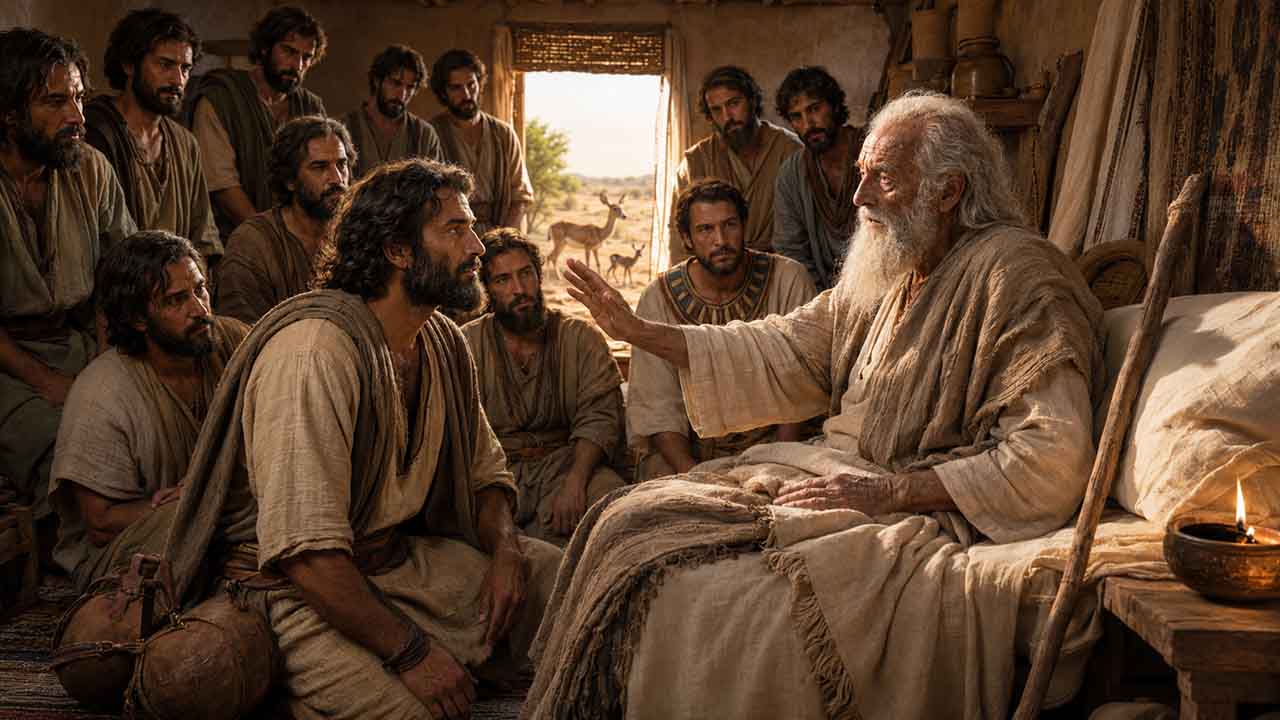
Released Into Grace
Naphtali kneels before Jacob as a word of freedom and beauty is spoken over him. Beyond the doorway, the open land and gentle doe echo a future marked by grace, fruitfulness, and life beyond the struggle.
Listen to this Bible Exhibit
From Wrestling to Galilee’s Light
Naphtali was Jacob’s sixth son and the second son born to Bilhah, Rachel’s servant. Scripture does not give him a long personal story. He does not speak in Genesis. No great act is recorded under his own name. Yet the Bible carefully remembers him as a true son of Jacob, a father within Israel, and the ancestor of one of the twelve tribes [1 Chronicles 2:2].
His name means “my wrestling” or “my struggle,” because Rachel named him during her painful rivalry with Leah. Naphtali was born into a divided home, but God’s covenant purpose did not reject him. He went down to Egypt with Jacob’s household, fathered four sons, and received a brief but beautiful word in Jacob’s final blessing [Genesis 46:24] [Genesis 49:21].
The tribe of Naphtali carried his name into the northern land of Israel, near Galilee. There, the tribe knew blessing, courage, failure, invasion, and exile. Yet Isaiah promised that the humbled land of Naphtali would see a great light, and Matthew says that promise was fulfilled when Jesus began His ministry in Galilee [Isaiah 9:1-2] [Matthew 4:12-17]. Naphtali’s life is quiet, but his name becomes part of a great biblical pattern: God remembers the overlooked, redeems broken beginnings, and causes light to dawn where darkness once fell.
Born in Rachel’s Struggle
Naphtali’s birth took place inside one of Scripture’s most wounded households. Jacob loved Rachel, but Leah bore children first [Genesis 29:31-35]. Rachel, grieving her barrenness, gave Bilhah to Jacob so that children might be counted through her household [Genesis 30:1-8]. Bilhah first bore Dan, and then Naphtali.
When Naphtali was born, Rachel said, “With mighty wrestlings I have wrestled with my sister and have prevailed.” The child’s name, therefore, carried the ache of rivalry. Rachel saw his birth as a victory in her contest with Leah. The name Naphtali preserves that moment: struggle, tension, longing, and human competition.
Yet Scripture does not treat Naphtali as a lesser son because of the disorder around his birth. He was born through Bilhah, but he is counted among Jacob’s sons [Genesis 35:22-26]. He belongs to the family through whom God was keeping His promises to Abraham, Isaac, and Jacob. Human sin and sorrow did not cancel divine mercy.
That is one of the first lessons of Naphtali’s life. A child may be born into conflict, but he is not defined only by the conflict into which he is born. Rachel named him from her struggle. God remembered him within His covenant.
A Quiet Son, Fully Counted
Naphtali remains a quiet figure in Genesis. Scripture gives no speech from him and no separate episode centered on his choices. He appears mainly in the lists of Jacob’s sons. This silence should not make readers dismiss him.
The Bible often teaches by what it records briefly. Naphtali’s name is preserved because he belongs to Israel’s foundation. He stands beside brothers whose stories are much longer: Reuben, Judah, Levi, Joseph, and Benjamin. Yet the covenant family is not made only of the most visible men. It is made of all those whom God names and gathers.
Naphtali’s quietness also guards us from speculation. Later traditions may try to fill in the gaps, but Scripture gives us enough. We know his birth, his place among Jacob’s sons, his descent into Egypt, his sons, and his father’s blessing.
Father of Four Sons
When famine brought Jacob’s household to Egypt, Naphtali went with them [Genesis 46:6-7]. Genesis names his four sons: Jahzeel, Guni, Jezer, and Shillem. These names show that Naphtali was not a passing figure in the family story. He became a father, and his line continued.
Exodus includes Naphtali among the sons of Jacob who entered Egypt [Exodus 1:1-4]. That movement into Egypt was both preservation and foreshadowing. God saved Jacob’s family from famine through Joseph, but the family would later become enslaved in the land where they had found refuge [Exodus 1:6-14]. Naphtali lived at the hinge of that story. His descendants would multiply in Egypt, suffer with Israel, and later be brought out by the Lord’s mighty hand.
Numbers later traces the clans of Naphtali through his sons: the Jahzeelites, Gunites, Jezerites, and Shillemites [Numbers 26:48-50]. This is more than genealogy. It is covenant continuity. The son born in Rachel’s struggle became the father of families counted among the redeemed people of God.
Jacob’s Final Word
Near the end of his life, Jacob blessed his sons and spoke words that reached beyond their own lifetimes [Genesis 49:1-26]. Naphtali’s blessing is short: “Naphtali is a doe let loose that bears beautiful fawns,” or, as some translations render it, “he gives beautiful words.”
Because the Hebrew line is brief and poetic, we should read it with care. The image of a released doe suggests freedom, grace, quickness, and life. It is not a heavy or bitter word. It carries beauty and motion. The second phrase is debated, but whether the focus is beautiful offspring or beautiful words, Jacob’s blessing leaves Naphtali with an image of grace.
This is striking when placed beside his birth. Naphtali’s name began with wrestling. Jacob’s final word pictures release. Rachel named him out of rivalry, but the blessing over him breathes freedom. In Scripture, God often takes names marked by pain and folds them into a better story.
Naphtali is not cursed like Simeon and Levi for violence. He is not lifted to kingship as Judah is. He is not expanded like Joseph into overflowing fruitfulness. But he is blessed. The quiet son receives a gentle word, and that word is not forgotten.
The Tribe That Carried His Name
Naphtali, the man, becomes most visible through the tribe that descended from him. In the wilderness, the tribe counted 53,400 fighting men in the first census and 45,400 in the second [Numbers 1:42-43]. Naphtali camped north of the tabernacle with Dan and Asher and marched with that division [Numbers 2:25-31] [Numbers 10:25-28]. Its leader was Ahira, son of Enan, and its spy was Nahbi, son of Vophsi [Numbers 1:15] [Numbers 13:14].
Moses blessed Naphtali as “satisfied with favor” and “full of the blessing of the LORD” [Deuteronomy 33:23]. The tribe’s inheritance later fell in the north, near the Sea of Galilee and the upper Jordan, with fortified cities and fruitful land [Joshua 19:32-39]. Kedesh in Naphtali became a city of refuge and a Levitical city [Joshua 20:7] [Joshua 21:32].
This land was beautiful, but it was also exposed. Northern blessing brought northern danger. Naphtali’s position placed it near trade routes, Canaanite strongholds, and later foreign invasion. The tribe lived where Israel met the nations.
Courage and Compromise
The tribe of Naphtali shows both courage and compromise. It did not fully drive out the Canaanites from Beth-shemesh and Beth-anath, but lived among them and pressed them into forced labor [Judges 1:33]. Like many tribes, Naphtali received an inheritance but did not complete the obedience that inheritance required.
Yet Naphtali also answered the call to battle. Barak came from Kedesh in Naphtali, and Deborah summoned him to lead ten thousand men from Naphtali and Zebulun against Sisera [Judges 4:6-10]. Deborah’s song honors Naphtali for risking life “on the heights of the field” [Judges 5:18]. Later, Naphtali responded to Gideon’s call against Midian [Judges 6:35] [Judges 7:23].
The tribe also supported David at Hebron, sending officers and many armed men with supplies for the feast of covenant joy [1 Chronicles 12:34, 40]. Under Solomon, Ahimaaz served as the royal officer in Naphtali, and Hiram, whose mother was from Naphtali, crafted bronze work for the temple [1 Kings 4:15] [1 Kings 7:13-14].
Naphtali’s legacy is therefore mixed. It knew incomplete obedience, but also real courage. It knew border weakness, but also faithful service. This is the pattern of Israel itself: grace received, obedience tested, mercy still needed.
Naphtali is a doe set free; he gives beautiful words.
Genesis 49:21
A Land Humbled, Then Honored
In the divided kingdom, Naphtali became part of the northern kingdom of Israel. Its border location made it vulnerable. Ben-hadad of Syria struck the region in the days of Baasha and Asa [1 Kings 15:20] [2 Chronicles 16:4]. Later, Tiglath-pileser, king of Assyria, captured Galilee and “all the land of Naphtali,” carrying the people into exile [2 Kings 15:29].
This could have been the last word over Naphtali: a name born in struggle, a land swallowed by darkness. But the prophets speak with deeper hope. Isaiah remembered “the land of Zebulun and the land of Naphtali” as a place brought into contempt, but promised that God would make it glorious. The people walking in darkness would see a great light.
Matthew declares that this promise was fulfilled when Jesus left Nazareth and lived in Capernaum, “in the territory of Zebulun and Naphtali.” The region once humbled by invasion became the stage on which the kingdom of heaven was proclaimed.
This is the great theological beauty of Naphtali’s story. The man’s name means struggle. His tribe’s land knew shadow. Yet in that shadow, Christ shone. The gospel did not begin in the places human pride would choose. It dawned in Galilee, in the old world of Naphtali, where covenant mercy answered ancient grief.
Remembered at the End
Naphtali’s name does not disappear from the Bible’s final vision. Ezekiel gives Naphtali a place in the restored land and names a gate of the renewed city after him [Ezekiel 48:3-4] [Ezekiel 48:34]. Revelation also includes Naphtali among the sealed tribes of Israel [Revelation 7:6].
These final references belong to the tribe rather than to the patriarch as an individual, but they still matter for understanding his biblical legacy. The son born in a tense family tent is remembered in visions of restoration. The name first spoken by Rachel in rivalry remains present as Scripture looks toward God’s completed redemption.
Naphtali teaches us to read quiet lives with covenant eyes. Some people receive only a few lines in Scripture, yet those lines are held within the grand story of God. Naphtali is not a central hero like Abraham, Moses, or David. He is not a prophet, priest, or king. But he is named. He is counted. He is blessed. His descendants are judged, preserved, and remembered. And the land tied to his name becomes a place where Jesus brings light.
Why Naphtali Matters
Naphtali matters because his life shows that God works through families marked by weakness. Jacob’s household was full of envy, favoritism, rivalry, and pain. Yet from that household, God formed Israel. Naphtali’s birth does not excuse Rachel’s rivalry, but it does reveal God’s mercy within a broken home.
Naphtali also matters because he reminds us that quiet does not mean forgotten. Scripture says little about him, but it says enough to show that he belonged. He was not pushed outside the covenant because his mother was Bilhah. He was not erased because his personal story was brief. He stood among the sons of Jacob, and his name continued among the tribes of Israel.
Most of all, Naphtali matters because his story bends toward Christ. His name begins with wrestling. His blessing speaks of release. His land passes through darkness. Then the light of Jesus dawns there. In Naphtali, we see a small but lovely thread in the whole Bible: God brings grace out of struggle, beauty out of obscurity, and light out of the shadow of death.