


Reuben, Son of Jacob

Reuben, Son of Jacob
Firstborn Strength, Unstable Waters
Carousel of images for this Bible Exhibit
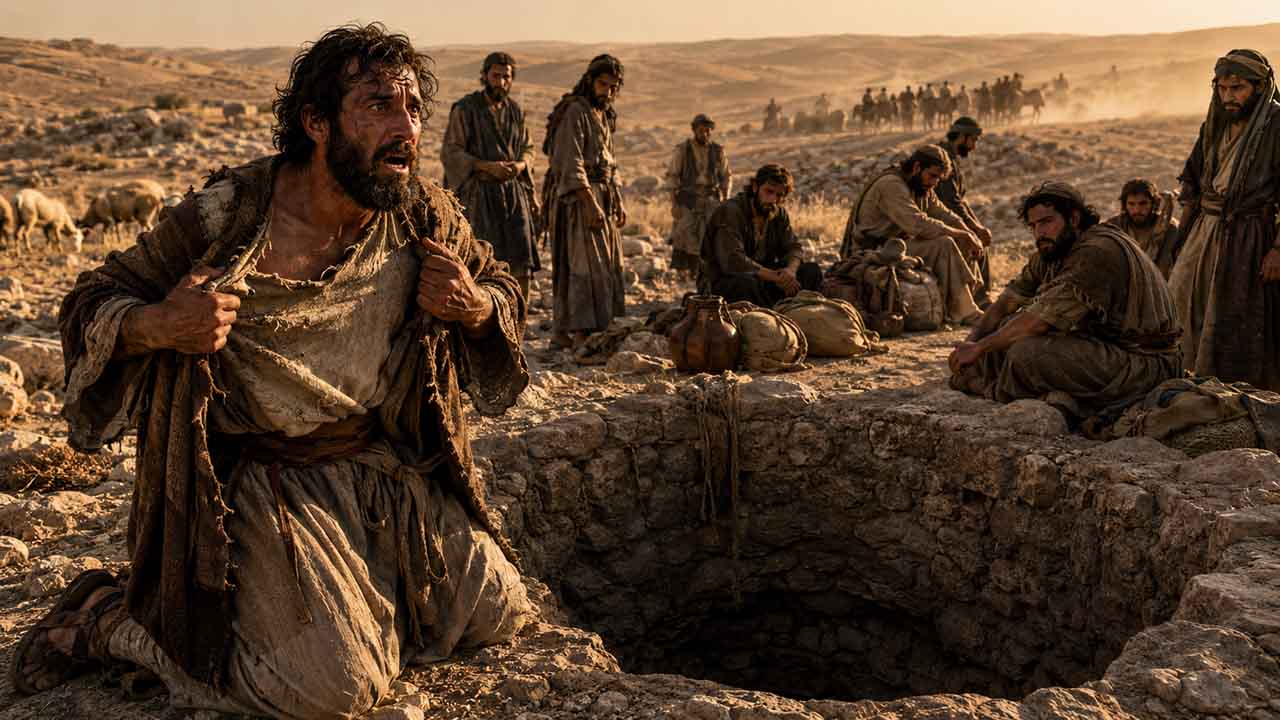
The Empty Cistern
Reuben tears his garment beside the pit, realizing too late that Joseph is gone and his half-formed rescue has failed. Around him, the silent brothers and fading caravan turn the desert into a place of guilt, fear, and irreversible loss.
Listen to this Bible Exhibit
Firstborn Strength, Unstable Waters
Reuben was Jacob’s firstborn son and the first child born to Leah. His name is tied to the Lord seeing Leah’s affliction, for she hoped that the birth of a son would draw Jacob’s love toward her. From the beginning, Reuben stood in a place of honor, but he was born into a house wounded by favoritism, rivalry, and sorrow.
Scripture remembers Reuben with honest complexity. He was the firstborn, “Jacob’s might” and “the firstfruits of his strength.” Yet he sinned gravely by sleeping with Bilhah, his father’s concubine, and that act cost him the birthright. He also showed real conscience in the story of Joseph, stepping between his brother and murder, grieving when Joseph disappeared, and later recognizing the family’s guilt.
Reuben is not a simple villain, nor a hidden hero. He is a warning. Good impulses are not the same as faithful leadership. Privilege is not the same as holiness. A man may begin with honor and still lose what he was called to carry. Yet Reuben is also remembered. He went down to Egypt with Jacob, fathered a line in Israel, and his tribe still appears in later visions of restoration. His life points beyond every unstable son to the faithful Firstborn who never fails.
Born When the Lord Saw Leah
Reuben’s story begins with Leah’s sorrow. Jacob loved Rachel more than Leah, and Leah lived in the pain of being unwanted by her own husband [Genesis 29:30-32]. Yet Scripture says the Lord saw Leah and opened her womb. Her first son was Reuben.
Leah named him with hope: “Because the LORD has looked upon my affliction; for now my husband will love me.” The name Reuben sounds like “See, a son.” His birth was both a gift from God and a cry from a wounded wife. Leah rejoiced that God had seen her, but she also longed for Jacob to see her.
This matters for understanding Reuben. He was born into privilege, but not into peace. He was the first son in a divided home, the first child in a family shaped by competing loves. Scripture does not excuse his later sin by pointing to his painful setting, but it does teach us to read him honestly. Reuben’s life unfolded within a household where love was uneven, grief was deep, and children became caught up in adult rivalry.
Even so, God was at work. The Lord’s mercy did not wait for Jacob’s family to become healthy before advancing His covenant promise. Reuben’s birth shows that God sees the afflicted, gives life in broken places, and begins His purposes in households that still need grace.
The Weight of the Firstborn
As the firstborn, Reuben held real dignity. He was the first sign of Jacob’s strength and the natural heir of the firstborn responsibility. In Israel’s later law, the firstborn son normally received special honor and a double portion [Deuteronomy 21:15-17]. Reuben, therefore, stood at the head of Jacob’s sons by birth.
But Scripture never treats birth order as enough. The firstborn must be more than first. He must be steady, holy, and able to govern himself. Reuben had rank, but he lacked the character needed to carry it.
A brief scene from his youth shows the troubled world in which he grew up. During the wheat harvest, Reuben found mandrakes in the field and brought them to Leah [Genesis 30:14-16]. Rachel asked for some, and the moment became another exchange in the sisters’ painful rivalry. The Bible does not invite speculation beyond the text. It simply shows that even an ordinary act by Reuben became entangled in the conflict of Jacob’s home.
The future firstborn leader was learning life in a house of bargaining, resentment, and longing. But a hard home did not remove his responsibility before God. Reuben would still answer for what he chose.
Sin Against His Father’s House
Reuben’s great fall is recorded with striking brevity. After Rachel died, Reuben went and slept with Bilhah, his father’s concubine, and Israel heard of it [Genesis 35:16-26]. The text does not linger over the act, but it does not soften it.
This was a serious sin. Reuben violated his father’s house, defiled the family order, and showed a lack of self-rule at the very point where the firstborn should have guarded honor. Scripture gives no excuse and does not explain his motive. It tells us what he did, and later reveals what it cost him.
His sin was also public enough to mark the family memory. Immediately after the report, Genesis lists Jacob’s sons, with Reuben still named first. That order is important. Reuben remained first by birth, but his place had been stained. He had the title, but not the fitness. He possessed rank, but he had damaged trust.
The Bible’s judgment is clear: covenant privilege does not cancel moral responsibility. His family’s sins did not merely wound Reuben. He became guilty of his own.
Reuben and Joseph’s Pit
Reuben appears in a better light when his brothers plotted against Joseph. They hated Joseph and planned to kill him [Genesis 37:18-30]. Reuben heard their plan and tried to rescue him. “Let us not take his life,” he said, urging them instead to throw Joseph into a pit. He intended to return Joseph safely to Jacob.
This was a real act of mercy. Reuben was not as hard as the brothers who wanted Joseph dead. He put a brake on bloodshed, and when he later returned to the pit and found Joseph gone, he tore his clothes in grief. His distress was not fake. He knew disaster had fallen.
Yet even here, Reuben’s weakness remains. He did not openly confront the brothers with full courage. He did not take Joseph home at once. He tried to manage evil rather than stop it. His plan was better than murder, but it was not strong enough to rescue Joseph.
Reuben shows us the danger of partial courage. He saw the wrong, felt the wrong, and tried to lessen the wrong. But he did not stand firmly enough to end it. A troubled conscience is not the same as obedient strength.
Conscience in Egypt
Years later, the brothers stood in Egypt before Joseph, though they did not recognize him [Genesis 42:6-38]. When trouble came upon them, they remembered Joseph’s anguish and their own guilt. Reuben spoke in that moment: “Did I not tell you not to sin against the boy?”
His words show that the old sin still lived in his conscience. The brothers had hidden Joseph’s fate from Jacob, but they had not hidden it from God. Reuben understood that guilt does not disappear with time. Hidden sin waits for reckoning.
Soon after, Reuben tried to persuade Jacob to send Benjamin to Egypt. He offered his own two sons as a pledge if he failed to bring Benjamin back. This was intense but unwise. Jacob refused him. Reuben’s offer sounded sacrificial, yet it placed his own sons under a rash threat. Once again, he felt the danger but lacked steady judgment.
Reuben was not without conscience. He was not without affection. He was not without courage. But he was unstable. He rose in moments, then failed to carry them with lasting strength.
Reuben, you are my firstborn, my might and the beginning of my strength, excelling in honor, preeminent in power. Turbulent as the waters, you shall not have preeminence, because you went up to your father’s bed; onto my couch and defiled it.
Genesis 49:3–4
“Unstable as Water”
Jacob’s final words over Reuben bring the whole life into focus. He first names Reuben’s dignity: “my firstborn, my might, and the firstfruits of my strength, preeminent in dignity and preeminent in power” [Genesis 49:3-4]. Jacob does not deny what Reuben was given.
Then comes the judgment: “Unstable as water, you shall not have preeminence.” The reason is stated plainly: Reuben went up to his father’s bed and defiled it. His instability was not a small flaw. It cost him the leadership attached to his birth.
First Chronicles later explains the result. Reuben was the firstborn, but because he defiled his father’s couch, his birthright was given to Joseph’s sons. Yet the ruling line did not come through Joseph either, for Judah became strong among his brothers, and from him came the chief ruler [1 Chronicles 5:1-2].
This is one of the deepest lessons in Reuben’s story. The birthright was divided. Joseph received the double portion through Ephraim and Manasseh [Genesis 48:5]. Judah received the royal promise [Genesis 49:8-10]. Reuben remained first in genealogy, but he lost the honor of firstborn rule.
God is not bound to natural rank. He is holy. He gives gifts, but He also judges sin. The firstborn who will truly carry the blessing must be faithful.
The Sons and Tribe of Reuben
Reuben went down to Egypt with Jacob’s household, and Scripture names his four sons: Hanoch, Pallu, Hezron, and Carmi [Genesis 46:8-9]. His line continued, and the tribe that bore his name remained part of Israel.
That tribe carried something of Reuben’s own pattern. It was counted among Israel’s fighting men, camped on the south side of the tabernacle, and marched in ordered formation [Numbers 1:20-21] [Numbers 2:10-16] [Numbers 10:18]. Yet later, Reuben’s descendants settled east of the Jordan with Gad and half of Manasseh, promising to help their brothers take the land west of the Jordan [Numbers 32:1-42] [Joshua 4:12-13].
At times, the tribe showed faithfulness. At other times, it showed hesitation. Deborah’s song asks why Reuben stayed among the sheepfolds while others risked themselves in battle [Judges 5:15-16]. The same word over the man seems to echo over the tribe: great searchings of heart, but uncertain action.
Still, Reuben was not erased. Moses prayed, “Let Reuben live, and not die” [Deuteronomy 33:6]. Ezekiel gives Reuben a place in the restored land, and Revelation names Reuben among the sealed tribes [Ezekiel 48:6-7] [Revelation 7:5]. The man lost preeminence, but his name remained in God’s covenant memory.
Why Reuben Matters
Reuben matters because he shows the danger of ungoverned privilege. He had the place many would envy, but he did not have the steadiness that place required. He was firstborn, but not faithful enough to lead as firstborn.
He also matters because Scripture refuses shallow categories. Reuben sinned grievously. Yet he also tried to save Joseph. He made a foolish pledge, yet he did care about Benjamin. He was guilty, but not heartless. He was unstable, but not erased.
Most of all, Reuben matters because his failure creates a longing for a better Firstborn. Israel’s firstborn son could not hold his honor. Reuben was as unstable as water. But the Bible moves toward Jesus Christ, the beloved Son who never defiles His Father’s house, never abandons His brothers, and never fails in the work given to Him [John 17:4] [Hebrews 2:10-13]. He is the faithful Firstborn, preeminent in all things [Colossians 1:15-18].
Reuben warns us not to trust position without holiness, emotion without obedience, or good intentions without courage. And he teaches us to look beyond every failing son of Jacob to the perfectly faithful Son.