


Gad, Son of Jacob

Gad, Son of Jacob
Good Fortune, Battle Tested
Carousel of images for this Bible Exhibit
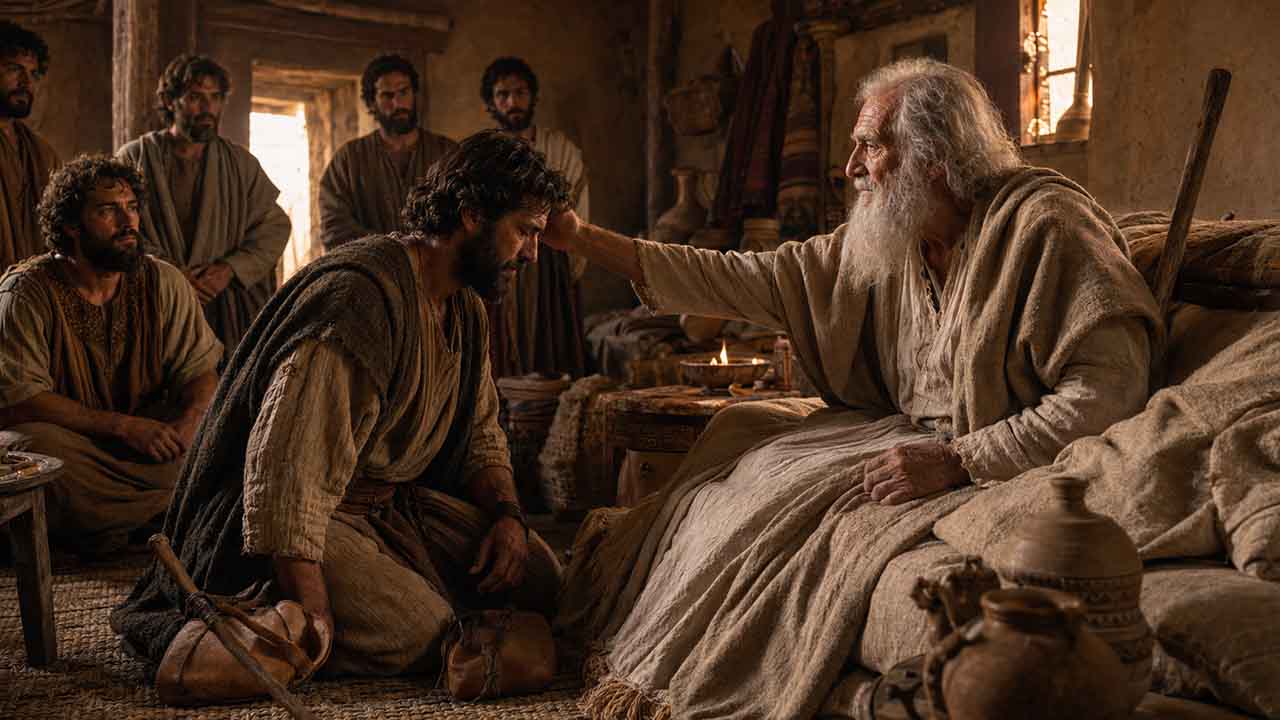
The Son Who Would Not Be Overcome
Gad bows beneath Jacob’s final blessing, receiving a hard word of attack, endurance, and reversal. Though raiders would press against him, his future would not end in defeat, for the Lord would make him strike back at their heels.
Listen to this Bible Exhibit
Good Fortune, Battle Tested
Gad stands among Jacob’s sons with a quiet but durable place in Scripture. No words of his are recorded. No long personal scene is given to him. Yet his name, family, and blessing carry a strong witness. He was Jacob’s seventh son, the first son born to Zilpah, and the ancestor of a tribe known for conflict and courage. Gad’s descendants would later settle east of the Jordan River, in rich pastureland that also left them exposed to enemy raids and border wars. Gad’s story begins in rivalry, but it does not end in disorder. It shows the Lord preserving His covenant promise through a wounded family and teaching His people that blessing does not always mean ease.
Born in a Divided House
Gad was born during the painful rivalry between Leah and Rachel. Leah had already borne sons to Jacob, but when she saw that she had stopped bearing children, she gave her servant Zilpah to Jacob. Zilpah bore a son, and Leah named him Gad [Genesis 30:9-11].
Jacob’s household was not a picture of peace. It was marked by favoritism, jealousy, longing, and competition. Yet Genesis does not hide this brokenness. The family through whom God would build Israel was a real family, full of real sin and sorrow.
That makes Gad’s birth important. He was not born into an ideal home, but he was not outside the Lord’s purpose. God’s covenant promise did not depend on human neatness. The Lord was still forming Israel, even through a household that needed mercy at every turn.
A Name of Good Fortune
Leah named the child Gad because his birth felt like a good fortune, a sign of blessing in a house where every son seemed to carry emotional weight. The name is connected with fortune or blessing, but Scripture soon deepens the meaning. Gad’s life would not be defined by comfort, ease, or lucky circumstances.
This is one of the quiet tensions in his story. A son named for good fortune would become the father of a tribe known for pressure and battle. His name sounds bright, but Jacob’s blessing speaks of raiders. The Bible teaches us not to confuse blessing with a trouble-free life. Sometimes the Lord’s favor is seen not in the absence of conflict, but in His power to preserve His people through it.
Counted Among the Sons of Israel
Though Gad was born through Zilpah, he was fully counted among Jacob’s sons. Scripture names him in the formal lists of Israel’s fathers, alongside the sons of Leah, Rachel, Bilhah, and Zilpah [Genesis 35:22-26] [Exodus 1:1-4] [1 Chronicles 2:1-2].
That matters. Gad was not a lesser son because of his mother’s status. He belonged to the covenant family and would become the father of one of Israel’s tribes. Scripture gives him a place, a name, and a future.
Gad reminds us that God’s people were never built on human pride. Israel came from a complicated family, yet every son whom God appointed had a place in the story. The Lord remembers those who seem quiet in the text, and He preserves His promise through them.
A Father of Seven Sons
When Jacob’s household went down into Egypt, Gad went with them. Genesis records seven sons belonging to Gad: Zephon, Haggi, Shuni, Ezbon, Eri, Arodi, and Areli [Genesis 46:16]. Later, Numbers remembers these lines as clans within the tribe of Gad [Numbers 26:15-18].
This brief genealogy tells us that Gad’s line was already growing before Israel became a nation. The son named in Leah’s hope became the father of a household. That household would later become a tribe.
God often works this way in Genesis. A name becomes a family. A family becomes a people. A people becomes the stage on which God reveals His covenant faithfulness. Gad’s story may be short, but his place in the line of promise is secure.
The Blessing of Raiders and Resistance
The clearest word over Gad comes from Jacob’s final blessing: “Raiders shall raid Gad, but he shall raid at their heels” [Genesis 49:19].
The verse is brief but powerful. In Hebrew, it uses a striking wordplay on Gad’s name, turning the sound of his name into the sound of attack and counterattack. Gad’s future would be marked by conflict. He would be raided, pressed, and threatened. But he would not simply collapse. He would strike back.
This blessing looks beyond Gad the man to the tribe that would bear his name. It does not tell us that Gad himself lived a dramatic military life. Scripture gives no such story. Instead, Jacob’s words cast the shape of Gad’s future: pressure, struggle, and endurance.
The blessing is honest about life in the covenant. God’s people are not promised a path without enemies. But neither are they left without help. Gad’s blessing teaches that the Lord can preserve His people in contested places.
As for Gad, raiders shall raid him, but he will attack them at their heels.
Genesis 49:19
The Tribe on the Frontier
Gad’s descendants later became known for livestock, strength, and life east of the Jordan. Along with Reuben and the half-tribe of Manasseh, they asked Moses for land in Gilead because it was good for their herds [Numbers 32:1-27]. Moses warned them not to abandon their brothers in the conquest. They answered that their fighting men would cross the Jordan and help Israel take the land before returning to their own inheritance.
They kept that vow. Joshua later released them with a blessing because they had obeyed Moses’ command and had not forsaken their brothers [Joshua 22:1-6]. This is one of Gad’s brightest tribal moments. They chose land on the far side of the Jordan, but they did not separate themselves from the people of God.
When the eastern tribes built a large altar by the Jordan, the rest of Israel feared rebellion. But Gad, Reuben, and the half-tribe of Manasseh explained that the altar was not for false worship. It was a witness that they too belonged to the Lord and had a share in His people [Joshua 22:10-34].
Gad’s frontier life, therefore, carries both danger and beauty. Living at the edge could expose the tribe to attack, distance, and misunderstanding. Yet their altar of witness declared, “The LORD is God.” They wanted future generations to know that the Jordan must not become a spiritual wall between brothers.
Strength, Failure, and Hope
Moses later blessed Gad with the image of a lion and praised the tribe for carrying out the Lord’s justice with Israel [Deuteronomy 33:20-21]. That image fits much of Gad’s later story. Some Gadites became mighty warriors who joined David in the wilderness, men described as fierce, swift, and ready for battle [1 Chronicles 12:8-15].
But Gad’s history was not only a strength. The tribes east of the Jordan were vulnerable to invasion and spiritual decline. 1 Chronicles says the Transjordan tribes broke faith with the God of their fathers and were carried into exile [1 Chronicles 5:25-26]. Jeremiah later speaks of Ammon occupying Gad’s cities [Jeremiah 49:1].
Yet Gad is not erased from hope. Ezekiel includes Gad in his vision of restored tribal portions and in the gates of the renewed city [Ezekiel 48:27-34]. Revelation also names Gad among the sealed tribes of Israel [Revelation 7:5]. The biblical story holds together warning and mercy. Gad’s descendants knew battle, failure, exile, and promise. The Lord disciplines His people, but He does not forget His covenant.
Why Gad Matters
Gad matters because his story teaches us how to read quiet lives in Scripture. He was born in rivalry, named with hope, counted among the sons, and blessed for a future of conflict that would not end in defeat.
His life reminds us that God works through complicated families. He gives real places to overlooked people. He can make a son named “good fortune” into a witness that blessing is deeper than comfort. And He can keep His people when they live on the frontier, where faith must be guarded, and promises must be kept.
In the full light of Scripture, Gad points us beyond tribal endurance to the greater faithfulness of God. Israel needed more than strong sons and brave tribes. Israel needed the Lord to keep His promise and bring salvation. That promise comes to its fullness in Jesus Christ, the true Son of Israel, who entered our conflict, overcame our enemies, and gathers God’s people into an inheritance that cannot be lost.