


The Tribe of Levi
The Lord Was Their Inheritance
Carousel of images for this Bible Exhibit
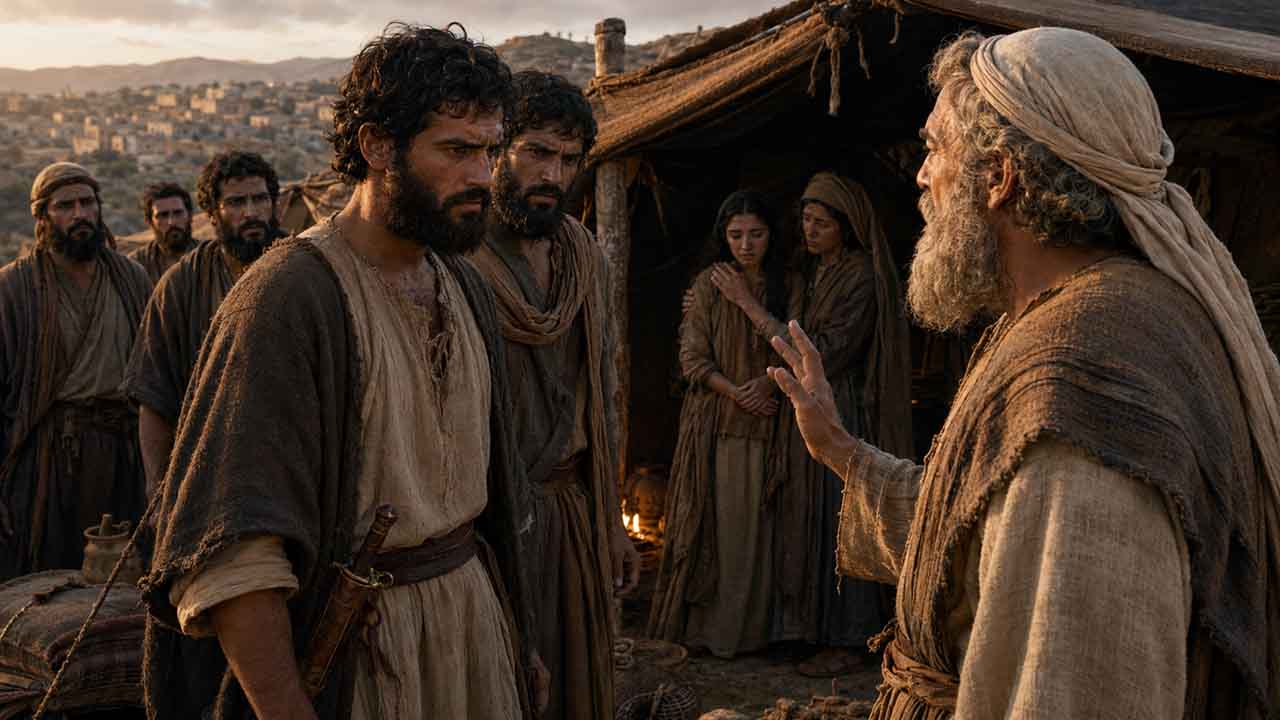
Zeal Without Wisdom
Levi stands before Jacob in the heavy silence after vengeance, fierce and unyielding, while his father confronts the danger his anger has brought upon the family. Behind them, Dinah’s sorrow lingers in the shadows, reminding every son of Israel that loyalty without righteousness can become a wound of its own.
Listen to this Bible Exhibit
Levi Before the Holy Place
Levi stands around the tabernacle, not as a tribe of broad fields and fixed borders, but as a people set near the holiness of God. Scattered among Israel, entrusted with worship, warned by judgment, and fulfilled in Christ, Levi teaches that nearness to holy things is both a gift and a summons. The Lord Himself was their inheritance, and their service pointed beyond the altar to the perfect Priest who would offer Himself once for all.
A Son Named Levi
The tribe takes its name from Levi, the third son of Jacob and Leah. When Levi was born, Leah said that now her husband would be “joined” to her, and she called his name Levi [Genesis 29:34]. His name is tied to joining, attachment, and nearness, a theme that would later echo in the tribe’s service around Aaron and the sanctuary [Numbers 18:2-4].
Yet Levi’s personal story begins in darkness. When Shechem violated Dinah, Levi and Simeon answered with deception and slaughter [Genesis 34:25-31]. Jacob rebuked them, and on his deathbed, he cursed their anger and foretold that they would be divided and scattered in Israel [Genesis 49:5-7].
That word of scattering did come true, but in Levi’s case, God turned judgment into mercy. Levi would not receive a single tribal territory, such as Judah, Ephraim, or Gad. Instead, the tribe would be spread through Israel for holy service. The discipline of worship would answer the sword of anger. The scattered tribe would become a living reminder that grace can transform even a hard family history into service before the Lord.
Moses, Aaron, and the House of Levi
Levi’s sons were Gershon, Kohath, and Merari [Genesis 46:11]. These three lines became the major Levitical clans. Exodus later traces the line from Levi through Kohath and Amram to Moses and Aaron, and Miriam also belonged to that Levite household [Exodus 6:16-20] [Numbers 26:59].
This matters because Levi’s story is woven into the exodus itself. Moses, born to Levite parents during Pharaoh’s oppression, was preserved by God and raised to lead Israel out of Egypt [Exodus 2:1-10]. Aaron, also from Levi, became the first high priest [Exodus 28:1]. Miriam, their sister, led Israel in praise to the Lord after the Lord overthrew Pharaoh’s army [Exodus 15:20-21].
Still, Scripture is careful. The Tribe of Levi and the priests are related, but they are not identical. Priests came from Aaron’s line within Levi. Aaron and his sons were set apart for altar ministry, sacrifices, holy garments, and priestly mediation [Exodus 28:1-43]. The other Levites served around that priesthood. They guarded, carried, assisted, sang, taught, and helped preserve the order of worship.
This distinction is essential. Not every Levite was a priest. All priests were Levites, but not all Levites were priests. The Lord assigned different kinds of holy service, and none could be seized by ambition.
Consecrated at Sinai
Levi’s special calling became clear after Israel’s sin with the golden calf. When the camp fell into idolatry, Moses stood at the gate and called for everyone who was for the Lord to come to him. The sons of Levi gathered to Moses [Exodus 32:25-29].
This scene must be handled with reverence. It is not a celebration of violence for its own sake. It shows the dreadful seriousness of covenant rebellion. The Lord had just redeemed Israel, yet the people bowed before an idol and called it worship. Levi’s zeal stood against that apostasy, and the Levites were set apart for the Lord’s service through a costly act of covenant loyalty.
Afterward, the Lord took the Levites in place of Israel’s firstborn sons [Numbers 3:11-13]. The firstborn belonged to God because He had spared Israel’s firstborn in Egypt. Now Levi would stand before Him in representative service. The Levites were cleansed, presented, and given to assist the priests in the work of the tent of meeting [Numbers 8:5-22].
Levi’s calling, then, was not self-appointed. God gave it. Holy service is never a platform for ambition. It is a stewardship received with fear, gratitude, and obedience.
Guardians of the Tabernacle
Unlike the other tribes, Levi was not counted in the ordinary military census. The Levites were assigned to the tabernacle, and they camped around it so that no unauthorized person would come near and bring wrath upon Israel [Numbers 1:47-54].
Their duties were carefully ordered. The Gershonites cared for curtains, coverings, screens, and hangings. The Kohathites carried the most holy furnishings, but only after the priests had covered them. The Merarites handled the frames, bars, pillars, bases, and structural parts of the tabernacle [Numbers 3:21-37] [Numbers 4:1-49].
These details may seem technical, but they teach theology. The Lord was present among His people, and His nearness was not casual. Even the curtains and poles of His dwelling were handled under command. Levi’s work taught Israel that worship is not invented by human preference. It is received from God.
Holiness, Order, and Warning
The honor of Levitical and priestly service came with severe warnings. Nadab and Abihu, sons of Aaron, offered unauthorized fire before the Lord and died before Him [Leviticus 10:1-3]. Their judgment taught Israel that holy office does not excuse disobedience. Those who draw near must regard the Lord as holy.
Korah, a Levite from the line of Kohath, gives another warning. He and others challenged Aaron’s priestly office, claiming a holiness that defied God’s appointed order [Numbers 16:1-11]. The result was judgment. The issue was not whether Korah belonged to Levi. He did. The issue was whether he would accept the place God assigned.
Yet Levi’s story also includes zeal rightly ordered. Phinehas, Aaron’s grandson, acted during Israel’s rebellion at Peor, and the Lord gave him a covenant of peace and a lasting priesthood [Numbers 25:10-13]. Levi’s history, therefore, holds both warning and honor. Nearness to holy things can become deadly when handled proudly, but it is beautiful when joined to reverent obedience.
No Land Like the Other Tribes
Levi received no ordinary tribal inheritance. The Lord Himself was their inheritance, and the tithes of Israel supported their sanctuary service [Numbers 18:20-32]. Deuteronomy repeats that Levi had no tribal portion because the Lord was his inheritance [Deuteronomy 10:8-9].
This did not mean Levi was homeless. The tribe received forty-eight cities with pasturelands, scattered throughout Israel [Numbers 35:1-34]. Joshua records their distribution throughout the land [Joshua 21:1-42]. Six of the Levitical cities were cities of refuge, places where one who killed unintentionally could flee for protection until judgment was made.
Here, Jacob’s word is transformed. Levi was scattered, but by grace that scattering became ministry. Their cities placed teachers, worship servants, and guardians of covenant life throughout the land. Levi’s inheritance was not measured by borders, but by nearness to God and service among His people.
Teachers, Singers, Gatekeepers, and Reformers
Moses’ blessing over Levi gathers the tribe’s calling into a few powerful words. Levi was entrusted with the Lord’s judgments, His law, incense, and whole burnt offerings [Deuteronomy 33:8-11]. The tribe’s work was not only ritual. It included teaching.
That teaching role appears throughout Israel’s history. In David’s time, Levites were organized for temple service, including assisting the priests, caring for the sanctuary, offering praise, and performing appointed duties in worship [1 Chronicles 23:1-32]. Other Levitical families were assigned as gatekeepers, guarding the temple’s ordered space [1 Chronicles 26:1-19]. Their songs helped lead Israel’s praise. Their gates guarded holy space. Their service gave visible order to worship.
In the divided kingdom, many priests and Levites left the north when Jeroboam made his own priests and established rival worship [2 Chronicles 11:13-17]. In times of reform, faithful Levites were crucial. Jehoshaphat sent Levites and priests to teach the Book of the Law in Judah [2 Chronicles 17:7-9]. Hezekiah’s cleansing of the temple depended on Levites who consecrated themselves and helped restore worship [2 Chronicles 29:12-19]. In Josiah’s day, Levites helped lead the Passover with care and order [2 Chronicles 35:1-19].
After exile, Levites returned, served, and helped the people understand the Law as Ezra read it publicly [Ezra 2:40-42] [Nehemiah 8:7-12]. This is one of Levi’s finest moments. The word was not merely heard. It was explained so the people could understand.
At that time the Lord set apart the tribe of Levi to carry the ark of the Lord’s covenant, to stand before the Lord to serve him and to pronounce blessings in his name, as they still do today. Therefore Levi has no portion or inheritance among his brothers; the Lord is his inheritance, just as the Lord your God told him.
Deuteronomy 10:8–9
Corruption and Covenant Rebuke
Levi’s calling did not make the tribe immune to sin. The prophets rebuked priests who polluted worship and failed to teach faithfully. Malachi looks back to the covenant with Levi as a covenant of life and peace, then condemns priests who turned aside from the way and caused many to stumble [Malachi 2:4-9].
This is one of the great warnings of Levi. Sacred office can become corrupt when the heart drifts from the Lord. A man can handle holy things and still lose the fear of God. A teacher of the Law can become a stumbling block. A guardian of worship can become careless with the glory of the One he serves.
Levi’s story calls every generation to holy fear. Ministry is never protected by title alone. The Lord desires truth in the mouth, reverence in the heart, and faithful instruction that turns many from iniquity.
Fulfilled in Jesus Christ
When the New Testament opens, Levi’s line is still present. Zechariah is a priest from the division of Abijah, and Elizabeth is from the daughters of Aaron [Luke 1:5]. Their son John prepares the way for the Lord, standing at the edge of the old covenant as the Messiah comes.
Barnabas, a Levite from Cyprus, also appears in the early church as a generous servant who sells a field and lays the proceeds at the apostles’ feet [Acts 4:36-37]. Levi’s name is still present, but the center has shifted.
Hebrews teaches why. The Levitical priesthood was real, God-given, and holy in its purpose, but it was not final. If perfection had come through the Levitical priesthood, another priest would not have been needed. Jesus came from Judah, not Levi, and He is priest forever according to the order of Melchizedek [Hebrews 7:11-17].
The old priests stood daily, offering sacrifices that could never finally take away sins. Christ offered Himself once for all and sat down at the right hand of God [Hebrews 10:11-14]. Levi guarded the sanctuary. Jesus is the true and better Priest who brings His people into the presence of God. Levi offered repeated sacrifices. Jesus offered the finished sacrifice. Levi taught holiness. Jesus makes His people holy by His blood.
This does not make Levi meaningless. It makes Levi fulfilled. The tribe’s ministry was a shadow cast by a greater glory. In Christ, the altar, priesthood, sacrifice, cleansing, teaching, and access to God all reach their appointed goal.
Remembered in Hope
Levi is not erased from the Bible’s future-facing visions. Ezekiel’s restored city has a gate bearing Levi’s name [Ezekiel 48:31]. Revelation names Levi among the sealed tribes of Israel [Revelation 7:7]. The tribe that had no ordinary land inheritance is still remembered before God.
That remembrance is fitting. Levi’s story began with a son named for joining. It passed through anger, scattering, service, holiness, warning, teaching, worship, corruption, reform, and fulfillment. Through it all, the Lord remained the true inheritance of His servants.
Why Levi Matters
Levi teaches that nearness to holy things is never casual. Worship must be received from God, not reinvented by man. Ministry must be carried with humility, not seized by ambition. Teaching must turn people toward the Lord, not away from Him.
Levi also teaches that God can transform judgment into mercy. Jacob said Levi would be scattered, and the Lord made that scattering a means of service throughout Israel. Grace did not erase the warning, but it turned the tribe’s future toward worship, refuge, and instruction.
Most of all, Levi points us to Christ. Every priest, sacrifice, song, gate, altar, and holy duty was waiting for Him. The Lord was Levi’s inheritance, and through Jesus Christ, God gives Himself to His people forever.