


The Tribe of Naphtali

The Tribe of Naphtali
The Tribe That Saw Great Light
Carousel of images for this Bible Exhibit
Released Into Grace
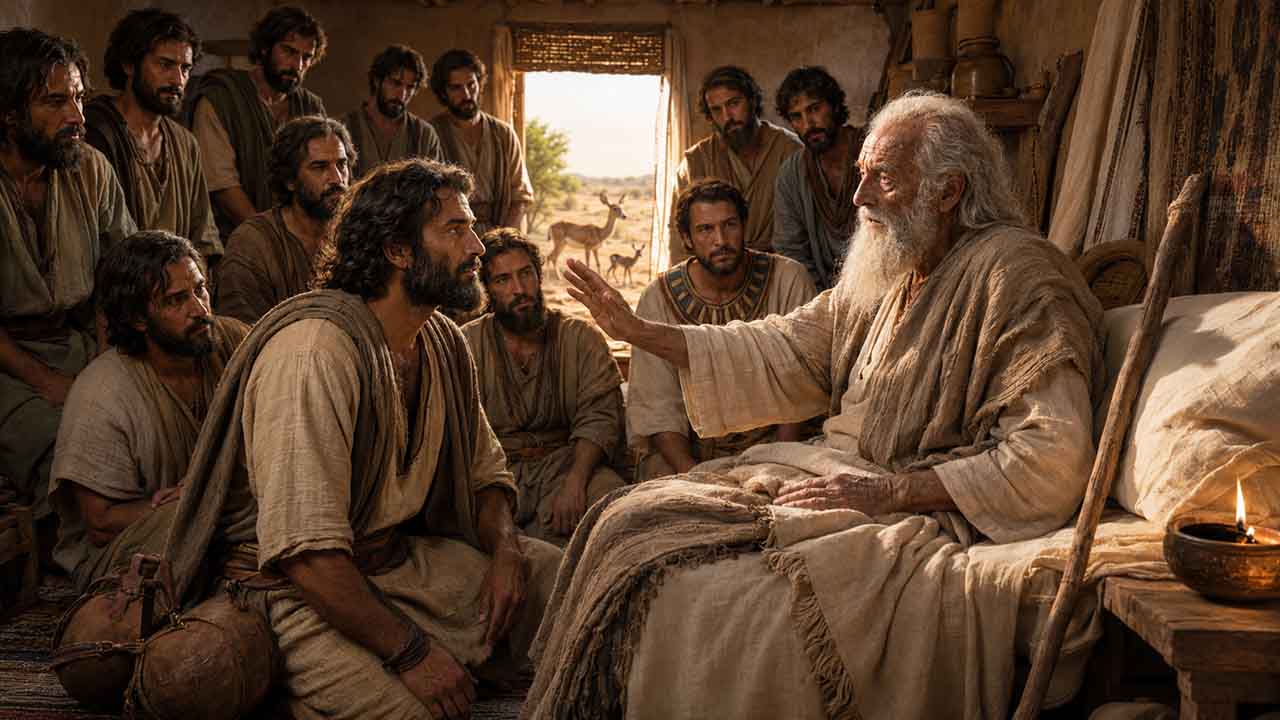
Naphtali kneels before Jacob as a word of freedom and beauty is spoken over him. Beyond the doorway, the open land and gentle doe echo a future marked by grace, fruitfulness, and life beyond the struggle.
Listen to this Bible Exhibit
Naphtali in the Hills of Galilee
Naphtali stands in the northern hills of Israel, where fertile slopes descend toward the Sea of Galilee and the roads of the nations pass through the land. Blessed with favor, tested by compromise, courageous in battle, and humbled by invasion, Naphtali becomes a witness that no place darkened by judgment is beyond the mercy of God. In the land once brought low, the light of Christ would dawn.
A Son Named Wrestling
The tribe takes its name from Naphtali, Jacob’s sixth son and the second son born to Bilhah, Rachel’s servant. His birth came from the painful rivalry between Rachel and Leah, and Rachel named him Naphtali after her struggle with her sister and her sense that she had prevailed [Genesis 30:1-8].
Naphtali’s name came from household rivalry, but his tribe was not treated as lesser within Israel. He went down to Egypt with Jacob’s family, and Scripture names his four sons: Jahzeel, Guni, Jezer, and Shillem [Genesis 46:24]. Chronicles also preserves Naphtali’s family line among Israel’s genealogies [1 Chronicles 7:13].
Scripture gives few personal details about Naphtali the man. Like many of Jacob’s sons, his individual story quickly becomes the story of the people who descended from him. The tribe bearing his name would live in a beautiful and vulnerable region, where blessing and danger often stood close together.
A Doe Set Free
Jacob’s blessing over Naphtali is brief and poetic. He pictures Naphtali as a doe set free, associated with beauty, grace, and fruitful speech [Genesis 49:21]. The wording is difficult, but the image suggests freedom, vitality, and blessing.
Moses later blessed Naphtali as a tribe filled with favor and the Lord’s blessing, called to possess the lake and the south [Deuteronomy 33:23]. This blessing fits the tribe’s later inheritance near Galilee. Naphtali would receive a land of hills, water, fertile spaces, and strategic roads.
Yet blessing in Scripture is never bare comfort. A graceful doe still needs protection. A favored land still requires obedience. Naphtali’s story shows that God’s gifts are real, but they are also tests of faithfulness.
Counted Around the Tabernacle
In the wilderness, Naphtali was counted and ordered among the people of God. At the first census, the tribe numbered 53,400 fighting men [Numbers 1:42-43]. At the second census, near the end of the wilderness years, Naphtali numbered 45,400 [Numbers 26:48-50].
Naphtali camped on the north side of the tabernacle under the standard of Dan, together with Dan and Asher [Numbers 2:25-31]. When Israel marched, that camp moved as the rear guard [Numbers 10:25-28]. Naphtali also had named leaders in Israel’s common life. Ahira, son of Enan, led the tribe in the wilderness and brought Naphtali’s offering at the dedication of the altar [Numbers 1:15] [Numbers 7:78-83]. Nahbi, son of Vophsi, represented Naphtali among the spies, and Pedahel, son of Ammihud, helped oversee the division of the land [Numbers 13:14] [Numbers 34:28].
Naphtali also stood among the tribes appointed on Mount Ebal when Israel heard the covenant curses [Deuteronomy 27:13]. This was not a minor detail. Before Naphtali had towns, roads, and fields, it stood with all Israel under the word of the Lord.
A Northern Inheritance
Naphtali received territory in the far north of Canaan [Joshua 19:32-39]. Its land lay in Upper Galilee, with Asher to the west, Zebulun and Issachar toward the south, and the Jordan and Sea of Galilee to the east. The allotment included fortified cities such as Hazor, Ramah, Kedesh, Edrei, and Beth-anath.
The inheritance was beautiful and strategic. It included fertile places, wooded hills, springs, and approaches from the north. But the very roads that brought trade could also bring armies. Naphtali lived on a frontier. Its blessing was exposed.
Kedesh in Galilee, in Naphtali’s hill country, became a city of refuge and a Levitical city [Joshua 20:7] [Joshua 21:32]. That means Naphtali’s territory was not merely agricultural or military. It was also woven into Israel’s structures of mercy, justice, worship, and instruction.
Compromise in a Good Land
The book of Judges records a serious failure. Naphtali did not drive out the inhabitants of Beth-shemesh or Beth-anath. Instead, the tribe lived among the Canaanites, and those inhabitants became forced labor [Judges 1:33].
This was more than an incomplete campaign. It was a covenant compromise. Israel had been called to obey the Lord fully in the land. To leave entrenched Canaanite worship and culture in place was to allow spiritual danger to remain close to home.
Naphtali’s failure belongs to the larger pattern of Judges. The tribes received good land, but they often accepted partial obedience. That kind of compromise can look practical in the moment, but it weakens the soul of God’s people.
A blessed place does not protect an unfaithful heart. Naphtali’s beauty could not substitute for obedience.
Courage With Deborah and Barak
Naphtali’s story is not defined by compromise alone. In the days of Deborah, Barak, son of Abinoam, came from Kedesh in Naphtali. Deborah summoned him to gather men from Naphtali and Zebulun and confront Sisera’s army [Judges 4:6-10].
Barak hesitated and insisted that Deborah go with him. Scripture is honest about that weakness. Yet the larger story still remembers Naphtali with honor. Deborah’s song says that Zebulun and Naphtali risked their lives on the heights of the field [Judges 5:18].
This is biblical realism. Naphtali could be compromised and courageous. Barak could hesitate and still be used by God. The tribe that failed to drive out the Canaanites also stood in battle when the Lord delivered His people.
Later, Naphtali answered Gideon’s call against Midian, joining Asher, Zebulun, and Manasseh in pursuit of Israel’s enemies [Judges 6:35] [Judges 7:23]. The northern tribe was not forgotten in the struggle for Israel’s freedom.
Support for David and Service in the Kingdom
Naphtali later supported David when Israel gathered at Hebron. The tribe sent 1,000 commanders and 37,000 men, each with a shield and spear [1 Chronicles 12:34-40]. Along with nearby northern tribes, Naphtali also helped provide food for the feast. Though far from Judah, Naphtali took its place in the united kingdom under the Lord’s chosen king.
During David’s administration, Jeremoth, son of Azriel, was appointed over Naphtali [1 Chronicles 27:19]. Under Solomon, Ahimaaz served as an officer in Naphtali and married Basemath, Solomon’s daughter [1 Kings 4:15].
Scripture also connects Solomon’s temple work with the north. Hiram, the skilled bronze craftsman, is described in the book of Kings as the son of a widow from Naphtali [1 Kings 7:13-14]. Chronicles identifies his mother as a Danite, so the details should be handled carefully [2 Chronicles 2:13-14]. Israel’s worship life drew service from many places, including the northern tribes.
Psalm 68 also names Naphtali among the tribes in a worshiping procession [Psalm 68:27]. Naphtali stood far north on the map, but not outside the praise of Israel.
Nevertheless, there will be no more gloom for those who were in distress. In earlier times he humbled the land of Zebulun and the land of Naphtali, but in the latter time he will honor Galilee of the nations, by the way of the sea, beyond the Jordan. The people walking in darkness have seen a great light; those who live in a land of deep darkness, on them the light has shone.
Isaiah 9:1–2
The Cost of the Frontier
Naphtali’s northern location brought danger. During the divided monarchy, Ben-hadad of Aram attacked northern Israel, striking Ijon, Dan, Abel-beth-maacah, Chinneroth, and all the land of Naphtali [1 Kings 15:20].
A darker blow came later. In the days of Pekah, king of Israel, Tiglath-pileser, king of Assyria, captured Ijon, Abel-beth-maacah, Janoah, Kedesh, Hazor, Gilead, Galilee, and all the land of Naphtali. He carried the people captive to Assyria [2 Kings 15:29].
The land blessed with favor became a land of humiliation. The frontier felt the enemy’s pressure first. Naphtali’s story warns us that privilege does not cancel accountability. Israel’s northern beauty could not save it from judgment when the nation turned from the Lord.
Galilee and the Light of Christ
The prophets did not leave Naphtali in darkness. Isaiah spoke of the land of Zebulun and the land of Naphtali, the way of the sea, beyond the Jordan, Galilee of the nations. The land once brought into contempt would see a great light [Isaiah 9:1-2].
Matthew declares that this hope was fulfilled when Jesus withdrew to Galilee and lived in Capernaum by the sea, in the territory of Zebulun and Naphtali [Matthew 4:12-17]. This is one of the great reversals in Scripture.
The region first humbled by invasion became one of the first great theaters of the Messiah’s public ministry. The land of shadow heard the preaching of the kingdom. The place associated with loss, mixed populations, and northern contempt became the place where Christ’s light shone.
Naphtali’s story does not end with exile. It bends toward Jesus.
Remembered in Hope
Naphtali is not erased from the Lord’s purposes. Ezekiel’s vision of restored tribal portions gives Naphtali a place in the renewed land, near the northern tribes [Ezekiel 48:3-4]. One of the gates of the restored city also bears Naphtali’s name [Ezekiel 48:34].
In Revelation, Naphtali appears among the sealed tribes of Israel [Revelation 7:6]. Scripture does not invite us to treat these final tribal lists as curiosities only. They remind us that the Lord remembers the names of His people.
Naphtali was distant, exposed, compromised, courageous, humbled, and honored. Through all of it, God did not forget.
Why Naphtali Matters
Naphtali teaches that beautiful places can still become battlegrounds. The tribe received a favored inheritance, but frontier beauty brought pressure, and covenant compromise brought danger.
Naphtali also teaches that failure is not the only word over God’s people. The tribe did not fully obey in the land, yet it later risked its life under Deborah and Barak, answered Gideon’s call, supported David, and remained named in Israel’s hope.
Most of all, Naphtali points us to Christ. The land humbled by invasion became the land illumined by the Messiah. Jesus did not begin His ministry only in places of prestige. He brought the kingdom near to Galilee, to the land of old sorrow, to the people sitting in darkness.
Naphtali’s story calls us to receive God’s favor with obedience, resist the quiet danger of compromise, and hope in the Savior whose light reaches the places history has wounded.