


Judah, Son of Jacob
Praise, Shame, and the Lion
Carousel of images for this Bible Exhibit
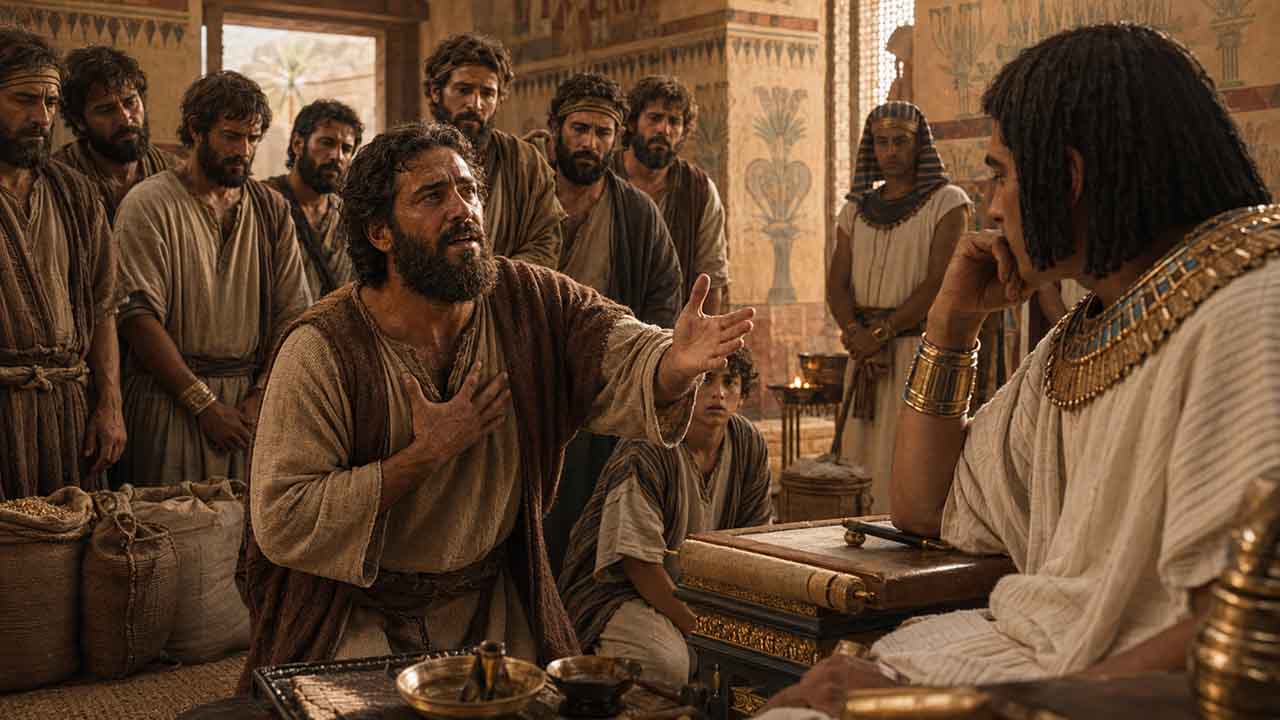
The Brother Who Stood in the Breach
Judah pleads before Joseph with his hand over his heart, offering himself in Benjamin’s place so his father will not be crushed by grief. In this moment, the brother who once failed Joseph becomes an intercessor, marked by repentance, courage, and costly love.
Listen to this Bible Exhibit
Praise, Shame, and the Lion
Judah is one of the most searching and surprising sons of Jacob. He was born from Leah’s praise, but his life would pass through shame, guilt, confession, and costly responsibility. He helped sell Joseph, failed Tamar, and brought sorrow into his father’s house. Yet the Bible also shows him changed. The man who once treated a brother as expendable later offered himself in another brother’s place. Judah is not presented as a clean hero. He is a sinner humbled by truth and carried by grace. Through him, God preserved the royal line that would lead to David and, at last, to Jesus Christ, the Lion of the tribe of Judah.
Born from Leah’s Praise
Judah was Jacob’s fourth son and Leah’s fourth son. His birth came after Leah had already borne Reuben, Simeon, and Levi. Those earlier names were marked by Leah’s sorrow in a divided marriage. She longed to be seen, loved, and received. But when Judah was born, Leah’s words turned upward: “This time I will praise the LORD” [Genesis 29:31-35].
His name is tied to praise. That beginning matters. Judah entered a house filled with rivalry, favoritism, and pain, yet his name testified that the Lord was still worthy of worship. Leah’s life was wounded, but not godless. In the birth of Judah, she recognized the Lord’s hand.
Still, a name of praise did not make Judah mature. He would need to be exposed, humbled, and changed. Scripture is honest about that. The Lord does not build His redemptive plan through flawless families or polished people. He works through real sinners, and He does not lose His purpose in their weakness.
A Brother Who Chose Compromise
Judah first steps forward as a leading voice in Joseph’s story. Jacob loved Joseph openly, and Joseph’s brothers hated him. When they found him away from home, some wanted him dead. Reuben tried to delay the murder, hoping to rescue him later. But while Reuben was absent, Judah spoke.
He asked what profit there would be in killing Joseph and proposed selling him instead [Genesis 37:26-27]. This spared Joseph’s life, but it was not righteousness. Judah recognized that Joseph was their brother, their own flesh, yet still handed him over for gain. He avoided bloodshed while committing betrayal.
That is the moral complexity of Judah. He was not the most violent brother in the scene, but he was not innocent. His compromise sent Joseph into slavery, deceived Jacob, and buried the family under years of hidden guilt. Judah shows us that sin often disguises itself as the “better option” when the heart refuses true obedience.
Exposed by Tamar
Genesis then turns to one of the darkest chapters in Judah’s life. After Joseph was sold, Judah left his brothers, settled near Adullam, married a Canaanite woman, and fathered three sons: Er, Onan, and Shelah [Genesis 38:1-30].
Judah gave Tamar to Er as a wife, but Er was wicked and died under the judgment of the Lord. Onan then refused his duty to preserve his brother’s line and also died under judgment. Judah promised Tamar that Shelah would be given to her later, but he delayed and withheld what was right.
Tamar was left vulnerable, childless, and dishonored. Judah protected himself, but he did not protect her. When Tamar later disguised herself and Judah slept with her, Judah unknowingly became the father of her children. When he heard she was pregnant, he demanded judgment. But Tamar produced the tokens Judah had given her, and the truth came into the light.
Judah’s response matters: “She is more righteous than I.” He did not keep hiding. He did not shift blame. He was exposed, and he confessed.
This confession does not erase his sin. Tamar’s story is painful because Judah’s failure was real. Yet the chapter also displays the strange mercy of God. From this broken scene came Perez and Zerah. Through Perez, the family line continued. Judah’s shame was not the end of God’s promise.
Responsibility Awakened in the Famine
Years later, famine pressed Jacob’s family into crisis. Food was in Egypt, but Joseph—still unrecognized by his brothers—had commanded that Benjamin come with them if they returned. Jacob feared losing Benjamin as he had lost Joseph.
At this point, Judah spoke in a new way. He urged Jacob to face the danger and pledged himself for Benjamin’s safety: “I will be a pledge of his safety. From my hand you shall require him” [Genesis 43:8-10].
This is one of the great turning points in Judah’s life. Earlier, he had helped give away one of his brothers for silver. Now he bound himself to another brother’s life. Earlier, he had deepened Jacob’s grief. Now he carried his father’s grief as part of his own burden.
The Bible does not tell us every inward step of Judah’s change. It does not describe how guilt worked in him over the years. But it shows the fruit. Judah began to accept responsibility. Grace was teaching him to stand where he had once failed.
Judah Before Joseph
The fullest evidence of Judah’s transformation comes when Benjamin is threatened in Egypt. Joseph’s test placed the brothers under terrible pressure. The silver cup was found in Benjamin’s sack, and Benjamin appeared doomed to remain as a slave.
Then Judah stepped forward and spoke to Joseph [Genesis 44:14-34]. His speech is one of the longest and most moving in Genesis. He retold the family’s grief, described Jacob’s attachment to Benjamin, and explained that another loss would crush his father. He did not excuse himself. He did not save himself first.
Then came the great reversal: Judah offered himself in Benjamin’s place.
The man who once sold Joseph into bondage now asked to become a slave so Benjamin could go free. The man who once valued profit over brotherhood now chose loss for his brother’s good. This does not mean Judah became sinless. It means real change has taken place.
Judah’s plea moved Joseph to reveal himself [Genesis 45:1-3]. Reconciliation came through Joseph’s mercy, but Judah’s self-giving intercession stands at the doorway. In Judah, Scripture shows what repentance looks like when it has grown into responsibility.
Sent Ahead to Goshen
When Jacob’s household finally moved to Egypt, Judah again appeared in a leadership role. Jacob sent Judah ahead to Joseph to show the way before him to Goshen [Genesis 46:28]. It is a quiet detail, but a meaningful one.
Judah had once helped send Joseph away from the family. Now Judah helped lead the family toward Joseph. The old wound was not forgotten, but grace had begun to reorder the story. The brother once marked by betrayal now served the preservation of the household.
Jacob’s Lion and Scepter Blessing
Near the end of his life, Jacob blessed his sons. Reuben, Simeon, and Levi were all passed over for leadership because of their failures. Then Jacob turned to Judah and spoke words of praise, victory, kingship, and abundance [Genesis 49:8-12].
Judah’s brothers would praise him. His hand would be on the neck of his enemies. He would be like a lion—strong, royal, and not easily roused. Most importantly, Jacob said the scepter would not depart from Judah, nor the ruler’s staff from between his feet, until the one to whom it belongs would come, and to him would be the obedience of the peoples.
This blessing is not a reward for Judah’s moral perfection. Judah’s record will not allow that. It is a word of grace and destiny. God chose the line of Judah for royal rule, not because Judah was clean, but because God is faithful.
The imagery of wine, milk, vine, and abundance points beyond survival. Judah’s line would carry promise, rule, blessing, and hope. The son named “Praise” would become the father of kings.
Judah is a lion’s cub; you return from the prey, my son. He crouches and lies down like a lion, and like a lioness; who dares to rouse him? The scepter shall not depart from Judah, nor the ruler’s staff from between his feet, until he to whom it belongs shall come, and the obedience of the nations shall be his.
Genesis 49:9–10
The Tribe That Bore His Name
After Genesis, Scripture speaks often of the tribe that came from Judah. Judah became the leading tribe in the wilderness camp, stationed on the east side of the tabernacle with Issachar and Zebulun, and marching first when Israel moved [Numbers 2:3-9] [Numbers 10:14]. Judah was also the largest tribe in the wilderness censuses [Numbers 1:26-27] [Numbers 26:19-22].
From Judah came Caleb, the faithful spy who trusted the Lord when most of Israel trembled [Numbers 13:6] [Joshua 14:6-14]. Judah received a large inheritance in the land, including the hill country, the Shephelah, the wilderness, and the Negeb [Joshua 15:1-63]. Othniel, the first judge named in Judges, came from Judah [Judges 3:7-11].
But the greatest tribal legacy was royal. David was from Judah. The kings of David’s line ruled from Jerusalem. Even after the kingdom was divided, Judah remained the southern kingdom tied to the house of David [2 Samuel 2:4] [1 Kings 12:20]. The line passed through judgment, exile, and waiting, but the promise did not die.
Judah and the Messiah
The New Testament opens by tracing Jesus Christ through Abraham, Isaac, Jacob, Judah, Perez, Boaz, David, and the kings [Matthew 1:1-17]. Luke also places Jesus in the line of Judah [Luke 3:33]. Hebrews reminds us that our Lord descended from Judah, a tribe not known for priestly service under the law, showing that Christ’s priesthood is of a greater order [Hebrews 7:14].
Then Revelation gathers Judah’s whole story into one blazing title. John weeps because no one is found worthy to open the scroll. Then he hears the announcement: “The Lion of the tribe of Judah, the Root of David, has conquered” [Revelation 5:5-6].
But when John looks, he sees a Lamb standing as slain. This is the wonder of the gospel. The Lion conquers as the Lamb. The promised King from Judah wins not by selfish power, but by sacrificial blood.
Judah once offered himself so Benjamin could go free. That moment was only a shadow. Jesus, the greater Son of Judah, truly gives Himself for the guilty. He does not merely offer to become a slave. He bears the cross, defeats sin and death, and brings His people into the kingdom of God.
Why Judah Matters
Judah matters because his story refuses shallow religion. The Bible does not hide its sin. He betrayed Joseph, failed Tamar, and showed the hypocrisy of a man quick to judge another while blind to himself. Yet Scripture also refuses despair. Judah was exposed, humbled, and changed. His guilt did not have the final word. Grace did.
He also matters because his life shows that leadership in God’s story is not built on birth order or natural worthiness. Judah was not the firstborn. He was not morally spotless. Yet God’s purpose came to rest on his line. The scepter belonged to Judah because the Lord chose to keep His promise through Judah.
Most of all, Judah matters because his story leads to Christ. Praise, shame, confession, substitution, kingship, lion, and lamb all meet in the gospel. Judah’s life teaches us to face sin truthfully, receive mercy humbly, and look beyond every flawed human leader to Jesus Christ, the true King who was wounded for His people and reigns forever.