


Judas Iscariot
The Disciple Who Chose the Night
Carousel of images for this Bible Exhibit
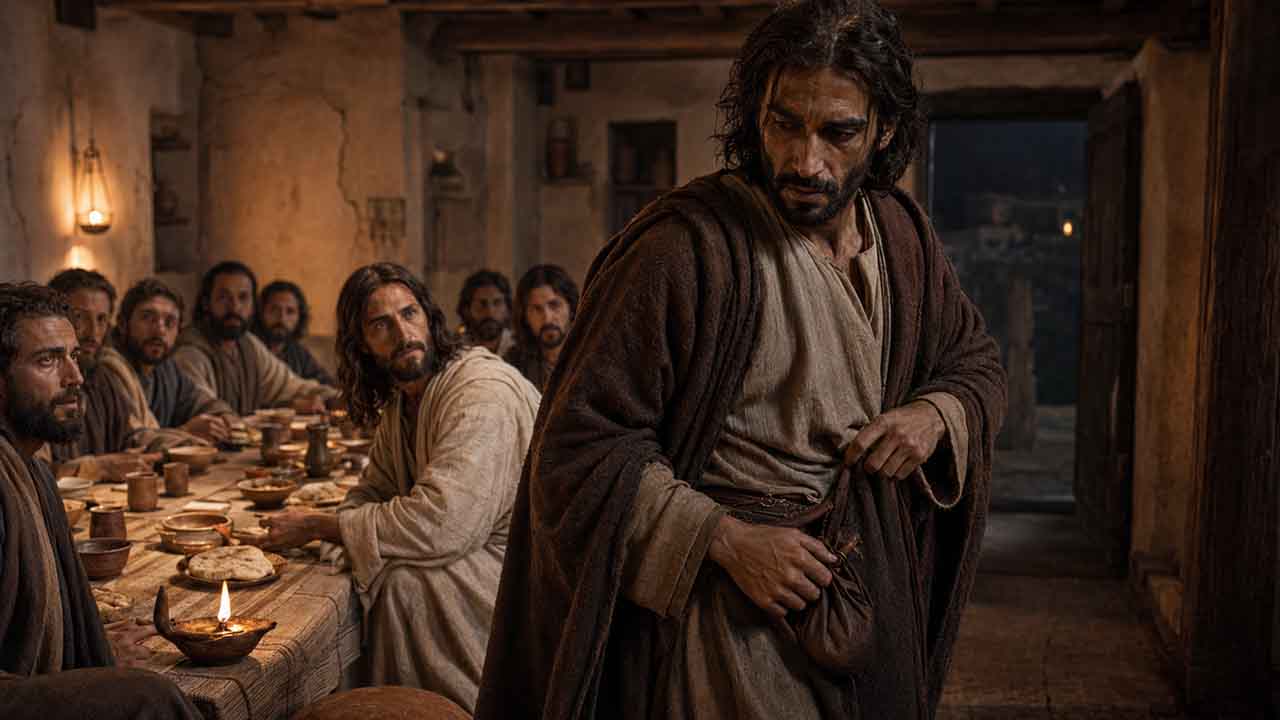
Judas Iscariot
In the upper room, Judas turns toward the door with the money bag in hand, showing that a man can sit near Jesus, share the bread, and still choose the night. As the disciples sit in confusion, Christ sees the betrayal already alive in the heart.
Listen to this Bible Exhibit
One of the Twelve
Judas Iscariot steps into the Gospel story as one of the Twelve, but he leaves it as the betrayer of the Son of God. He is not an enemy standing far away from Jesus. He is a disciple who walked near the Light, heard the truth, shared the table, and still chose the night.
Judas was a common name in the first century, so Scripture identifies this man with care. John calls him the son of Simon Iscariot. The meaning of Iscariot is uncertain, but it most likely means “man of Kerioth.” If so, Judas may have been the only Judean among the Twelve. Other suggestions have been made, but Scripture does not rest the meaning of his life on his hometown. It rests on his betrayal.
The Gospel lists Judas among the apostles, usually last, and remembers him as the one who betrayed Jesus [Matthew 10:1-4]. That is what makes his story so sobering. Judas was not outside the circle of discipleship. He was chosen with the Twelve, traveled with them, and shared in their public identity as followers of Christ.
John tells us that Jesus knew from the beginning who did not truly believe and who would betray Him [John 6:64-71]. This does not make Judas innocent. It shows that Jesus was never deceived. The betrayal did not catch the Son of God by surprise.
Trusted with the Money Bag
Judas held a place of trust among the disciples. He carried the money bag, which means the group depended on him for ordinary needs and acts of giving. Yet John tells us that Judas was a thief.
This becomes clear at Bethany. Mary poured costly perfume on Jesus in an act of beautiful devotion. Judas objected that the perfume should have been sold and the money given to the poor. His words sounded merciful, but his heart was false. He did not love the poor. He loved what he could take [John 12:1-8].
This is one of Scripture’s sharp warnings about hidden sin. Greed can learn religious language. Covetousness can sound like concern. Judas stood close to Jesus, but his heart was being ruled by something else.
The Price of Betrayal
Soon Judas went to the chief priests and agreed to hand Jesus over for thirty pieces of silver [Matthew 26:14-16]. The leaders already wanted Jesus arrested, but they feared the crowds. Judas gave them what they needed: a way to seize Jesus privately, away from public attention.
Luke adds that Satan entered Judas as he sought an opportunity to betray Jesus when no crowd was present [Luke 22:1-6]. Scripture holds these truths together without apology. Satan was at work. Judas acted willingly. God’s plan was being fulfilled. None of these truths cancels the others.
Jesus Himself said the Son of Man would go as it had been decreed, but woe would come to the man who betrayed Him [Luke 22:21-23]. Divine sovereignty does not erase human guilt. Judas was not a puppet. He was responsible for the sin he chose.
The Last Appeal at the Table
At the Last Supper, Jesus knew everything. He washed His disciples’ feet, warned that not all were clean, and spoke of the one who would betray Him. The disciples did not suspect Judas. Some even wondered if they themselves might be the betrayer.
Then Jesus gave Judas the dipped bread. In the setting of a meal, this was a sign of closeness. Yet in Judas’s hands, the sign of fellowship became the moment of final hardness. He received the bread, and Satan entered him. Jesus told him to do quickly what he was about to do. Judas left, and John writes with terrible simplicity that it was night [John 13:1-30].
The darkness was more than the hour. Judas had walked away from the Light of the world.
The Kiss in Gethsemane
Judas knew where Jesus often went with His disciples. He came to Gethsemane with an armed crowd and had arranged a sign: the one he kissed was the one to arrest. A kiss should have meant respect, loyalty, and affection. Judas made it the signal of treachery.
Jesus was not trapped. He did not lose control of the moment. He stepped toward the cross in obedience to the Father. Yet Judas’s guilt remained his own. He came as a friend and acted as a betrayer [Matthew 26:47-56].
John also shows Jesus stepping forward and identifying Himself before the arresting party. Even in the hour of betrayal, Jesus is not a victim of confusion or weakness. He gives Himself up willingly [John 18:1-11].
Remorse and the Field of Blood
When Judas saw that Jesus was condemned, he was seized with remorse. He returned the silver and confessed that he had betrayed innocent blood. But remorse is not the same as repentance. Judas did not run to Christ for mercy. He threw down the money and went out to his death.
The priests would not put the blood money into the temple treasury, so they used it to buy a field for burying strangers. Matthew connects this with the prophetic shape of Scripture, where the rejected price and the potter’s field bear witness to Israel’s deep tragedy [Matthew 27:3-10].
Acts remembers Judas with solemn finality. He had been numbered among the apostles, but he turned aside from his ministry. His place was left empty, and Matthias was chosen to take his place among the Twelve [Acts 1:16-26].
Scripture Fulfilled
Judas’s betrayal stands within the larger story of Scripture. The Psalms had spoken of the pain of betrayal by a close companion, one who shared bread and then turned against the Lord’s anointed [Psalm 41:9]. The prophets had pictured silver weighed out and thrown toward the potter [Zechariah 11:12-13].
These connections do not make Judas less guilty. They show that God was ruling even over human evil. Judas meant betrayal. The leaders meant destruction. Satan meant darkness. Yet God brought about the cross, where Jesus died for sinners and opened the way of salvation.
Why Judas Iscariot Matters
Judas Iscariot matters because he shows that nearness to Jesus is not the same as faith in Jesus. He heard the teaching, saw the miracles, shared the table, and served among the Twelve. Yet he did not love Christ. He had privilege without surrender, knowledge without worship, and outward discipleship without a renewed heart.
His story also warns against hidden sin. Judas’s greed did not remain small. It grew into theft, hypocrisy, betrayal, despair, and death. Sin that is kept secret will not remain harmless.
Judas must never be turned into a symbol for a whole people. Scripture presents him as one man, responsible for his own sin. His failure is a warning to every reader, not a weapon against others.
Most of all, Judas helps us see the glory of Christ. Jesus knew the betrayer and still walked toward the cross. Judas did not defeat him. He gave Himself for sinners. The darkest act of treachery became part of God’s saving plan. Judas chose the night, but even that night could not overcome the Light.
What is a Disciple?
A disciple is a follower and learner of Jesus. During his earthly ministry, Jesus called many to follow him, but he chose twelve to be his closest companions and witnesses.
These men walked with Jesus, heard his teaching, saw his miracles, and were formed by his presence. He sent them to proclaim the Kingdom of God, heal the sick, and bear witness to his authority.
The disciples were not flawless heroes. They misunderstood, doubted, argued, and failed. Yet Jesus patiently shaped them by grace. After his resurrection, and through the gift of the Holy Spirit, these once-fearful followers became bold witnesses to the risen Christ.
Their lives show the heart of discipleship: to be called by Christ, formed by Christ, and sent by Christ. A disciple does not merely admire Jesus from a distance, but follows him in faith, obedience, and love.