


King Jeroboam I
reigned 931-910 BC
Carousel of images for this Bible Exhibit
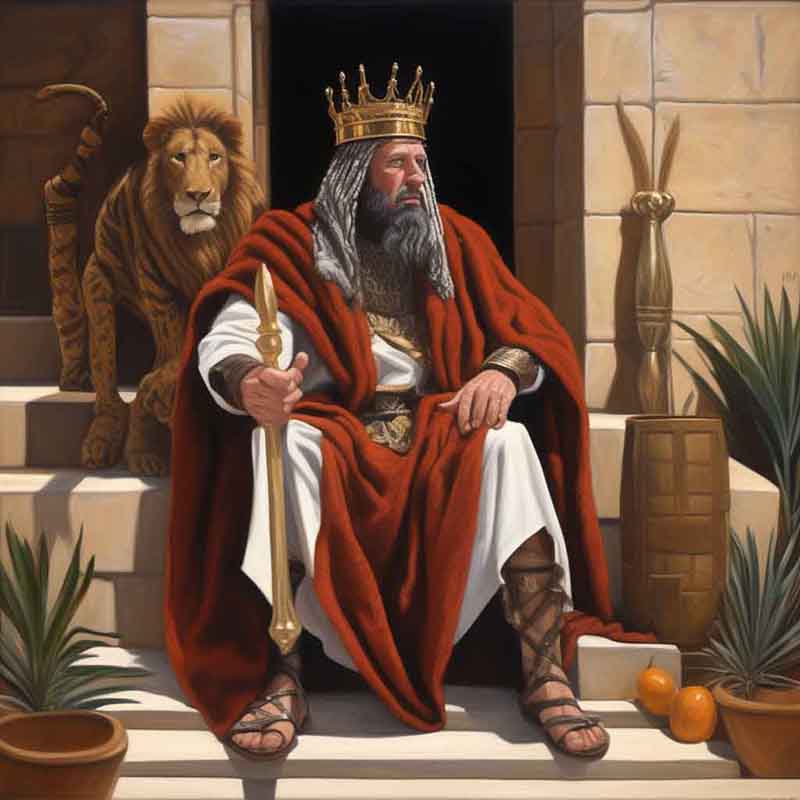
King Jeroboam I, the First King of the Northern Kingdom of Israel
Jeroboam rose from a capable leader to become the first king of Israel after the kingdom was divided. He reigned for twenty-two years, bringing political stability to the northern tribes but leading them into spiritual corruption through idolatry and false worship. His fear-driven decisions set a destructive pattern that shaped the history of Israel for generations.
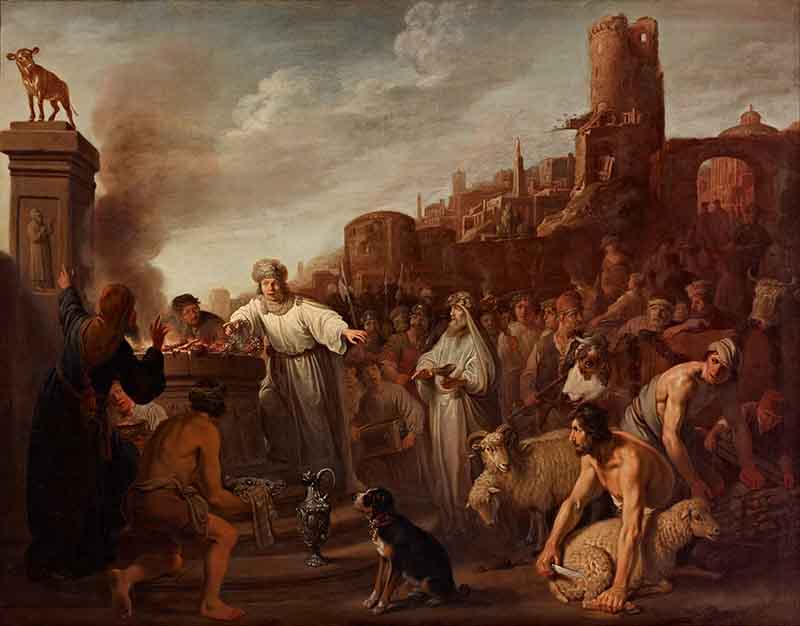
Jeroboam Struck at the Altar of Bethel
This scene captures the dramatic moment when King Jeroboam, in defiance of God’s command, offers an illicit sacrifice at the altar in Bethel. As he stretches out his arm in anger and authority, divine judgment falls, and his arm is suddenly paralyzed. The moment exposes the emptiness of power built on disobedience and reveals that no throne stands secure when worship is shaped by fear rather than submission to God.
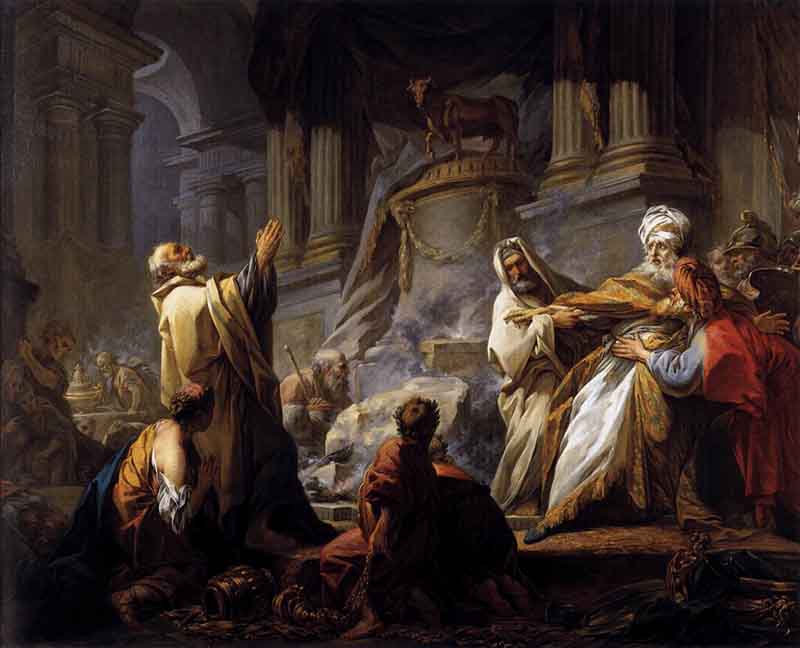
Jeroboam’s Defiant Sacrifice
The rebellious king stands at the altar, his gesture frozen in defiant devotion as incense rises into the air. Tension fills the scene while onlookers witness a moment charged with impending divine judgment. What appears to be an act of worship is exposed as open rebellion, revealing the danger of honoring God with outward ritual while resisting Him in the heart.
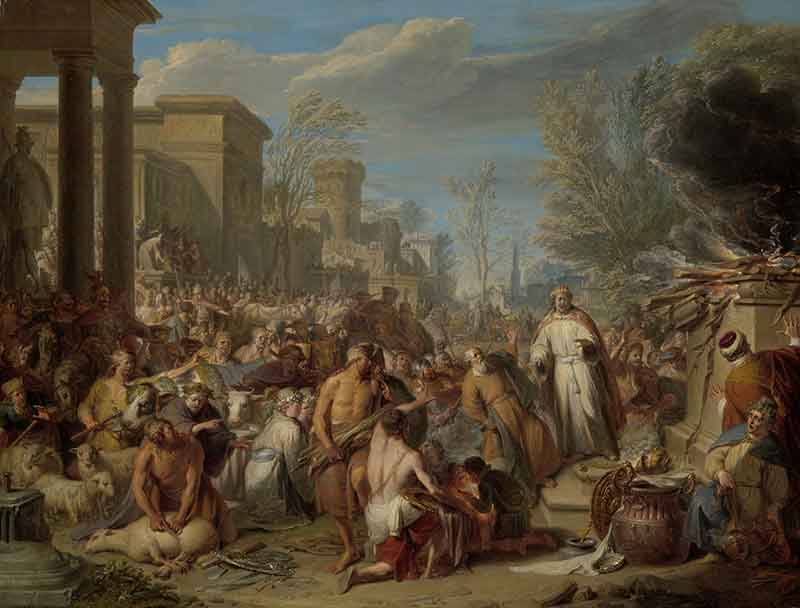
The Shattering of Jeroboam’s Altar
As King Jeroboam sacrifices to idols before the temple, the altar suddenly shatters, leaving him, the priests, and the people frozen in stunned horror. To the left, sacrificial animals are prepared for slaughter, while on the right, ornate censers and sacred vessels underscore the ritual’s splendor, now broken by divine judgment. The scene reveals the futility of worship built on disobedience and marks the unraveling of a kingdom shaped by fear rather than faith.
Jeroboam I, son of Nebat, was the first king of Israel’s northern kingdom after the splitting of Solomon’s kingdom. An Ephraimite from Zeredah, Jeroboam rose to prominence during Solomon’s reign as an industrious official, overseeing forced labor in the territories of Ephraim and Manasseh 1 Kings 11:28 . His leadership and ambition marked him as a key figure, but they also set the stage for rebellion.
The prophet Ahijah of Shiloh played a pivotal role in Jeroboam’s rise. Ahijah symbolically tore a new cloak into twelve pieces, giving ten to Jeroboam, prophesying that he would rule over ten tribes of Israel. This division was declared a judgment against Solomon for his idolatry, although one tribe remained loyal to David’s line in accordance with God’s covenant with David 1 Kings 11:29-40 . When Solomon learned of this, he sought to kill Jeroboam, who fled to Egypt under the protection of Pharaoh Shishak.
After Solomon’s death, Jeroboam returned to Israel during political unrest. The people of the northern tribes, burdened by heavy taxes and forced labor under Solomon, sought relief from his successor. However, Rehoboam arrogantly refused their request, declaring that his father had scourged them with whips but that he would scourge them with scorpions 1 Kings 12:13-20 . The northern tribes responded with revolt, rejecting Rehoboam’s rule and proclaiming Jeroboam as their king.
Jeroboam made Shechem his capital to consolidate his kingdom and to fortify other cities, such as Penuel. Concerned that his people might return to Judah if they continued to worship in Jerusalem, he established new centers of worship at Bethel and Dan, respectively, along the southern and northern borders. He set up golden calves, declaring that these are your gods, Israel, who brought you up out of Egypt 1 Kings 12:28-33 . This act echoed the idolatry of Aaron’s golden calf and led Israel into sin. Jeroboam also appointed non-Levitical priests and introduced new religious festivals, further departing from the worship ordained by God.
Jeroboam’s reign was marked by conflict. Although he enjoyed initial success, his kingdom faced internal dissent and external threats, including an invasion by Pharaoh Shishak, which weakened Israel and Judah alike 1 Kings 14:25-26 . Despite prophetic warnings, Jeroboam refused to repent. When his son Abijah fell ill, Jeroboam sought counsel from Ahijah, who prophesied the downfall of his dynasty and his son’s death 1 Kings 14:1-18 .
Jeroboam reigned for twenty-two years, leaving a legacy of idolatry and division. His actions set a precedent for future kings of Israel, many of whom were condemned for following Jeroboam’s sins of idolatry 1 Kings 15:25-26 . His life serves as a warning of the consequences of disobedience to God’s commands.