


King Omri
reigned 885-874 BC
Carousel of images for this Bible Exhibit
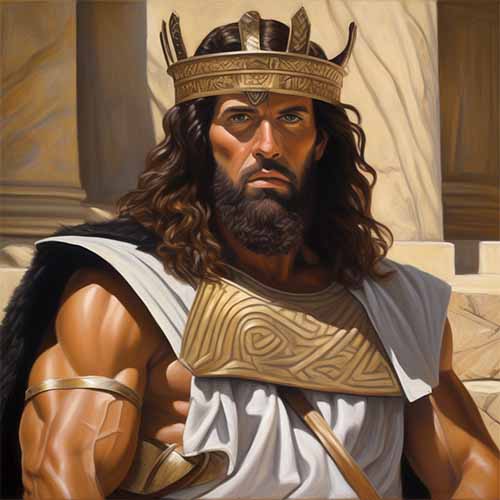
King Omri, the Sixth King of the Northern Kingdom of Israel
Omri rose to power during a season of chaos and established himself as one of Israel’s strongest political leaders, ruling for twelve years. He secured the throne through military strength, founded Samaria as Israel’s capital, and expanded the kingdom’s influence through alliances and conquest. Yet his success came at a spiritual cost, as he led Israel deeper into idolatry and rebellion against God. Omri’s reign shows that political strength and lasting legacy mean little when faithfulness to God is abandoned.
Omri was the sixth king of the northern kingdom of Israel, ruling for twelve years. His reign began amid turmoil following the assassination of King Elah by Zimri, one of his military officials. Zimri seized the throne but ruled for only seven days before Omri, the commander of the army, was proclaimed king by the troops. Omri marched on Tirzah, the capital city, and laid siege to it. Realizing that he had been defeated, Zimri set the royal palace on fire and perished in the flames 1 Kings 16:15–18 . However, Omri’s ascension was not immediate, as Israel was divided, with half of the people supporting another claimant, Tibni son of Ginath. After four years of conflict, Omri’s forces prevailed, and he became the undisputed ruler of Israel 1 Kings 16:21–22 .
Omri’s reign marked a turning point in Israel’s history, as he strengthened the kingdom politically and militarily. One of his most significant achievements was the establishment of Samaria as the new capital of Israel. He purchased the hill of Samaria from Shemer and built a fortified city, which remained the capital of Israel until its destruction by the Assyrians in 722 BC 1 Kings 16:23–24 . Samaria’s location made it strategically valuable, offering both military defense and trade opportunities.
Omri expanded Israel’s influence and secured alliances with surrounding nations. He subjugated Moab, forcing it to pay tribute, as recorded on the Mesha Stele, an ancient engraving 2 Kings 3:4 . He also established a close alliance with Phoenicia, which was later strengthened when his son Ahab married Jezebel, the daughter of King Ethbaal of Sidon 1 Kings 16:31 . This relationship with Phoenicia led to economic prosperity, as Israel benefitted from Phoenician trade and craftsmanship. However, it also resulted in the promotion of Baal worship in Israel, a practice that angered God and contributed to Israel’s spiritual decline 1 Kings 16:25–26 .
Omri’s reign laid the foundation for Israel’s most significant period of political strength, but it came at a spiritual cost. The Bible condemns him for continuing in the sins of Jeroboam, sinning even more than those who came before him, and leading Israel further into idolatry 1 Kings 16:25–26 . His dynasty lasted for four generations, through Ahab, Ahaziah, and Jehoram, before being overthrown by Jehu 2 Kings 9:6–10 . Omri’s name remained influential even after his dynasty ended, as Assyrian records referred to Israel as the “land of Omri” for over a century.
Though Omri was a strong political leader, his failure to follow God’s commandments led to judgment upon his descendants. His reign serves as a reminder that earthly success cannot replace faithfulness to God. Despite his military achievements and diplomatic skill, Omri’s legacy is one of idolatry and disobedience, ultimately leading to the downfall of his house and the continued spiritual decline of Israel.