


Manasseh, Son of Joseph
Firstborn, Not Forgotten
Carousel of images for this Bible Exhibit
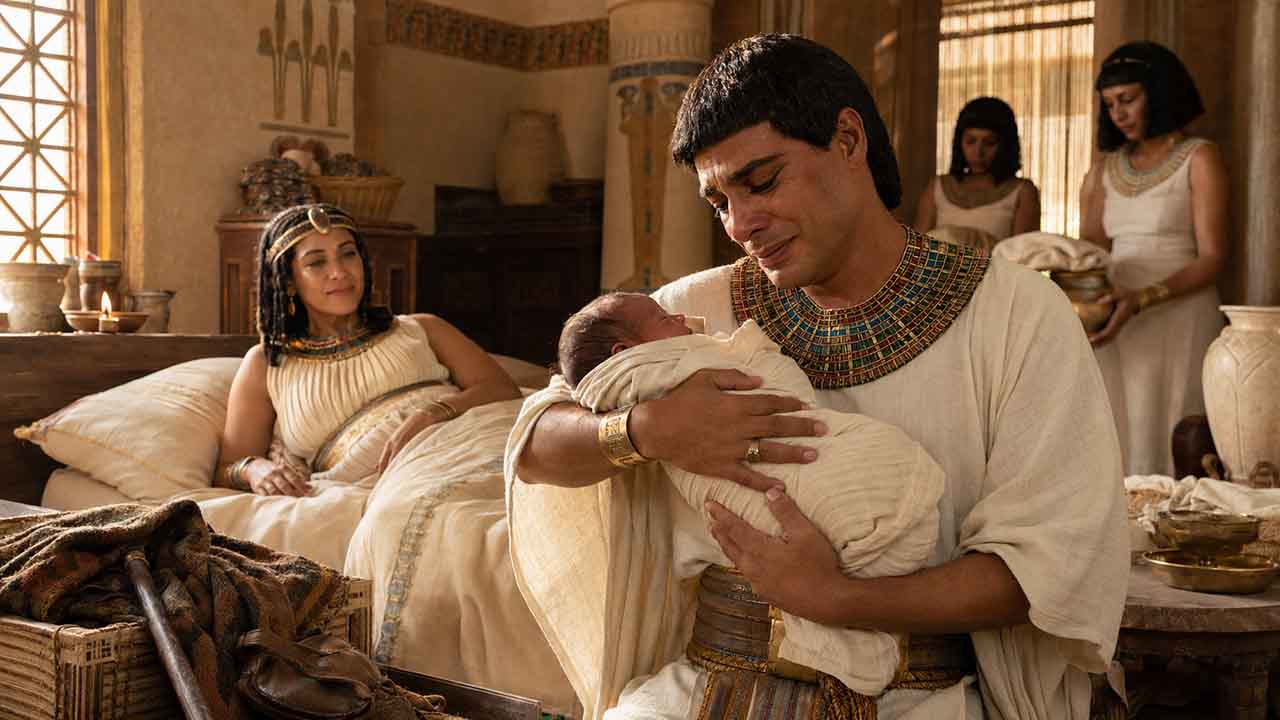
A Son in the Land of Affliction
Joseph holds his firstborn with quiet tears, seeing in Manasseh a gift of mercy after betrayal, slavery, and years of exile. In the warmth of an Egyptian household, the Lord begins to heal Jacob's wounded son through the fragile life of a newborn child.
Listen to this Bible Exhibit
Firstborn, Not Forgotten
Manasseh stands at a quiet but important turn in the story of Israel. He was Joseph’s firstborn son, born in Egypt before the years of famine, and his name recalled God’s mercy after years of pain. Yet Manasseh’s most famous moment came when his younger brother Ephraim received the greater blessing from Jacob. Scripture does not present this as rejection. Manasseh was adopted into Israel, blessed by Jacob, made great in his own right, and remembered through a tribe that stretched across both sides of the Jordan. His story teaches that lesser prominence is not a sign of lesser grace. God gives inheritance by His wisdom, not by human expectation.
Born in Egypt, Named from Healing
Manasseh was born after Joseph had been lifted from prison to power in Egypt. Pharaoh gave Joseph Asenath, the daughter of Potiphera, priest of On, as his wife, and before the famine came, she bore Joseph two sons [Genesis 41:45-52].
Joseph named his firstborn Manasseh, saying, “God has made me forget all my hardship and all my father’s house.” The name is tied to forgetting, but not in the sense that Joseph erased his past or abandoned his family. Joseph still loved his father. He would later weep over his brothers and preserve his household alive. The meaning is deeper: God had so met Joseph in Egypt that his pain no longer ruled him.
Manasseh’s birth became a memorial of mercy in exile. Joseph had been betrayed, sold, accused, imprisoned, and forgotten by men. Yet the Lord had not forgotten him. In Egypt, far from Canaan, God gave Joseph a son and a household. Manasseh’s name teaches that God can bring healing even in the land of affliction.
A Son of Joseph, Adopted by Jacob
Manasseh was Joseph’s son and Jacob’s grandson, not one of Jacob’s biological sons. Yet near the end of Jacob’s life, that changed in a covenantal way. Joseph brought Manasseh and Ephraim to his dying father, and Jacob declared that Joseph’s two sons would be counted as his own, “as Reuben and Simeon are” [Genesis 48:1-6].
This was more than a grandfather’s affection. Jacob gave Manasseh and Ephraim tribal standing in Israel. Joseph would receive a double portion through his two sons. That is why Israel later had tribes named for Ephraim and Manasseh, but usually no separate tribe named simply for Joseph.
This moment is full of grace. Manasseh was born in Egypt to an Egyptian mother, yet he was brought into the inheritance of Israel. His place was not secured by birthplace, rank, or custom alone. It was given through Jacob’s blessing under the providence of God.
Manasseh reminds us that covenant belonging is never a matter of human neatness. God’s promise can reach into foreign lands, complicated families, and unexpected places. He gathers whom He wills and gives inheritance by grace.
The Crossed Hands of Jacob
When Joseph placed his sons before Jacob, he arranged them as expected. Manasseh, the firstborn, was placed near Jacob’s right hand. Ephraim, the younger, was placed near Jacob’s left. Joseph expected Manasseh to receive the stronger blessing [Genesis 48:13-20].
But Jacob crossed his hands. He placed his right hand on Ephraim and his left hand on Manasseh. Joseph tried to correct him, saying that Manasseh was the firstborn. Jacob refused. He knew what he was doing.
This scene belongs to a larger pattern in Genesis. God often overturns the order people expect. Isaac is chosen rather than Ishmael. Jacob receives the blessing rather than Esau. Judah rises to leadership, though he is not the firstborn. Joseph received a double portion, though his brothers hated him. Now Ephraim is placed before Manasseh.
This does not mean birth order means nothing. It means God’s purpose means more. The future of His people is not ruled by custom, human arrangement, or natural privilege. The Lord blesses according to His own wise will.
Blessed, Though Not First
It is important to read this scene carefully. Manasseh was not rejected. Jacob did not remove him from the covenant family. He did not speak over him as an outsider. Jacob said plainly that Manasseh would also become a people and would be great.
Manasseh’s blessing was real, even though Ephraim received greater prominence. This is one of the most pastorally important truths in his story. In the kingdom of God, not every servant receives the same role, visibility, or influence. But lesser prominence does not mean lesser love. A hidden place can still be a blessed place. A second place can still be held in God’s hand.
Manasseh had to stand under a blessing that did not flatter human expectation. Joseph wanted one order. Jacob declared another. In that holy reversal, the family learned again that inheritance belongs to the Lord.
The blessing given to Ephraim and Manasseh also became a blessing for later generations: “By you Israel will pronounce blessings, saying, ‘God make you as Ephraim and as Manasseh.’” Manasseh’s name would not disappear in shame. It would remain in the language of blessing.
A House Remembered Through Machir
Scripture records very little about Manasseh’s personal actions. No speech of his is preserved. No journey or deed is recounted except for the blessing scene. Yet his house is remembered.
Before Joseph died, he saw the children of Machir, the son of Manasseh, born on Joseph’s knees [Genesis 50:23]. Later genealogies connect Manasseh’s line with Machir, Gilead, and the clans that would shape the tribe’s future [1 Chronicles 7:14-19].
This quiet continuation matters. Manasseh’s story is not built around personal fame, but around preserved lineage. The son born in Egypt became the father of a house in Israel. Through Machir and Gilead, his descendants would become strong, numerous, and deeply tied to the land east and west of the Jordan.
God often works this way. A life may be quiet on the page, yet fruitful across generations. Manasseh’s personal record is brief, but his name becomes large in Israel’s history.
The Tribe That Bore His Name
The tribe of Manasseh became one of the tribes of Israel. In the wilderness, Manasseh camped on the west side of the tabernacle with Ephraim and Benjamin [Numbers 2:18-24]. At the first census, Manasseh numbered 32,200 fighting men; by the second census, the tribe had grown to 52,700 [Numbers 1:34-35] [Numbers 26:34]. Gaddi, son of Susi, represented the tribe among the spies sent into Canaan [Numbers 13:11].
Manasseh’s inheritance was unusual because it stood on both sides of the Jordan. The descendants of Machir received land in Gilead and Bashan east of the Jordan, while the rest of the tribe received territory west of the Jordan, north of Ephraim [Numbers 32:33-42] [Joshua 13:29-31].
This made Manasseh both blessed and exposed. The tribe received a wide territory, fertile lands, strategic cities, and a strong inheritance. But life on both sides of the Jordan also brought pressure, distance, and danger. The same inheritance that displayed God’s generosity also required faithfulness, unity, and courage.
But his father refused and said, “I know, my son, I know; he too will become a people and he also will be great. Nevertheless, his younger brother shall be greater than he, and his descendants shall become a multitude of nations.”
Genesis 48:19
Courage, Inheritance, and Unfinished Obedience
Manasseh’s tribal story includes both courage and weakness. The eastern Manassites joined Reuben and Gad in promising Moses that their warriors would cross the Jordan and help their brothers take the land before returning to their own inheritance [Numbers 32:16-27]. Joshua later released them with a blessing because they had kept that word [Joshua 22:1-9].
The tribe also appears in the story of Zelophehad’s daughters. Because Zelophehad had no sons, his daughters asked for an inheritance among their father’s brothers. The Lord upheld their request, and their case became part of Israel’s inheritance law [Numbers 27:1-11] [Joshua 17:1-13]. Later, the Lord also guarded the tribal inheritance by requiring daughters who inherited land to marry within their father’s clan, preserving both family memory and the tribe’s appointed portion [Numbers 36:1-12]. From Manasseh’s line comes a beautiful witness that the Lord sees what human systems may overlook and guards the inheritance of the vulnerable.
Yet Manasseh also failed to drive out all the Canaanites from its territory. Cities such as Beth-shean, Taanach, Dor, Ibleam, and Megiddo remained difficult strongholds [Judges 1:27-28]. Manasseh became strong enough to put the Canaanites to forced labor, but not obedient enough to complete what the Lord had commanded.
This is the warning in Manasseh’s inheritance. A great blessing must not be met with partial obedience. To receive land from God and then tolerate what He has forbidden is a dangerous compromise.
Leaders, Exile, and Hope
Manasseh’s descendants produced important leaders for Israel. Gideon, who delivered Israel from Midian, came from Manasseh [Judges 6:11-16]. Jair and Jephthah are associated with Gilead, the eastern region associated with Manasseh [Judges 10:3-5] [Judges 11:1-12]. Men from Manasseh later joined David at Ziklag and helped make him king at Hebron [1 Chronicles 12:19-37].
But Manasseh’s later story also entered the sorrow of the northern kingdom. The Transjordan tribes broke faith with the God of their fathers and were carried into exile by Assyria [1 Chronicles 5:23-26]. Yet Scripture does not leave Manasseh without hope. Some from Manasseh humbled themselves and came to Jerusalem for Hezekiah’s Passover [2 Chronicles 30:10-20]. Manasseh is named as belonging to the Lord in the Psalms: “Gilead is mine; Manasseh is mine” [Psalm 60:7] [Psalm 108:8]. Ezekiel includes Manasseh in his vision of restored tribal portions [Ezekiel 48:4]. Revelation names Manasseh among the sealed tribes of Israel [Revelation 7:6].
The story moves from blessing to failure, from exile to remembered mercy. The Lord disciplines His people, but He does not forget His covenant.
Why Manasseh Matters
Manasseh matters because his story teaches us how to receive God’s place for us with humility. He was the firstborn, yet he did not receive first place. He was surpassed, but not cast off. He was second to Ephraim, yet still blessed by Jacob and made great by God.
He also teaches that healing is possible after suffering. His name came from Joseph’s testimony that God had made him forget his hardship. The Lord did not undo Joseph’s past by pretending it never happened. He overcame its bitterness by mercy.
Manasseh teaches that adoption is central to the story of grace. A son born in Egypt was brought into Israel’s inheritance. He belonged because he was received, named, and blessed.
Most of all, Manasseh points beyond himself to the God who gives inheritance by grace. In Christ, the true Firstborn, God brings many sons and daughters into His family. He does not give His people a place because they deserve it, control it, or outrank others. He gives it because He is merciful.
Manasseh was firstborn, but not first. Lesser, but not forgotten. Quiet, but not insignificant. His life calls us to trust the wisdom of the God who remembers His people, heals their sorrows, and keeps His promise from generation to generation.