


Matthew
The Tax Collector Called by Mercy
Carousel of images for this Bible Exhibit
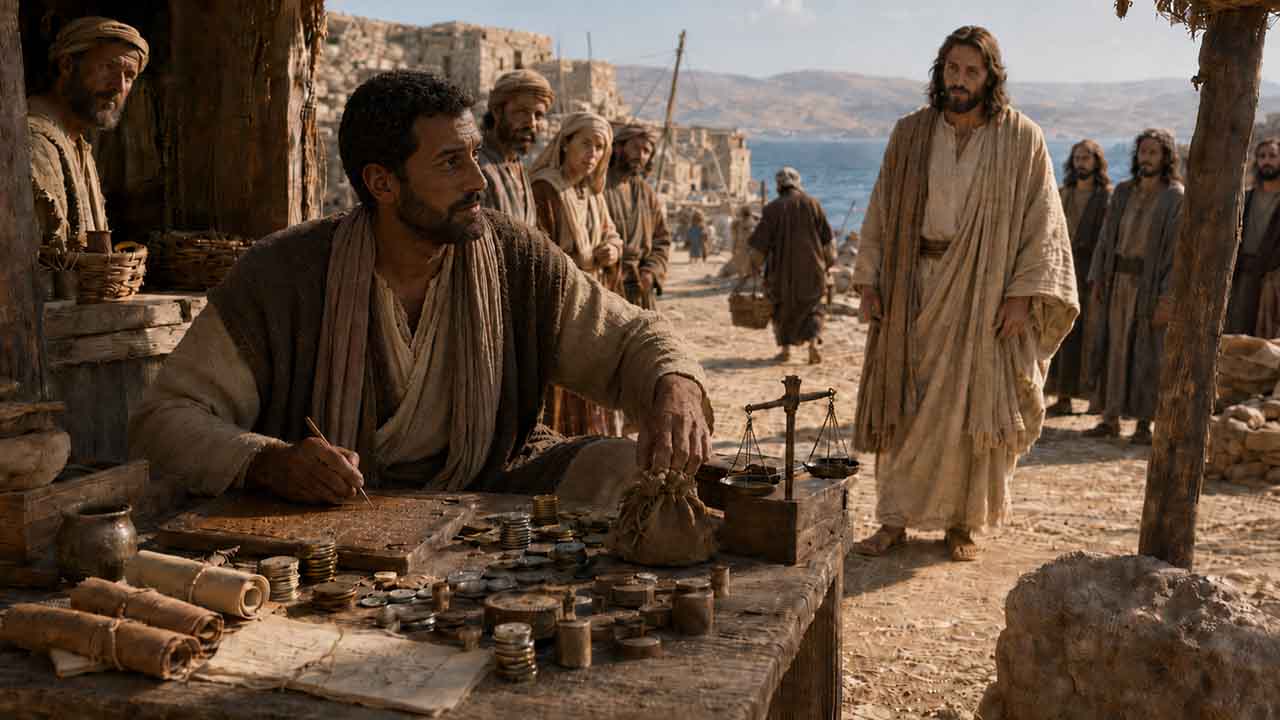
Matthew
At the tax booth by the Sea of Galilee, Matthew looks up from his coins and records as Jesus calls him from a life of compromise into the mercy of discipleship. In one searching glance, the table of profit begins to lose its power, and the tax collector is summoned to rise and follow the King.
Listen to this Bible Exhibit
A Tax Collector Named Levi
Matthew sits at the tax booth near Capernaum, surrounded by coins, records, and the distrust of his own people. Then Jesus passes by and speaks two words that change everything: “Follow me.” The man known for collecting debts rises to follow the One who came to forgive sinners.
Matthew was also called Levi. Mark identifies him as Levi, son of Alphaeus, while Matthew’s own Gospel names him Matthew. The call story is the same in Matthew, Mark, and Luke, so Matthew and Levi are best understood as the same man [Mark 2:13-17].
The name Matthew likely means “gift of Yahweh.” That name is fitting, because his life becomes a gift of grace displayed in public. He was a tax collector in the region of Capernaum, likely collecting tolls on goods moving through Galilee. This work made him wealthy enough to host a large banquet, but it also made him despised.
Tax collectors were hated because they worked within a system tied to foreign rule and local oppression. Many collected more than required and kept the extra. They were often grouped with “sinners,” not merely because they had bad reputations, but because their work marked them as unclean, compromised, and greedy in the eyes of many Jews.
Called from the Booth
Jesus did not call Matthew after he had repaired his reputation. He called him while he was still sitting at the tax booth. Luke says Matthew left everything and followed Him [Luke 5:27-32]. The words are simple, but the cost was great. Matthew left behind a profitable post, a secure income, and the old life that had defined him.
This is the wonder of grace. Jesus did not merely offer Matthew a better moral path. He summoned him into the kingdom. The call of Christ was stronger than the pull of money, shame, and habit. The tax collector stood up because the King had spoken.
A Table for Sinners
Matthew’s first recorded act as a disciple was hospitality. He opened his house to Jesus, His disciples, and many tax collectors and sinners. The Pharisees were offended. To them, a holy teacher should avoid such people. Jesus answered that the healthy do not need a doctor, but the sick. Then He quoted the word of God: “I desire mercy, not sacrifice.” He had not come to call the righteous, but sinners [Matthew 9:9-13].
Matthew’s table became a living picture of the gospel. The Messiah had come not to gather the respectable and leave the guilty outside. He had come as the physician for the sick, the Savior for sinners, and the King who brings mercy to the outcast.
The scene also exposes the danger of self-righteousness. The Pharisees could see Matthew’s sin, but they could not see their own need. Matthew knew he needed mercy. That made him ready to follow Jesus.
Among the Twelve
Matthew was later named among the Twelve apostles. In Matthew’s own apostolic list, he is called “Matthew the tax collector” [Matthew 10:1-4]. The title is striking. It does not hide his past. It preserves it as a witness to grace.
The former tax collector was sent with the others to proclaim the kingdom. The man once known for taking now carries the message of the King who gives. He became part of the foundation witness of the Church, not because his past was clean, but because Christ had called him.
After the resurrection and ascension, Matthew appears again with the apostles in Jerusalem. He is gathered in prayer, waiting for the promised work of God [Acts 1:12-14]. Scripture gives no certain record of his later ministry or death, and we should not fill that silence with uncertain stories.
Matthew and the Gospel Witness
The early church strongly associated Matthew with the Gospel that bears his name. The Gospel itself does not name its author, and the research traditions discuss the question with care. Still, the connection is ancient and meaningful.
The Gospel called Matthew opens by presenting Jesus as the Messiah, the son of David and the son of Abraham [Matthew 1:1]. It is deeply concerned with the fulfillment of Scripture, the kingdom of heaven, God’s mercy, and the call to true discipleship. These themes fit beautifully with Matthew’s own story. He knew what it meant for the promised King to call a sinner from the margins and bring him into the kingdom.
Matthew’s background also helps us imagine why he could be associated with careful witness. A tax collector would know records, accounts, languages, and details. The man who once kept the ledgers of tolls became linked to testimony about Christ.
Why Matthew Matters
Matthew matters because he shows who Jesus came to save. The Lord did not choose only the admired, the clean, or the religiously approved. He called a tax collector from the booth and welcomed sinners at the table.
His life also shows that mercy creates mission. Matthew did not keep Jesus to himself. He brought others near, opening his home so that sinners could sit with the Savior. Grace made him a witness.
Jesus later taught that tax collectors and prostitutes were entering the kingdom ahead of those who would not repent [Matthew 21:28-32]. Matthew’s life stands as a personal picture of that truth. The kingdom belongs not to those who pretend they are well, but to those who know they are sick and come to Christ.
Matthew went from toll booth to table fellowship to apostolic witness. He was called from shame into fellowship, from gain into grace, and from counting coins to following the One who gave His life as a ransom for many [Matthew 20:25-28]. His story tells every sinner this good news: no past is too stained for the mercy of Jesus, and no life called by Christ remains the same.
What is a Disciple?
A disciple is a follower and learner of Jesus. During his earthly ministry, Jesus called many to follow him, but he chose twelve to be his closest companions and witnesses.
These men walked with Jesus, heard his teaching, saw his miracles, and were formed by his presence. He sent them to proclaim the Kingdom of God, heal the sick, and bear witness to his authority.
The disciples were not flawless heroes. They misunderstood, doubted, argued, and failed. Yet Jesus patiently shaped them by grace. After his resurrection, and through the gift of the Holy Spirit, these once-fearful followers became bold witnesses to the risen Christ.
Their lives show the heart of discipleship: to be called by Christ, formed by Christ, and sent by Christ. A disciple does not merely admire Jesus from a distance, but follows him in faith, obedience, and love.