


Philip
The Disciple Who Said, “Come and See”
Carousel of images for this Bible Exhibit
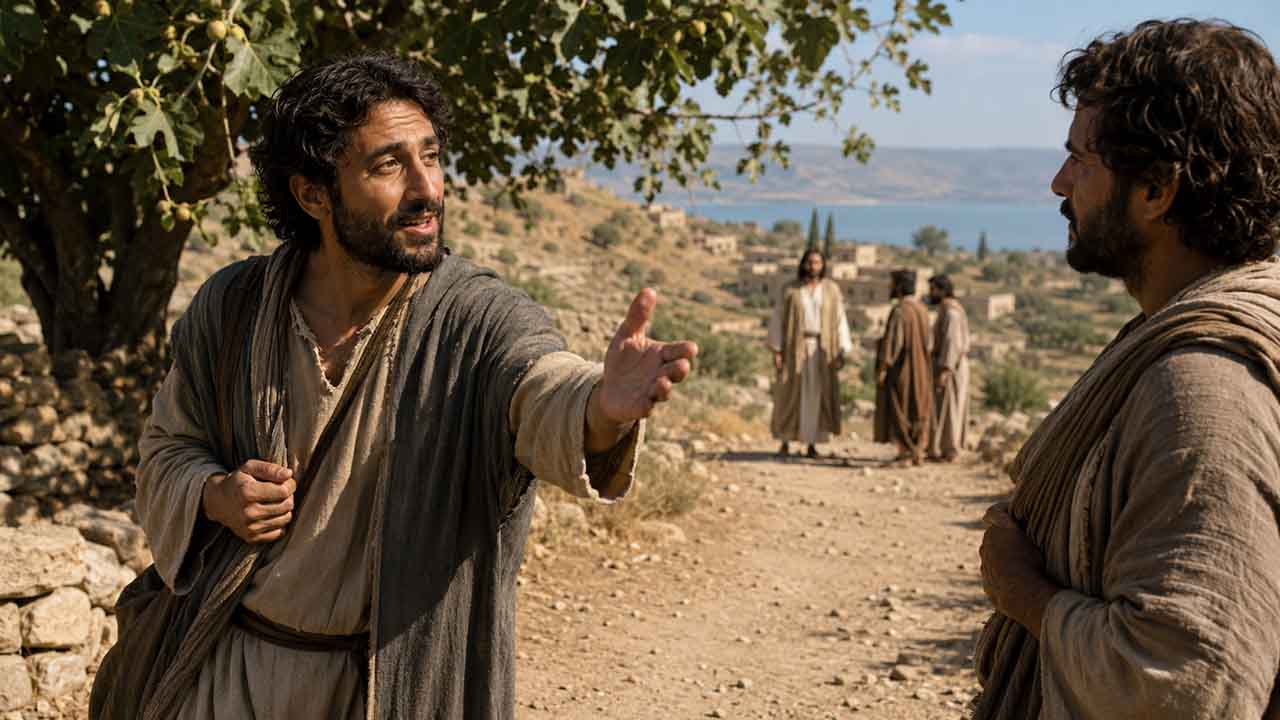
Philip
On a sunlit Galilean road, Philip reaches toward Nathanael with the simple invitation that changes everything: come and see the One Moses and the prophets foretold. In his open hand and eager face, discipleship becomes witness, finding Jesus and immediately leading another soul to Him.
Listen to this Bible Exhibit
A Disciple from Bethsaida
Philip stands on the road from Bethsaida with the wonder of a man newly called by Jesus. He has found the Messiah, but he is still learning who this Messiah truly is. Again and again, Philip brings others near to Christ, even while Christ patiently leads Philip into deeper faith.
Several men in the New Testament were named Philip, so we must read carefully. This Philip is not Philip the evangelist in Acts, nor one of Herod’s sons. He is Philip the apostle, one of the Twelve disciples chosen and sent by Jesus.
In the lists of the apostles, Philip always appears after the first two pairs of brothers: Peter and Andrew, James and John [Matthew 10:1-4]. The Synoptic Gospels name him but give no separate story about him. John’s Gospel gives the clearest portrait.
Philip was from Bethsaida in Galilee, the same town as Andrew and Peter. His Greek name may help explain why some Greek-speaking worshipers later approached him. Bethsaida stood in a region where Jewish faith and Gentile culture often met, and Philip’s story often places him at the doorway between seekers and Jesus.
Called by Jesus
John records Philip as one of the earliest disciples called by Jesus. The Lord found him and said, “Follow me.” Philip did not discover Jesus by cleverness or spiritual achievement. Jesus found Philip first.
That order matters. Discipleship begins with Christ’s initiative. The Lord calls, and the disciple follows. Philip’s life is not the story of a man who mastered Jesus, but of a man slowly mastered by Him.
Philip soon found Nathanael and announced that the One promised by Moses and the Prophets had come, Jesus of Nazareth. Nathanael questioned whether anything good could come from Nazareth. Philip did not answer every objection. He said, “Come and see” [John 1:43-51].
That invitation reveals the best of Philip. He may not have had a full theology of Christ yet, but he knew enough to bring his friend to Jesus. True witness does not require a perfect answer to every question. It begins by leading people to the One who can answer the heart.
Tested by the Bread
Philip also shows how slowly faith can grow. Before feeding the five thousand, Jesus asked him where bread could be bought for the crowd. John says Jesus asked this to test him. Philip answered with a careful calculation: even a large sum would not buy enough for each person to receive a little [John 6:5-13].
Philip was not wrong about the math. He was wrong about the moment. He measured the need but did not yet see the sufficiency of the One standing before him. Jesus was not asking because He lacked a plan. He was drawing Philip beyond calculation into trust.
The miracle that followed taught Philip that the kingdom does not depend on human resources. Empty hands are not a problem when they are placed before the Lord of creation. The disciple who counted the cost had to learn the abundance of Christ.
A Doorway for the Greeks
Philip appears again in Jerusalem when some Greeks who had come to worship at the festival wanted to see Jesus. They approached Philip and made their request. Philip went to Andrew, and together they brought the matter to Jesus [John 12:20-26].
This small scene carries great weight. Through Philip, Gentile seekers press toward Israel’s Messiah. Jesus’ answer points to His coming death, like a seed falling into the ground and bearing much fruit. The Greeks’ request is not treated as a passing curiosity. It points forward to the wider harvest that will come through the cross.
Philip again stands as a bridge. He brought Nathanael, an Israelite searching the Scriptures. Now he helps bring Greeks who want to see Jesus. The Messiah is not only the hope of Israel. He is the Savior whose death will bear fruit for the world.
“Show Us the Father”
Philip’s deepest misunderstanding comes in the upper room. Jesus has been speaking of the Father, the way, the truth, and the life. Philip then says, “Lord, show us the Father, and that will be enough for us.”
Jesus’ answer is one of the great revelations of the Gospel: anyone who has seen the Son has seen the Father [John 14:8-11].
Philip wanted a further vision, something beyond Jesus. Yet the full revelation of God was already standing before him. He had walked with the Son, heard the Son, watched the works of the Son, and still asked for the Father as though the Father could be known apart from Him.
Jesus does not crush Philip. He teaches him. The disciple who once said, “Come and see,” now had to learn what he himself had seen. In Jesus, the invisible God is made known. The Father is not revealed around the Son or behind the Son, but in the Son.
Present in Prayer
After the ascension, Philip was with the apostles in Jerusalem, gathered in prayer and waiting for the promised Spirit [Acts 1:12-14]. The disciple who had been tested, corrected, and taught was still there, waiting with the others for God’s power.
Early church tradition associates Philip with ministry in Asia Minor, especially Phrygia and Hierapolis, where he was said to have spent the latter part of his life and been buried. The traditions about his death differ. Some say he died naturally, while others remember him as a martyr, possibly by crucifixion. These traditions are not the foundation of his biblical portrait, but they show that the early church remembered Philip as a faithful witness beyond the Gospel story.
Why Philip Matters
Philip matters because he shows the beauty of growing discipleship. He is not presented as flawless or instantly mature. He brings Nathanael to Jesus, but he still needs his own understanding enlarged. He helps bring Greeks to Jesus, but he must still learn that the cross is the way the nations will be gathered. He asks to see the Father, and Jesus teaches him that the Father is fully revealed in the Son.
His life encourages ordinary disciples. Philip did not always understand, but he kept following. He did not have all the answers, but he brought others to Christ. He did not begin with complete sight, but Jesus patiently led him into deeper truth.
Philip’s story moves from calling to witness, from calculation to trust, from seeking a vision of God to seeing the Father in Jesus. In him, we learn that discipleship is not the absence of questions. It is bringing our questions, our friends, and our small faith to the Savior who says, “Follow me.”
What is a Disciple?
A disciple is a follower and learner of Jesus. During his earthly ministry, Jesus called many to follow him, but he chose twelve to be his closest companions and witnesses.
These men walked with Jesus, heard his teaching, saw his miracles, and were formed by his presence. He sent them to proclaim the Kingdom of God, heal the sick, and bear witness to his authority.
The disciples were not flawless heroes. They misunderstood, doubted, argued, and failed. Yet Jesus patiently shaped them by grace. After his resurrection, and through the gift of the Holy Spirit, these once-fearful followers became bold witnesses to the risen Christ.
Their lives show the heart of discipleship: to be called by Christ, formed by Christ, and sent by Christ. A disciple does not merely admire Jesus from a distance, but follows him in faith, obedience, and love.
