


Simon Peter
The Disciple Jesus Turned into a Rock
Carousel of images for this Bible Exhibit
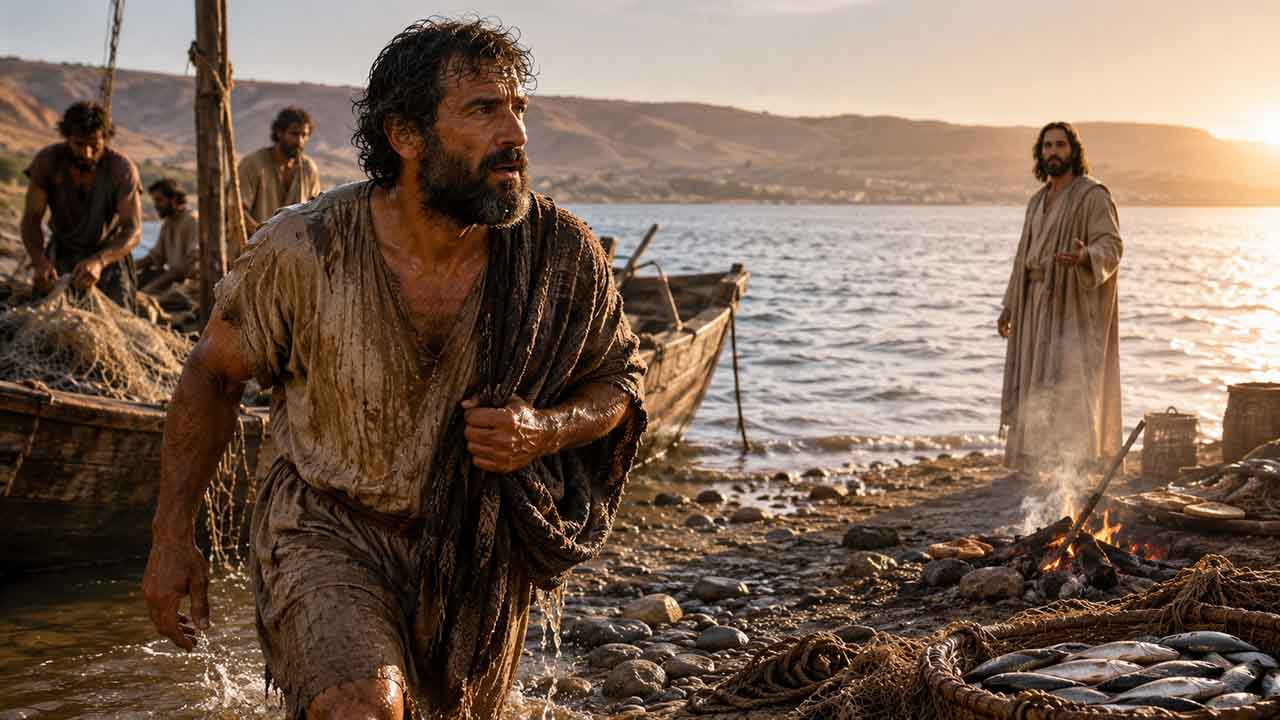
Simon Peter
Peter rushes from the water toward the risen Jesus, soaked and breathless, drawn by the love that would not let his failure have the final word. Beside the charcoal fire, the fisherman who once denied his Lord is being restored by grace and called again to shepherd Christ’s people.
Listen to this Bible Exhibit
Named Rock Before He Looked Like One
Simon Peter was called “rock” before he looked steady enough to deserve the name. He was a Galilean fisherman, the brother of Andrew, and one of the first men called to follow Jesus. His original name was Simon, but Jesus gave him the name Cephas, or Peter, meaning rock [John 1:40-42].
Peter came from Bethsaida and later lived in Capernaum, where Jesus healed his mother-in-law. This shows that Peter was married, and Paul later indicates that Peter’s wife accompanied him in ministry [Mark 1:16-31] [1 Corinthians 9:5]. Peter was not a polished religious expert. He was a working man from Galilee with boats, nets, family responsibilities, and a future Jesus would completely redirect.
Called by Grace
Peter’s call was marked by wonder and surrender. After a fruitless night of fishing, Jesus directed him to let down the nets again. The catch was so great that Peter recognized his own sinfulness in the presence of divine authority. Jesus then called him into a new mission, and Peter left everything to follow Him [Luke 5:1-11].
Peter was not chosen because he was flawless. He was chosen because Jesus is gracious. The fisherman would become a shepherd, preacher, and witness to the risen Christ.
First Among the Twelve
Peter became the most visible of the Twelve. His name appears first in the apostolic lists, and he often spoke for the group [Matthew 10:1-4]. Along with James and John, he belonged to Jesus’ inner circle. These three witnessed the raising of Jairus’s daughter, the transfiguration, and Jesus’ sorrow in Gethsemane [Mark 5:37-42] [Matthew 17:1-8] [Mark 14:32-42].
Peter asked questions others were afraid to ask. When many turned away from Jesus, Peter recognized that Jesus alone gives eternal life [John 6:66-69]. He was imperfect, but he was not indifferent.
Confession and the Cross
Peter’s great confession came at Caesarea Philippi. He identified Jesus as the Messiah and the Son of the living God, and Jesus spoke of Peter’s role in the building of His church. Yet moments later, Peter resisted the way of the cross and had to be sharply corrected [Matthew 16:13-23].
This contrast reveals Peter’s struggle. He saw the truth about Jesus, but he did not yet understand Jesus’ mission. He wanted glory without suffering. Jesus taught him that the kingdom comes through the cross.
Bold Faith, Fragile Faith
Peter often moved before he fully understood. He stepped out of the boat toward Jesus, then became afraid when he saw the wind [Matthew 14:28-31]. He resisted Jesus’ foot washing, then overcorrected when Jesus explained its meaning [John 13:6-11]. At Jesus’ arrest, Peter used a sword in misguided zeal, and Jesus corrected him again [John 18:10-11].
Peter loved Jesus deeply, but his courage needed maturity. His strength had to become dependence.
Denial and Restoration
The darkest moment in Peter’s life came on the night Jesus was arrested. Jesus warned him that he would be tested and would deny Him, but also promised that Peter would turn back and strengthen his brothers [Luke 22:31-34]. Peter later denied knowing Jesus three times and wept bitterly when he realized what he had done [Matthew 26:69-75].
His failure was serious, but it was not final. After the resurrection, the message at the empty tomb specifically included Peter [Mark 16:7]. The risen Lord also appeared to Peter, a fact remembered in the early witness of the church [Luke 24:34] [1 Corinthians 15:5].
By the Sea of Galilee, Jesus restored Peter publicly and personally. Three times Jesus drew out Peter’s love, and three times He entrusted him with the care of His sheep. Jesus also foretold that Peter’s future faithfulness would lead to suffering and death [John 21:15-19].
Early Christian tradition says Peter later ministered in Rome and died there as a martyr under Nero, most likely by crucifixion. A later tradition says he was crucified upside down, though Scripture itself does not give that detail.
What is a Disciple?
A disciple is a follower and learner of Jesus. During his earthly ministry, Jesus called many to follow him, but he chose twelve to be his closest companions and witnesses.
These men walked with Jesus, heard his teaching, saw his miracles, and were formed by his presence. He sent them to proclaim the Kingdom of God, heal the sick, and bear witness to his authority.
The disciples were not flawless heroes. They misunderstood, doubted, argued, and failed. Yet Jesus patiently shaped them by grace. After his resurrection, and through the gift of the Holy Spirit, these once-fearful followers became bold witnesses to the risen Christ.
Their lives show the heart of discipleship: to be called by Christ, formed by Christ, and sent by Christ. A disciple does not merely admire Jesus from a distance, but follows him in faith, obedience, and love.
He said to him the third time, “Simon son of John, do you love me?” Peter was hurt because Jesus asked him the third time, “Do you love me?” And he said, “Lord, you know everything; you know that I love you.” Jesus replied, “Feed my sheep.”
John 21:17
Leading the Early Church
After Jesus ascended, Peter stood at the front of the early church. He led the believers in replacing Judas, showing concern for apostolic witness [Acts 1:15-26]. At Pentecost, filled with the Holy Spirit, he preached Christ crucified and risen, and thousands were added to the believers [Acts 2:14-41].
The man who once denied Jesus before a servant girl now proclaimed Him before Jerusalem. Peter’s boldness was not natural self-confidence. It was restored faith, empowered by the Spirit.
Opening the Door to the Nations
Peter helped confirm the spread of the gospel to the Samaritans [Acts 8:14-17]. Through Cornelius, he also became the key human instrument in bringing the gospel to Gentiles, learning that God does not treat Gentile believers as unclean [Acts 10:1-48]. At the Jerusalem council, Peter defended the inclusion of Gentiles by grace through faith [Acts 15:7-11].
Peter was also correctable. Paul rebuked him at Antioch when fear led him to withdraw from Gentile fellowship [Galatians 2:7-14]. Peter’s authority was real, but the gospel stood above every apostle.
Why Peter Matters
Peter teaches that failure is not final when Christ restores. He is the representative disciple: bold and afraid, perceptive and confused, fallen and forgiven, weak and Spirit-filled.
God wants disciples who trust His restoring grace more than their own strength. Jesus took Simon the fisherman and made him Peter the rock, not because Peter was naturally steady, but because Christ is faithful to build His church with forgiven sinners.
