


The Tribe of Simeon
Scattered Yet Not Forgotten
Carousel of images for this Bible Exhibit
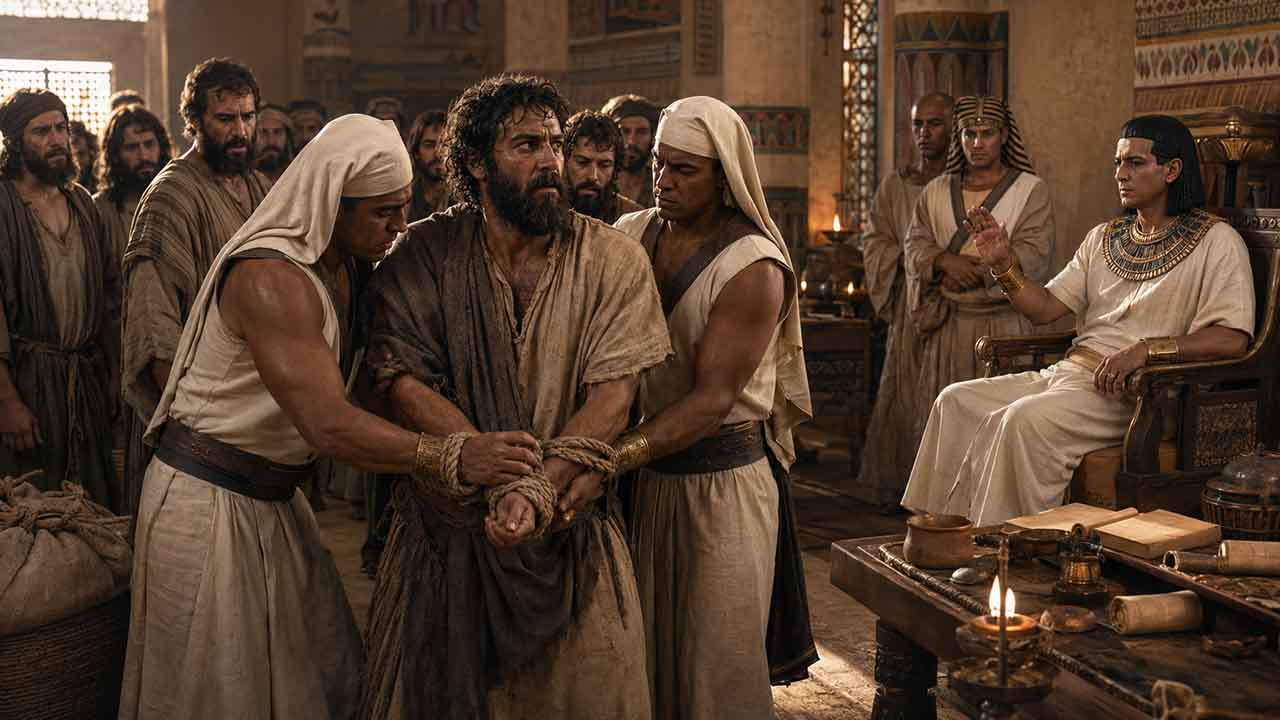
Bound Before the Brothers
Simeon stands restrained under Egyptian authority while his brothers watch in fear and shame, sensing that their hidden guilt has begun to find them. Across the room, Joseph remains composed, concealing both his identity and the sorrow that still binds him to them.
Listen to this Bible Exhibit
Simeon in Judah’s Southern Towns
Simeon stands in the dry southern lands of Israel, among the towns and pastures folded into Judah’s inheritance. His tribe bears the memory of violent anger, wilderness decline, and a scattered place in the land. Yet Simeon is not erased. Counted in the camp, present in battle, preserved in genealogies, and named in final hope, Simeon teaches that sin leaves real scars, but God remembers even a diminished tribe.
A Son Named “Heard”
The tribe takes its name from Simeon, Jacob’s second son and the second son born to Leah. When Simeon was born, Leah said that the Lord had heard that she was hated, and she called his name Simeon [Genesis 29:33]. His name is tied to hearing, and his birth belongs to the painful household rivalry between Leah and Rachel.
Simeon later appears with Levi in the violent retaliation against Shechem after Dinah was defiled [Genesis 34:25-31]. Jacob rebuked the brothers at the time, and he remembered the deed again on his deathbed. His final word over Simeon and Levi was severe: their anger was fierce, their wrath was cruel, and their descendants would be divided and scattered in Israel [Genesis 49:5-7].
Simeon also appears in the Joseph story. When Joseph tested his brothers in Egypt, Simeon was kept as a hostage until Benjamin was brought down [Genesis 42:24] [Genesis 43:23]. Later, Simeon went down to Egypt with Jacob’s household, and his sons became the ancestral lines of the tribe [Genesis 46:10] [Exodus 6:15].
The patriarch Simeon and the tribe that bore his name must be distinguished, but the ancestor’s story casts a long shadow over his descendants.
Counted Around the Tabernacle
Simeon’s later history must be read with sobriety, but not with contempt. In the wilderness, Simeon had a real place among the people of God. At the first census, the tribe numbered 59,300 fighting men, making it one of Israel’s larger tribes at that time [Numbers 1:22-23]. Simeon camped on the south side of the tabernacle under the standard of Reuben, together with Gad [Numbers 2:10-16].
When Israel marched, Simeon moved with that same southern camp [Numbers 10:18-20]. The tribe also brought its offering at the dedication of the altar through Shelumiel, son of Zurishaddai [Numbers 7:36-41]. Shaphat, son of Hori, represented Simeon among the spies sent into Canaan [Numbers 13:5].
These details matter. Before Simeon became a symbol of scattering, the tribe was ordered around the Lord’s dwelling. It had a place in the camp, a place in worship, a place in the march, and a place in Israel’s common calling.
A Sharp Decline
The second census brings a sobering change. Simeon fell from 59,300 fighting men to 22,200, the smallest tribal number recorded at that census [Numbers 26:12-14]. Scripture does not give a complete explanation for this decline, so we should not claim more than the text says.
Yet one dark moment stands nearby. At Baal Peor, a Simeonite leader named Zimri brought a Midianite woman into the camp during Israel’s rebellion, and Phinehas acted in zeal for the Lord, turning away divine wrath [Numbers 25:6-15]. The Bible does not say this event alone caused Simeon’s numerical collapse. But it does place a prominent Simeonite in one of the wilderness generation’s most grievous public sins.
Simeon is also absent from Moses’ final blessing in Deuteronomy 33. Scripture does not explain that omission. It is enough to say that Simeon’s biblical portrait includes not only real belonging but also public shame, diminished strength, and reduced prominence.
Even so, the Lord did not remove Simeon from the covenant people. In the ceremony of covenant blessing and curse, Simeon stood among the tribes appointed on Mount Gerizim to bless the people [Deuteronomy 27:12]. The tribe that knew decline still stood under the word of the Lord.
An Inheritance Within Judah
When the land was divided, Simeon did not receive a large, separate territory like Judah, Ephraim, or Naphtali. Its inheritance consisted of towns within the inheritance of Judah, because Judah’s portion was too large [Joshua 19:1-9].
This arrangement visibly fulfilled Jacob’s old word. Simeon was divided and scattered, not by being cast out of Israel, but by receiving a smaller, embedded place within a greater tribal territory. The tribe had real towns, including Beersheba, Moladah, Hormah, and Ziklag, but its independent identity was fragile.
That balance is important. Simeon had no large, separate territory like Judah or Ephraim, but Simeon did receive a true inheritance within Judah’s land. The inheritance itself preached a lesson. Violent anger had consequences. Covenant sin can leave marks on a people’s future.
Simeon’s towns were also linked with Judah in the list of Levitical cities [Joshua 21:9-16]. The tribe’s life was therefore folded into Judah’s geography, Judah’s strength, and Judah’s later story.
Brothers in Battle
Simeon’s story is not only about decline. At the beginning of Judges, Judah invited Simeon to go up with him against the Canaanites, and Simeon went [Judges 1:3]. Later, Judah and Simeon fought together at Zephath, and the city was called Hormah [Judges 1:17].
This partnership matters. Simeon was diminished, but not useless. It did not hold the leading role, but it still shared in Israel’s covenant responsibility. In Judges 1, the two tribes act as brothers.
Yet the silence that follows is also meaningful. Simeon does not appear in Deborah’s song [Judges 5]. The tribe gives Israel no major judge, no king, and no central sanctuary. Its biblical history moves mostly through smaller notices: towns, clans, movements, battles, and genealogies.
Not every tribe is remembered for greatness. Some are remembered because God does not forget the small.
Clans, Pasture, and Persistence
First Chronicles preserves Simeon’s genealogy and later movements [1 Chronicles 4:24-43]. That passage is not dramatic in the way David’s battles or Elijah’s miracles are dramatic. It is the record of families, leaders, settlements, pasture, and local conflicts.
Simeonite clans sought room for their flocks and found pasture in the south. Some struck down inhabitants in the days of Hezekiah, and others went to Mount Seir and defeated the surviving Amalekites [1 Chronicles 4:39-43].
This is easy to overlook, but it is part of Scripture’s mercy. Chronicles does not let Simeon vanish. It preserves names, fathers, sons, chiefs, towns, and movements. God’s word remembers what political history might ignore.
Simeon and Levi are brothers; weapons of violence are their swords. Let my soul not enter their council; may my glory not be united with their assembly, for in their anger they killed men, and in their self-will they hamstrung oxen. Cursed be their anger, for it is fierce, and their fury, for it is cruel. I will disperse them in Jacob and scatter them in Israel.
Genesis 49:5–7
Simeon in the Days of the Kings
Simeon also appears in the monarchy. When Israel gathered to David at Hebron, 7,100 mighty men from Simeon came ready for war [1 Chronicles 12:25]. David’s administration also names Shephatiah, son of Maacah, as ruler over the Simeonites [1 Chronicles 27:16].
These notices show that Simeon retained some tribal identity. The tribe was smaller and overshadowed by Judah, but it was not erased. It still had warriors, leaders, and a place in the kingdom.
During Asa’s reign, people from Simeon joined Judah when they saw that the Lord was with him [2 Chronicles 15:9]. This is one of the brighter notes in Simeon’s later story. The tribe appears not in violence or rebellion, but in movement toward covenant renewal.
In Josiah’s day, places associated with Simeon are mentioned in the wider sweep of reform, as the king tore down idolatrous places and cleansed the land [2 Chronicles 34:6-7]. Simeon still belonged on the map of God’s dealings with His people.
Remembered in Hope
Simeon’s story could have ended in obscurity. It did not. In Ezekiel’s vision of restored tribal portions, Simeon receives a place in the renewed land [Ezekiel 48:24-33]. One of the gates of the restored city also bears Simeon’s name.
That is a remarkable mercy. The tribe once marked by scattering is named in restoration. The tribe diminished among the allotments is remembered in prophetic hope.
Revelation also names Simeon among the sealed tribes of Israel [Revelation 7:7]. Scripture does not invite us to speculate beyond what is written. The theological force is clear enough: Simeon is not forgotten before God.
The name that began with Leah saying, “The LORD has heard,” becomes a testimony that the Lord still hears, still knows, and still preserves His people.
Why Simeon Matters
Simeon teaches that sin has consequences. Anger, vengeance, deceit, and public rebellion are not small matters. Jacob’s word over Simeon did not disappear. The tribe’s later history bears the marks of scattering, weakness, and diminished prominence.
Simeon also teaches that reduced prominence is not the same as abandonment. The tribe was counted in the wilderness, placed around the tabernacle, given towns in the land, joined Judah in battle, preserved in genealogies, represented under David, and remembered in restoration.
Most of all, Simeon teaches that God’s mercy reaches the diminished. The Lord does not excuse sin, but neither does He forget His covenant people. He disciplines, scatters, humbles, preserves, and remembers.
Simeon’s story calls us to fear the ruinous power of sinful anger, repent of public and private rebellion, and trust the God who keeps His people even when their strength has faded.
In Christ, God gathers what sin has scattered. He does not save only the prominent. He remembers the small, the wounded, the chastened, and the weak. Simeon’s name remains in Scripture as a quiet witness that the Lord hears.