


The Tribe of Manasseh
Blessed on Both Sides of the Jordan
Carousel of images for this Bible Exhibit
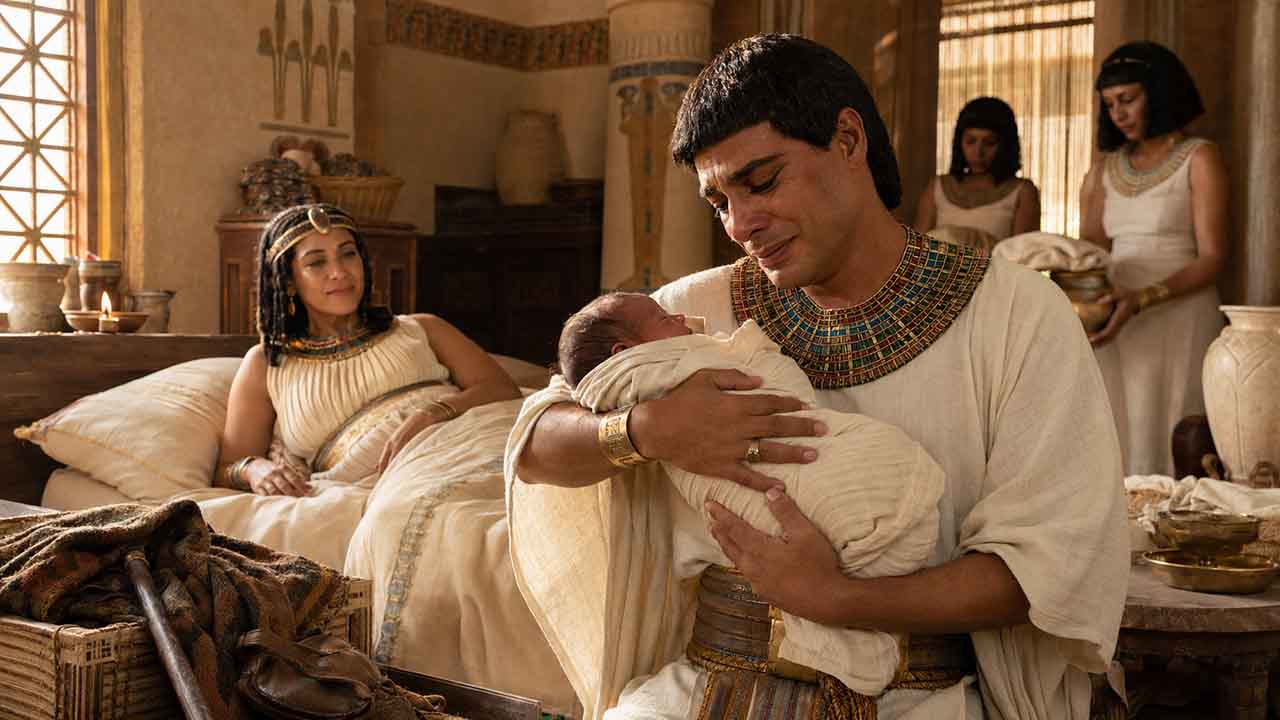
A Son in the Land of Affliction
Joseph holds his firstborn with quiet tears, seeing in Manasseh a gift of mercy after betrayal, slavery, and years of exile. In the warmth of an Egyptian household, the Lord begins to heal Jacob's wounded son through the fragile life of a newborn child.
Listen to this Bible Exhibit
Manasseh Between River and Promise
Manasseh stands with one foot in the hills of Canaan and the other in Gilead and Bashan beyond the Jordan. Born from Joseph’s house, blessed by Jacob, strengthened in the wilderness, and stretched across a divided inheritance, Manasseh teaches that God’s gifts are never small, but they are never weightless. Blessing must become obedience, and distance must never become division.
Joseph’s Firstborn, Jacob’s Adopted Son
Manasseh was the firstborn son of Joseph and Asenath, born in Egypt before the years of famine. Joseph named him Manasseh because God had made him forget his hardship and his father’s house [Genesis 41:50-52]. His younger brother was Ephraim, whose name was tied to fruitfulness.
When Jacob neared death, Joseph brought both sons for a blessing. Jacob adopted Ephraim and Manasseh as his own, giving Joseph a double portion within Israel. Yet Jacob crossed his hands and gave the greater blessing to Ephraim, the younger son. Joseph objected, but Jacob knew what he was doing. Manasseh would become a people and would be great, but Ephraim would be greater [Genesis 48:5-20].
That reversal matters, but it should not diminish Manasseh. Scripture does not present Manasseh as forgotten because Ephraim led. Manasseh remained a true heir in Israel, a Joseph tribe fully blessed by covenant grace.
Counted With the House of Joseph
In the wilderness, Manasseh was counted, camped, and ordered among the people of God. At the first census, the tribe numbered 32,200 fighting men [Numbers 1:34-35]. By the second census, near the edge of the land, Manasseh had grown to 52,700 [Numbers 26:28-34].
Manasseh camped on the west side of the tabernacle with Ephraim and Benjamin, under Ephraim’s standard [Numbers 2:18-24]. When Israel marched, Manasseh moved with that western camp [Numbers 10:22-23]. Gamaliel, son of Pedahzur, brought the tribe’s offering at the dedication of the altar [Numbers 7:54-59]. Gaddi, son of Susi, represented Manasseh among the spies [Numbers 13:11].
These details are more than census notes. Before Manasseh was divided by the Jordan, it was gathered around the Lord’s presence. The tribe’s identity began in worship, covenant order, and fellowship with Israel.
Machir, Gilead, and the Daughters Who Asked Faithfully
Manasseh’s clan structure is especially important because the tribe’s inheritance was shaped by families such as Machir, Gilead, and the descendants of Zelophehad. Machir’s descendants became associated with strength in Gilead, and Manassite leaders helped capture territory east of the Jordan [Numbers 32:39-42].
One of the most beautiful stories in Manasseh’s history comes through Zelophehad’s daughters: Mahlah, Noah, Hoglah, Milcah, and Tirzah. Their father died without sons, and they came before Moses, Eleazar, the chiefs, and the congregation, asking that their father’s name not be removed from his clan [Numbers 27:1-11].
The Lord ruled in their favor. Later, when the question arose of how inherited land would remain within the tribe, the Lord gave further instruction that preserved both family inheritance and tribal integrity [Numbers 36:1-12].
Their appeal was not rebellion. It was covenant courage. They wanted their father’s place in Israel remembered. In a tribe known for its vast territory and strong warriors, Scripture also preserves the faithful wisdom of daughters who trusted in the Lord’s justice.
One Tribe, Two Territories
Manasseh’s inheritance was unusual. It was one tribe, but it received territory on both sides of the Jordan. Eastern Manasseh received land in Gilead and Bashan, including regions associated with the former kingdom of Og [Numbers 32:33] [Deuteronomy 3:13-15] [Joshua 13:29-31]. Golan in Bashan, within eastern Manasseh, became a city of refuge and a Levitical city [Deuteronomy 4:43] [Joshua 20:8] [Joshua 21:27].
Western Manasseh received land north of Ephraim, reaching into central and northern Canaan [Joshua 17:1-13]. This included valuable and strategic territory, but also difficult strongholds. Scripture names cities and regions where Canaanite presence remained, including Beth-shean, Ibleam, Dor, Endor, Taanach, and Megiddo [Judges 1:27-28].
Manasseh’s broad inheritance was a gift, but it was also a test. The eastern half stood on a frontier, exposed to danger beyond the Jordan. The western half stood among rich land and fortified Canaanite centers. Manasseh’s calling was not simplified by blessing. It was deepened by blessing.
The Altar of Witness
Because part of Manasseh lived east of the Jordan and part lived west of it, geography could easily have become a spiritual fault line.
After the eastern tribes fulfilled their duty in the conquest, Joshua released them to return home. On the way, Reuben, Gad, and the half-tribe of Manasseh built a large altar near the Jordan. The western tribes feared apostasy. If this were a rival altar for sacrifice, it would be rebellion against the Lord.
But the eastern tribes explained that the altar was not for burnt offerings or sacrifices. It was a witness. They feared that future generations might say the tribes beyond the Jordan had no share in the Lord. The altar testified that they belonged to the same God and the same covenant people [Joshua 22:1-34].
This moment is central to Manasseh’s story. The tribe’s inheritance crossed a river, but its worship could not be divided. Distance must never become covenant separation.
Strength Without Full Obedience
Manasseh had land, numbers, and military strength, but Scripture refuses to flatter the tribe. The house of Joseph complained to Joshua that its allotment was too small. Joshua answered that if they were truly numerous and strong, they should clear the forested hill country and drive out the Canaanites, even though they had iron chariots [Joshua 17:14-18].
The issue was not whether the tribe had a future. The Lord had given them one. The issue was whether strength would become obedience.
The record is sobering. Manasseh did not drive out the Canaanites from several key cities. When Israel grew stronger, they forced the Canaanites into labor rather than fully obeying the Lord’s command. Partial victory can still be disobedience. Manasseh teaches that inheritance must be possessed by faith, not merely occupied by convenience.
Gideon and the God Who Uses the Weak
In the days of the judges, one of Manasseh’s most famous sons was Gideon. He came from Ophrah, from the clan of Abiezer, within Manasseh. When the angel of the Lord called him, Gideon did not feel like a mighty warrior. He said his clan was the weakest in Manasseh and that he was the least in his father’s house [Judges 6:11-16].
That was the point. The Lord would deliver Israel from Midian in a way that stripped away human boasting. Gideon’s reduced army and surprising victory showed that salvation belongs to the Lord [Judges 7:1-25].
Gideon’s story fits Manasseh perfectly. The tribe had size and strength, but God chose its weakness to display His power. Manasseh could not trust land, numbers, or reputation. Its hope had to be the Lord.
Gilead belongs to me, Manasseh is mine; Ephraim also is the helmet of my head, Judah my royal scepter.
Psalm 60:7
Warriors, Reform, and Exile
Manasseh’s later history contains courage and warning. Warriors from Manasseh joined David during the transition to his kingship, including men who came to him at Ziklag and thousands who later gathered at Hebron [1 Chronicles 12:19-37]. The tribe had a place in the rise of the king whom God chose.
Yet the eastern tribes, including Manasseh, also fell into unfaithfulness. Chronicles says they broke faith with the God of their fathers and went after the gods of the peoples of the land. Judgment came through Assyria, and they were carried away [1 Chronicles 5:23-26].
Still, Manasseh’s story was not only exile. Some from Manasseh came over to Asa when they saw that the Lord was with him [2 Chronicles 15:9]. In Hezekiah’s day, some from Manasseh humbled themselves and came to Jerusalem for the Passover. Though some were not ceremonially prepared, Hezekiah prayed for them, and the Lord healed the people because they had set their hearts to seek Him [2 Chronicles 30:10-20]. Josiah’s reforms also reached into areas associated with Manasseh [2 Chronicles 34:6].
The tribe’s history cannot be reduced to one word. It includes valor, compromise, judgment, humility, and mercy.
Remembered by the Lord
Even after judgment, Manasseh is not erased. The land may be contested, the tribe may be scattered, and the people may be disciplined, but the Lord does not lose what is His.
Ezekiel’s vision of restored tribal portions gives Manasseh a place in the renewed land [Ezekiel 48:4]. Revelation also names Manasseh among the sealed tribes of Israel [Revelation 7:6]. Scripture does not invite speculation over every variation in tribal lists. It invites worship of the God who remembers His people.
Manasseh’s name means that God made Joseph forget his sorrow, but Manasseh’s story also shows the reverse: God does not forget His covenant people.
Why Manasseh Matters
Manasseh teaches that blessing is real, but blessing carries responsibility. The tribe received a rich inheritance, a growing population, heroic leaders, and land on both sides of the Jordan. Yet those gifts did not excuse partial obedience.
Manasseh also teaches that unity must be guarded. The altar by the Jordan reminds us that physical distance can become spiritual danger if God’s people stop bearing witness to their shared life in the Lord.
Most of all, Manasseh teaches that God’s mercy outlasts human failure. The tribe was strong, yet often disobedient. It was judged, yet not forgotten. It was scattered, yet still named in hope.
The church needs Manasseh’s lesson: receive God’s gifts with gratitude, use strength in obedience, guard unity in truth, and trust the Lord who remembers His people beyond the ruins of their own unfaithfulness.
