


The Tribe of Gad

The Tribe of Gad
Courage Beyond the Jordan
Carousel of images for this Bible Exhibit
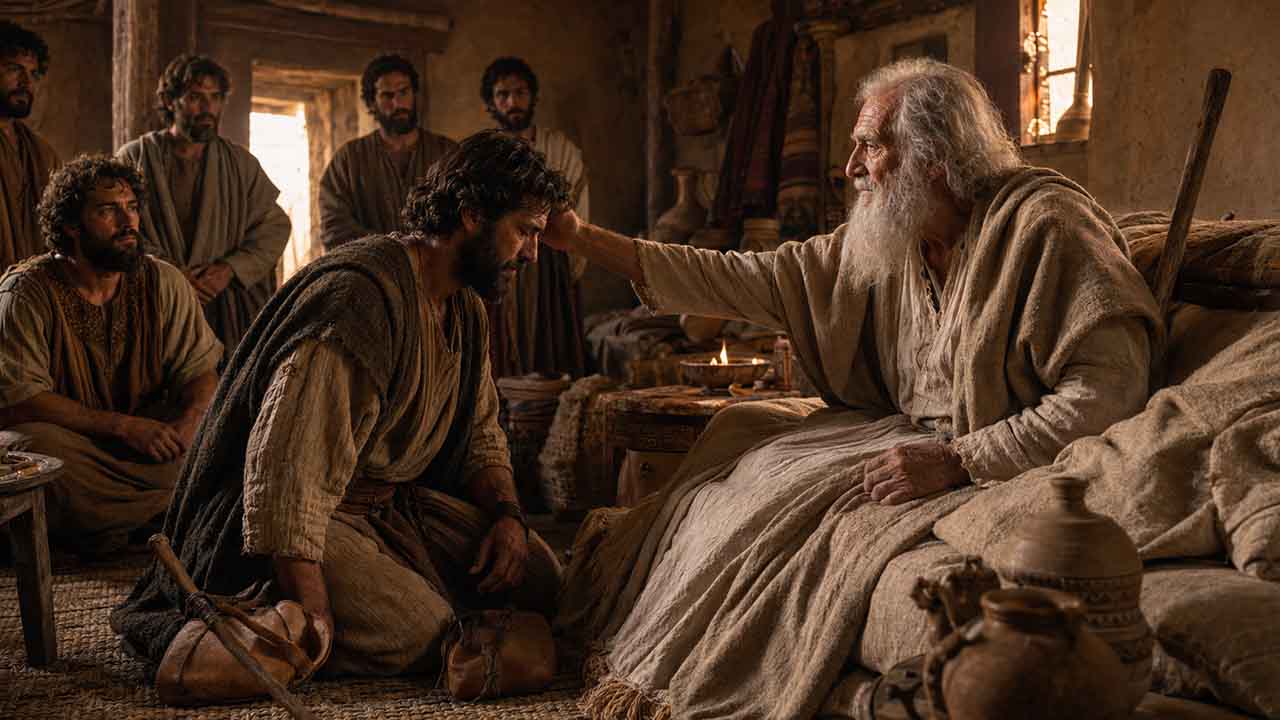
The Son Who Would Not Be Overcome
Gad bows beneath Jacob’s final blessing, receiving a hard word of attack, endurance, and reversal. Though raiders would press against him, his future would not end in defeat, for the Lord would make him strike back at their heels.
Listen to this Bible Exhibit
Gad on Israel’s Eastern Frontier
Gad stands east of the Jordan, among the pasturelands and strongholds of Gilead. His tribe chose good land for flocks, but did not abandon the people of God. Armed for battle, tested by distance, and later wounded by exile, Gad becomes a witness that courage is holy only when it remains bound to the Lord and to His covenant people.
A Son Named Fortune
The tribe takes its name from Gad, the seventh son of Jacob and the first son born to Zilpah, Leah’s servant. When Gad was born, Leah spoke with joy, and his name carried the sense of fortune or blessing [Genesis 30:9-11]. Gad later went down to Egypt with Jacob’s household, and Scripture names seven sons who became the clans of the tribe [Genesis 46:16].
Jacob’s blessing over Gad was brief but powerful: “Raiders shall raid Gad, but he shall raid at their heels” [Genesis 49:19]. From the beginning, Gad’s future was pictured as conflict met with endurance. This would fit the tribe’s later life on Israel’s frontier, where blessing and danger stood close together.
Counted Beside the Tabernacle
In the wilderness, Gad was counted, ordered, and placed among the people of God. At the first census, the tribe had 45,650 fighting men [Numbers 1:24-25]. Near the end of the wilderness years, Gad numbered 40,500 [Numbers 26:15-18].
Gad camped on the south side of the tabernacle under the standard of Reuben, together with Simeon [Numbers 2:10-16]. When Israel marched, Gad moved in ordered procession with that camp [Numbers 10:18-20]. The tribe also offered its dedication gift for the altar through Eliasaph, son of Deuel [Numbers 7:42-47]. Geuel, son of Machi, represented Gad among the twelve spies [Numbers 13:15].
These details matter. Before Gad was a frontier tribe, it was a tabernacle tribe. Its identity began not with geography, livestock, or military strength, but with a place among the people gathered around the Lord’s presence.
A Land Requested, a Duty Accepted
Gad’s defining moment came before Israel crossed the Jordan. The Gadites and Reubenites had many livestock, and the land east of the Jordan was well suited for herds. They asked Moses to receive that land as their inheritance, and Moses warned that such a request would become sin if it meant settling comfortably while their brothers went to war [Numbers 32:1-42].
Gad answered well. The tribe promised to build fortified cities for families and folds for livestock, and then to cross the Jordan, armed for battle, until the other tribes received their inheritance. Moses accepted the vow, but warned them that failure would be a sin against the Lord.
Joshua later reminded Gad, Reuben, and the half-tribe of Manasseh of this obligation, and they affirmed their loyalty [Joshua 1:12-18]. When Israel crossed the Jordan, the armed men of the eastern tribes crossed with them [Joshua 4:12-13]. Gad received an eastern inheritance, but not at the cost of western Israel’s need. The tribe’s blessing became honorable because it was joined to shared duty.
An Inheritance in Gilead
Gad’s inheritance lay east of the Jordan, in Gilead and the Jordan Valley, between Reuben to the south and Manasseh to the north. Its towns included Jazer, Beth-nimrah, Succoth, Zaphon, and portions of the former kingdom of Sihon [Joshua 13:24-28]. Gad also gave cities to the Levites, including Ramoth in Gilead, Mahanaim, Heshbon, and Jazer. Ramoth in Gilead became a city of refuge [Joshua 20:8] [Joshua 21:38-39].
The land was useful and desirable, especially for a people with flocks. But it was also exposed. The Jordan separated Gad from much of Israel’s shared life, and hostile peoples pressed from the east and north. Gad’s inheritance was a gift, but one that required courage, watchfulness, and visible unity with the rest of Israel.
That is one of Gad’s central lessons. A good place can become spiritually dangerous if distance from God’s people becomes distance from God’s worship.
The Altar of Witness
After the conquest, Joshua released the eastern tribes to return home. When Gad, Reuben, and the half-tribe of Manasseh reached the Jordan region, they built a large altar. The western tribes feared rebellion. If this were a rival altar for sacrifice, it would be treachery against the Lord.
But the eastern tribes explained that the altar was not for burnt offerings or sacrifices. It was a witness. They feared that future generations west of the Jordan might say that Gad and the other eastern tribes had no share in the Lord. The altar stood to declare, “The LORD is God” [Joshua 22:1-34].
This moment is one of Gad’s finest. The tribe understood that geography can become a spiritual fault line. They did not want their children to grow up as outsiders to the covenant. The altar was not a replacement for true worship. It was a testimony that distance must not become division.
Lionlike Strength
Moses’ blessing over Gad is full of strength. Gad is pictured as enlarged by God, crouching like a lion, receiving a leader’s portion, and carrying out the Lord’s righteous will with Israel [Deuteronomy 33:20-21]. The tribe would be remembered for courage.
That courage appears vividly in David’s day. Some Gadites came to David while he was still in the stronghold, before his kingdom was secure. Scripture describes them as mighty warriors, skilled with shield and spear, with faces like lions and speed like gazelles on the mountains [1 Chronicles 12:8-15]. Later, Gadites joined the great gathering at Hebron to make David king [1 Chronicles 12:37-38].
Gad’s strength also appears in the record of the eastern tribes’ war against the Hagrites, Jetur, Naphish, and Nodab. The Chronicler says they prevailed because they cried out to God and trusted Him [1 Chronicles 5:18-22]. That is the key to reading Gad’s courage. Scripture does not glorify mere toughness. Gad was strongest when its warriors knew that victory belonged to the Lord.
Of Gad he said, “Blessed be the one who enlarges Gad; he lives there like a lion, tearing at arm and scalp. He chose the best land for himself, for there the ruler’s portion was reserved; he came with the leaders of the people. He carried out the righteous acts of the Lord and his judgments concerning Israel.”
Deuteronomy 33:20–21
The Cost of the Frontier
Gad’s location brought danger. In Deborah’s song, Gilead remained beyond the Jordan, a sobering reminder that frontier life could lead to detachment from Israel’s common struggle [Judges 5:17]. During the Judges, the region of Gilead suffered Ammonite pressure until the Lord raised up Jephthah [Judges 10:6-11:33].
Later, during the monarchy, Gad’s region was struck by foreign powers. Hazael of Aram attacked the land east of the Jordan, including the Gadites, Reubenites, and Manassites [2 Kings 10:32-33]. Chronicles gives the deeper spiritual diagnosis: the eastern tribes broke faith with the God of their fathers and were carried away by Assyria [1 Chronicles 5:25-26].
Jeremiah gives another painful glimpse. Ammon is pictured as occupying the cities of Gad, as though Israel had no heir [Jeremiah 49:1]. The tribe that once received a good inheritance saw that land fall under judgment and foreign pressure.
Gad’s story is therefore not a simple story of heroism. Courage could not save the tribe when covenant unfaithfulness took root. The frontier required brave men, but even more, it required faithful hearts.
Remembered in Hope
Judgment did not erase Gad from Scripture. In Ezekiel’s vision of restored tribal portions, Gad receives a place in the renewed land, and one of the city’s gates bears Gad’s name [Ezekiel 48:27-34]. In Revelation, Gad appears among the tribes sealed by God [Revelation 7:5].
These final references matter. Gad’s name survives exile, loss, and judgment. The Lord remembers what history scatters. The God who placed Gad around the tabernacle, gave Gad land in Gilead, disciplined Gad for unfaithfulness, and named Gad in future hope is faithful to preserve His people.
Why Gad Matters
Gad teaches that courage is not enough by itself. Courage must be covenant courage. Gad was blessed with land, strength, warriors, cities, and pasture, but those gifts had to be used in loyalty to God and love for His people.
The tribe also warns us that distance can become dangerous. Separation may begin as geography, circumstance, or calling, but it must never become spiritual isolation. Gad’s altar of witness still speaks: God’s people must labor to remain visibly joined to the Lord and to one another.
Most of all, Gad points us to God’s faithfulness. He gives good gifts, calls His people to shared obedience, judges unfaithfulness, and remembers those who belong to Him. The tribe beyond the Jordan was never beyond the reach of His covenant mercy.