


The Tribe of Ephraim

The Tribe of Ephraim
The Fruitful Tribe God Would Not Forget
Carousel of images for this Bible Exhibit
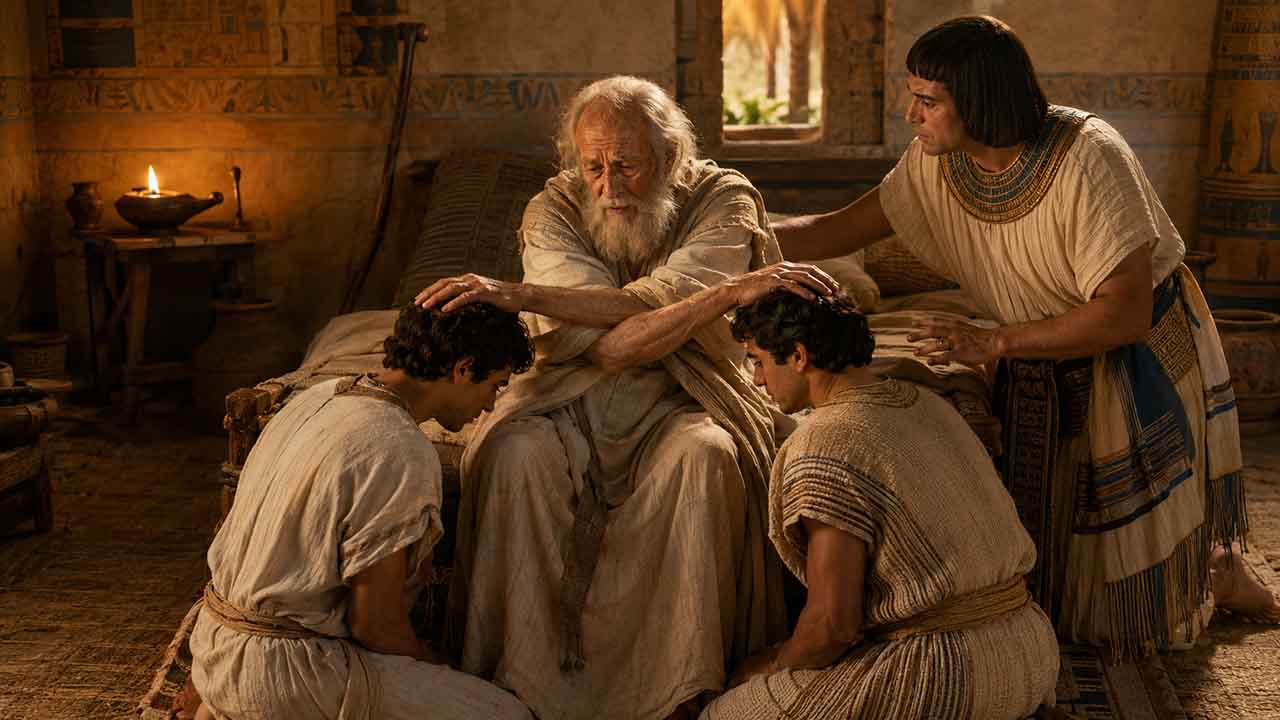
The Younger Receives the Greater Blessing
With deliberate crossed hands, Jacob blesses Ephraim above Manasseh, overturning the expected order while Joseph watches in astonishment. In this quiet room in Egypt, the dying patriarch shows that the covenant future rests not on human custom, but on the Lord’s sovereign purpose.
Listen to this Bible Exhibit
Ephraim in Israel’s Heartland
Ephraim stands among the green hills of central Israel, with Shiloh and Shechem behind him and the shadow of divided kingdoms ahead. Blessed as Joseph’s younger son, raised to prominence in Israel’s heartland, and later rebuked by the prophets, Ephraim becomes a living testimony that privilege cannot replace obedience and that God’s mercy remembers even a wandering son.
The Younger Son Given the Greater Blessing
Ephraim’s story begins in Egypt, not Canaan. He was the second son of Joseph and Asenath, born before the years of famine. Joseph gave him a name tied to fruitfulness, saying that God had made him fruitful in the land of his affliction [Genesis 41:50-52].
Jacob later adopted Ephraim and Manasseh as his own sons, giving Joseph a double portion within Israel. When Joseph brought the boys for blessing, he placed Manasseh, the firstborn, where Jacob’s right hand would naturally fall. But Jacob crossed his hands and gave the greater blessing to Ephraim [Genesis 48:5-20].
This was not confusion. It was providence. Ephraim was younger, but God’s blessing did not align with human expectations. The birthright passed to Joseph, though the royal line would come through Judah [1 Chronicles 5:1-2]. From the beginning, Ephraim’s story carried both privilege and tension: great fruitfulness in Joseph’s house, but not the final scepter.
Counted and Camped Near the Tabernacle
In the wilderness, Ephraim numbered 40,500 fighting men at the first census [Numbers 1:32-33]. At the second census, Ephraim numbered 32,500 [Numbers 26:35-37]. Ephraim was not Israel’s largest tribe, but it held an honored place. On the west side of the tabernacle, Ephraim led the camp that included Manasseh and Benjamin [Numbers 2:18-24].
The tribe also gave Israel one of its greatest leaders. Hoshea son of Nun, the spy from Ephraim, was renamed Joshua by Moses and later led Israel into the land [Numbers 13:8, 16]. Moses’ blessing over Joseph also anticipated strength and abundance, speaking of the “ten thousands of Ephraim” and the “thousands of Manasseh” [Deuteronomy 33:13-17].
Ephraim was being formed in the presence of God. The tribe stood close to the tabernacle, close to Joseph’s blessing, and close to the future leadership of Israel.
An Inheritance in the Heart of the Land
When Israel entered Canaan, Ephraim received territory in the central hill country [Joshua 16:1-10]. This inheritance was fertile, strategic, and protected by the land’s heights. Ephraim stood in Israel’s heartland, bordered by Manasseh to the north and Benjamin and Dan to the south.
Yet the gift required faith. The house of Joseph complained that its allotment was too small, and Joshua told them to clear the forested hill country and drive out the Canaanites with their iron chariots [Joshua 17:14-18]. Ephraim had strength, but strength had to become obedience.
The record is sobering. Ephraim did not drive out the Canaanites from Gezer [Judges 1:29]. The tribe was blessed with a rich inheritance, but compromise remained in the land. This pattern would become one of Ephraim’s great warnings: a people can receive much from God and still fail to walk fully with Him.
Ephraim’s territory also became a place of deep national memory. Shiloh, where the tabernacle was set up after the conquest, was in Ephraim’s region [Joshua 18:1]. Joshua was buried in the hill country of Ephraim, and Joseph’s bones were buried at Shechem [Joshua 24:30-32]. Ephraim was not a remote borderland. It stood in the spiritual and geographic center of Israel’s story.
Strength With a Proud Edge
Ephraim had courage and influence, but Scripture is honest about the tribe’s pride. In the days of Gideon, Ephraim helped capture Midianite leaders, then complained that Gideon had not called them earlier. Gideon answered with humility, and the conflict cooled [Judges 7:24-8:3].
The same spirit later brought disaster. When Jephthah defeated the Ammonites, the men of Ephraim were furious that they had not been included. This time, the conflict became a civil war, and the word “Shibboleth” became a test that exposed Ephraimite identity at the Jordan crossings [Judges 12:1-6].
These stories do not deny Ephraim’s strength. They show strength bent inward. Influence is a gift, but influence without humility wounds the people of God.
The book of Judges also places Micah’s idolatrous shrine in the hill country of Ephraim [Judges 17:1-13]. That detail matters. False worship was not only a border problem. It was growing in Israel’s heartland.
From Shiloh to Schism
As Israel’s monarchy developed, Judah rose to prominence. Psalm 78 looks back and says that God rejected the tent of Joseph, did not choose the tribe of Ephraim, but chose Judah, Mount Zion, and David, His servant [Psalm 78:67-72]. Ephraim’s earlier privilege did not bind God’s hands. Covenant history is governed by God’s faithfulness, not tribal entitlement.
After Solomon’s death, the old tensions broke open. Jeroboam, son of Nebat, an Ephraimite, led the northern revolt [1 Kings 11:26]. He fortified Shechem in the hill country of Ephraim and established rival worship at Bethel and Dan [1 Kings 12:1-33].
From then on, Ephraim often became a representative name for the northern kingdom of Israel [Isaiah 7:2-9] [Hosea 5:3-5]. The fruitful tribe had become the leading name for a divided and idolatrous kingdom.
Is Ephraim my dear son, the child in whom I delight? Though I often speak against him, I still remember him. Therefore my heart yearns for him; I will surely have mercy on him, declares the Lord.
Jeremiah 31:20
Judged by the Prophets, Remembered by Mercy
The prophets speak with devastating clarity. Hosea says, “Ephraim is joined to idols” [Hosea 4:17]. Ephraim looked to Assyria for healing instead of returning to the Lord [Hosea 5:13].
Yet Hosea also gives one of Scripture’s tenderest portraits of divine mercy. The Lord remembers teaching Ephraim to walk, taking him by the arms, and loving him like a son. Then God asks, “How can I give you up, Ephraim?” [Hosea 11:1-9].
“Is Ephraim my dear son? … I will surely have mercy on him.”
Jeremiah hears Ephraim grieving under discipline and turning back toward the Lord [Jeremiah 31:18-20]. He also pictures watchmen on the hills of Ephraim calling the people to go up to Zion [Jeremiah 31:6]. That is a beautiful reversal. The tribe once associated with rival worship is summoned toward restored worship.
The hope grows even fuller in Ezekiel. The prophet sees the stick of Joseph, “which is in the hand of Ephraim,” joined with Judah under one king, one covenant, and one shepherd [Ezekiel 37:15-28]. The tribe that helped embody Israel’s division becomes part of God’s promise to heal it.
In Revelation 7, Ephraim is not named separately among the sealed tribes. Joseph and Manasseh are named [Revelation 7:6-8]. Scripture does not explain Ephraim’s separate omission, so wisdom avoids speculation. The vision still reminds us that God knows and secures His people completely.
Why Ephraim Matters
Ephraim teaches that blessing is not entitlement. The tribe received a great name, a rich inheritance, honored leaders, sacred places, and central influence. Yet pride and idolatry turned fruitfulness into barrenness.
But Ephraim also teaches that judgment is not God’s final word over a repentant people. The Lord disciplines His wandering son, but He does not forget him. He exposes false glory, tears down rival worship, and promises reunion under the King He appoints.
Ephraim’s story calls us to receive God’s gifts with humility, flee the idols that hollow out the heart, and rest in the mercy of the Father who remembers His children.