


The Tribe of Judah

The Tribe of Judah
The Lion, the Scepter, and the King
Carousel of images for this Bible Exhibit
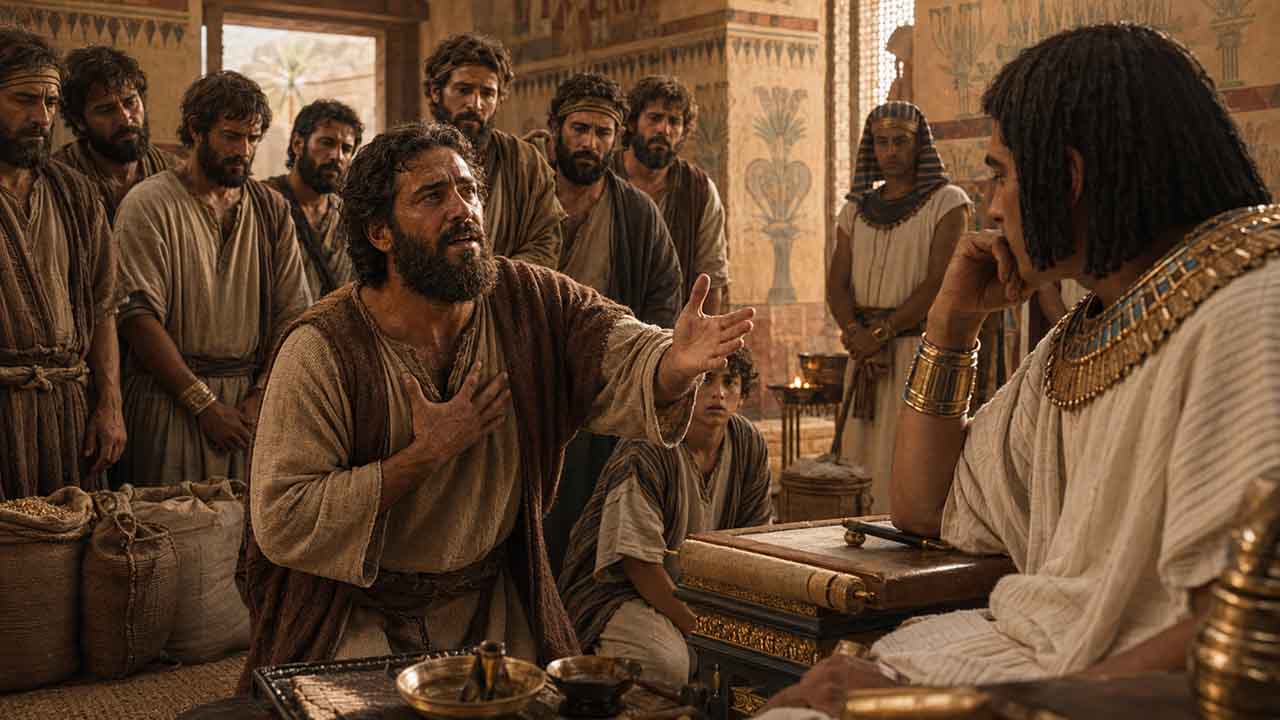
The Brother Who Stood in the Breach
Judah pleads before Joseph with his hand over his heart, offering himself in Benjamin’s place so his father will not be crushed by grief. In this moment, the brother who once failed Joseph becomes an intercessor, marked by repentance, courage, and costly love.
Listen to this Bible Exhibit
Judah in the Southern Hills
Judah stands among the rugged hills of the south, with Hebron behind him, Bethlehem before him, and Jerusalem rising in the distance. From this tribe came Caleb’s courage, David’s throne, the temple city, exile’s sorrow, and the promised King. Judah’s story is not a monument to tribal greatness, but a testimony to the God who brings royal hope through sinners, sufferers, and a line preserved by grace.
A Son Named Praise
The tribe takes its name from Judah, the fourth son of Jacob and Leah. When he was born, Leah said, “This time I will praise the LORD,” and she called his name Judah [Genesis 29:35]. His name is tied to praise, but his own life was marked by both sin and mercy.
Judah helped spare Joseph from death, but only by selling him into slavery [Genesis 37:26-28]. Later, his sin with Tamar exposed his hypocrisy, and yet his confession, “She is more righteous than I,” showed a humbled man brought into the light [Genesis 38:1-30]. From that broken story came Perez, through whom Judah’s royal line would eventually continue.
Judah also changed in the story of Joseph. When Benjamin was in danger, Judah offered himself as a substitute so the beloved son could return to his father [Genesis 44:18-34]. The brother who once sold Joseph became the brother willing to stand in another’s place.
This matters for the tribe’s whole story. Judah’s prominence never rests on human purity. It rests on God’s sovereign grace. The Lord chose to carry the kingly promise through a line that needed mercy from the beginning.
The Lion and the Scepter
Jacob’s blessing over Judah is one of the great turning points in the Bible’s tribal story. Judah is pictured as a lion, victorious over enemies, praised by his brothers, and associated with royal rule [Genesis 49:3-12].
Jacob’s final words explain the movement of leadership among the brothers. Reuben, Simeon, and Levi are all placed under judgment for sin, while Chronicles later explains that Joseph received the birthright but Judah received the ruler’s place [1 Chronicles 5:1-2]. This distinction is important. Joseph received a double portion through Ephraim and Manasseh. Judah received the royal trajectory.
Jacob’s words look beyond the tribe’s early history. The lion imagery points to strength and rule. The scepter points to kingship. The abundance of vine, wine, and milk points to blessing under righteous reign. Judah’s calling was not merely to be large or influential. It was to carry royal hope until the true King came.
First in the Wilderness
In the wilderness, Judah was already prominent. At the first census, Judah numbered 74,600 fighting men, the largest count among the tribes [Numbers 1:26-27]. At the second census, Judah numbered 76,500 [Numbers 26:19-22].
Judah camped on the east side of the tabernacle, toward the sunrise, with Issachar and Zebulun [Numbers 2:3-9]. When Israel marched, Judah went first [Numbers 10:14]. This position was more than geography. Judah stood at the front of Israel’s ordered life around the presence of God.
Nahshon, son of Amminadab, led Judah in the wilderness [Numbers 1:7]. He also brought Judah’s offering at the dedication of the altar [Numbers 7:12-17]. His name later appears in the genealogy leading to Christ [Matthew 1:4]. Even in the camp formation, the line of promise was quietly moving forward.
Moses’ blessing over Judah is brief, but it is full of dependence: “Hear, O LORD, the voice of Judah” [Deuteronomy 33:7]. The tribe that would carry kingship still needed God to hear, help, and defend.
Caleb and the Courage of Faith
Judah’s finest early representative was Caleb, son of Jephunneh. He represented Judah among the twelve spies [Numbers 13:6]. When most of Israel trembled before the land’s giants, Caleb urged the people to trust the Lord [Numbers 14:6-9].
Caleb did not deny the enemy’s strength. He simply measured the enemy against the promise and presence of God. That is biblical courage. It is not blindness to danger. It is faith that sees the Lord more clearly than the threat.
Years later, Caleb still trusted the promise. He asked Joshua for the hill country where the Anakim lived, because the Lord had spoken and Caleb still believed [Joshua 14:6-15]. His inheritance at Hebron became one of Judah’s great memories.
Yet Judah’s story also includes Achan, whose hidden sin brought trouble on Israel after Jericho [Joshua 7:1-26]. Caleb and Achan stand as a sober pair. The same tribe can show courageous faith and destructive disobedience. Tribal privilege never removes the need for holiness.
A Large Southern Inheritance
Judah received a large inheritance in the south of the land [Joshua 15:1-63]. Its territory included the Negeb, the lowlands, the hill country, and the wilderness near the Dead Sea. Its towns and landscapes would become central to the Bible’s story: Hebron, Bethlehem, the wilderness of Judah, and eventually Jerusalem at the northern edge of Judah’s world.
The allotment was so large that Simeon later received an inheritance within Judah’s territory [Joshua 19:1-9]. Judah’s land was broad, varied, and strategically important. The hill country gave refuge and strength. The lowlands opened toward Philistine pressure. The wilderness formed shepherds, fugitives, prophets, and kings.
After Joshua’s death, Judah was named first to go up against the Canaanites [Judges 1:1-20]. Judah fought alongside Simeon and gained real victories. Othniel, connected with Caleb’s family, later became Israel’s first judge [Judges 3:7-11].
But even Judah’s victories did not cure Israel’s deeper problem. The book of Judges still descends into covenant disorder. Judah could lead battles, but no tribe could save Israel from sin. The people needed more than tribal strength. They needed a righteous king.
From Bethlehem to David’s Throne
The royal hope of Judah came into focus through David. Ruth ends by tracing the line from Perez to Boaz, Obed, Jesse, and David [Ruth 4:18-22]. Then the Lord sent Samuel to Bethlehem, where David, the son of Jesse, was chosen by God [1 Samuel 16:1-13].
David first reigned over Judah at Hebron [2 Samuel 2:1-4]. Later, he was anointed over all Israel and reigned from Jerusalem [2 Samuel 5:1-10]. In David, Judah’s tribal calling became national. The lion and the scepter began to take visible shape.
The Lord then made covenant promises to David concerning his house, his throne, and his son [2 Samuel 7:12-16]. From this point forward, Judah’s story is bound to David’s line, Jerusalem, Zion, and the hope of the temple. Psalm 78 looks back and says that God did not choose the tribe of Ephraim, but chose Judah, Mount Zion, and David, His servant [Psalm 78:67-72].
This was not because Judah deserved grace more than the others. It was because God keeps His purpose through His chosen king.
The scepter will not depart from Judah, nor the ruler’s staff from between his feet, until he comes to whom it belongs, and the obedience of the nations shall be his.
Genesis 49:10
The Kingdom of Judah
After Solomon, the kingdom was divided. The northern tribes broke away, and the southern kingdom came to be known as Judah [1 Kings 12:16-24]. At this point, we must distinguish the tribe from the kingdom. The kingdom of Judah was centered in Judah’s old territory and ruled by David’s house. Still, it also included Benjamin, Jerusalem, Levites, and others who joined themselves to the southern kingdom [2 Chronicles 11:13-17].
Judah had immense privilege. Jerusalem was there. The temple was there. David’s throne was there. Yet privilege did not make Judah immune to sin. The prophets rebuked Judah for idolatry, injustice, false worship, and refusal to hear the word of the Lord [Isaiah 1:1-20; Jeremiah 7:1-15; Micah 3:9-12].
Judgment finally came. Jerusalem was broken, the temple was burned, and the people were carried into exile [2 Kings 25:1-21] [2 Chronicles 36:15-21]. Judah’s story proves that sacred places and royal promises must never be used as shelter for rebellion.
But exile was not the end. The Lord stirred Cyrus to send the exiles back, and Judah’s hope continued through return, rebuilding, and promise [Ezra 1:1-5]. The line remained alive because God remained faithful.
Fulfilled in Jesus Christ
The deepest meaning of Judah is found in Jesus Christ. Matthew begins by placing Jesus in the line of Abraham, Judah, David, and the kings [Matthew 1:1-17]. Luke also traces His descent through David and Judah [Luke 3:23-33]. Micah had promised that the ruler of Israel would come from Bethlehem, the town of David in Judah [Micah 5:2]. Matthew shows that promise being applied to the birth of Christ [Matthew 2:1-6].
Hebrews teaches that our Lord came from Judah, not Levi, and that His priesthood is not according to the old Levitical order but according to the order of Melchizedek [Hebrews 7:11-17]. Jesus is the King from Judah and the perfect Priest who brings His people to God.
Revelation brings the imagery to its glorious climax. John hears of the Lion of the tribe of Judah, the Root of David, who has conquered, but when John looks, he sees a Lamb standing as though slain [Revelation 5:5-6]. The Lion triumphs as the Lamb. The King conquers by sacrifice.
Judah’s promise does not end in tribal pride, political nostalgia, or human monarchy. It ends in Christ, the true Son of David, the King who bears the scepter, opens the scroll, judges rightly, and redeems His people by His blood.
Judah is also named first among the sealed tribes in Revelation 7 [Revelation 7:5]. The tribe of praise remains remembered, but its glory is now gathered into the worship of the Lamb.
Why Judah Matters
Judah teaches that God keeps royal promises through flawed people. Judah, the man, needed repentance. Judah, the tribe, needed holiness. Judah’s kingdom needed judgment. Yet through it all, God preserved the line of the King.
Judah also warns us against trusting privilege. A great name, a sacred city, a temple, a throne, and a rich history could not protect Judah from judgment when the people turned from the Lord. God’s gifts are never permission to drift. They summon God’s people to faithfulness.
Most of all, Judah points us to Jesus. The lion, the scepter, David’s throne, Bethlehem’s promise, exile’s grief, and restoration’s hope all find their answer in Him. Judah’s story begins with praise and ends with worship: “Worthy is the Lamb who was slain” [Revelation 5:12].