


King Rehoboam
reigned 931-915 BC
Carousel of images for this Bible Exhibit
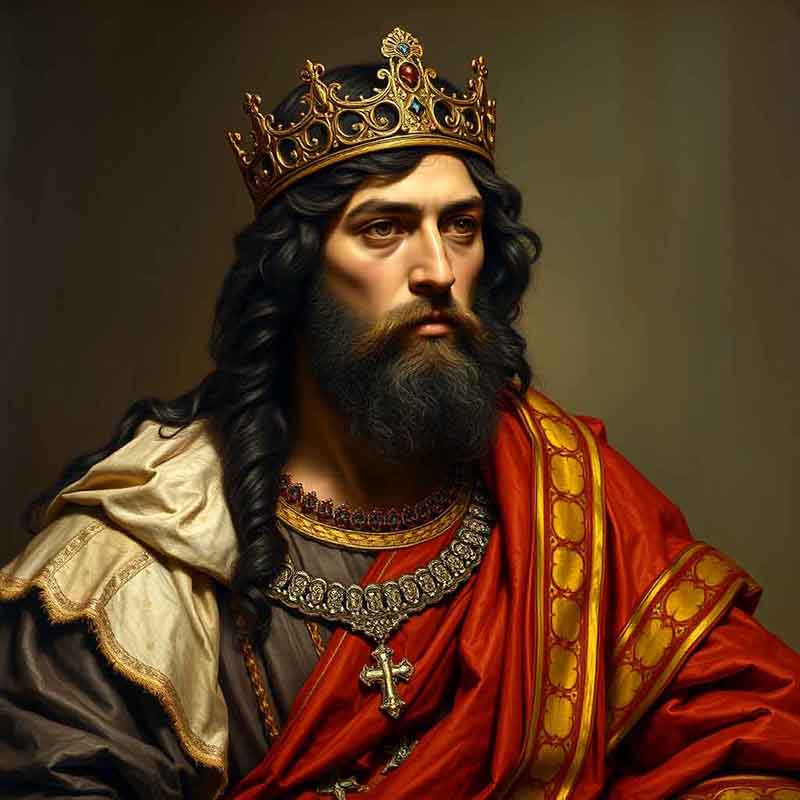
King Rehoboam, the First King of Judah
Rehoboam inherited the throne at a turning point in Israel’s history and ruled the Kingdom of Judah for seventeen years. By rejecting wise counsel and ruling with pride, he triggered the division of the kingdom and became its first king. Though his reign included moments of humility and mercy from God, it was marked by conflict and spiritual decline, leaving a lasting lesson about the cost of arrogance in leadership.
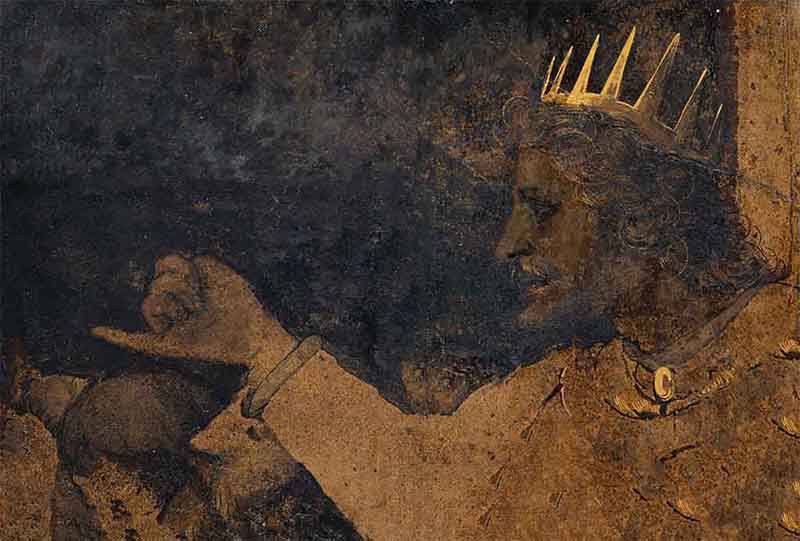
King Rehoboam Displays His Strength
This fragment of a wall painting shows King Rehoboam boldly gesturing with his little finger to boast that it was thicker than his father’s leg, a vivid expression of his pride and misplaced confidence. Originally part of the Great Council Chamber in Basel Town Hall and now preserved at the Kunstmuseum Basel in Switzerland, the image captures the king’s character at a pivotal moment in his reign and in Israel’s history.
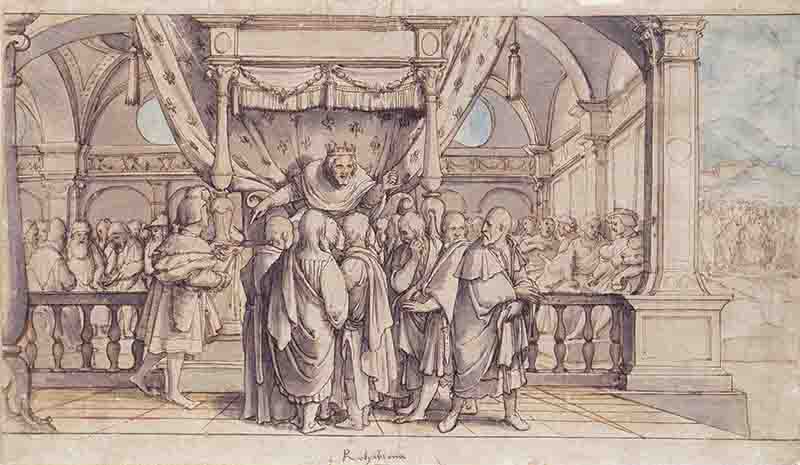
Rehoboam's Insolence
This painting portrays King Rehoboam in a moment of stubborn pride as he heeds the advice of his arrogant companions instead of the wise counsel offered to him. The scene reflects the critical choice that led to the division of the kingdom, highlighting the danger of prideful leadership and the consequences of rejecting sound guidance.
Rehoboam, son of King Solomon and Naamah the Ammonite, inherited the throne of Israel after his father Solomon’s death. His reign marked the end of the united monarchy and the division of Israel into two kingdoms. Rehoboam ruled the southern Kingdom of Judah, consisting of the tribes of Judah and Benjamin, for seventeen years, while Jeroboam became king over the ten northern tribes, forming the Kingdom of Israel 1 Kings 11:43 1 Kings 14:21 .
The division of the nation of Israel began with Rehoboam’s coronation at Shechem, where the northern tribes demanded relief from Solomon’s heavy taxation and forced labor. Rehoboam sought advice from two groups. The elders of his father’s generation urged him to lighten the people’s burdens, promising loyalty in return. However, his younger advisors counseled him to increase their yoke, claiming it would assert his authority. Rejecting the elders’ wisdom, Rehoboam followed the advice of his peers and arrogantly declared my father scourged you with whips, but I will scourge you with scorpions 1 Kings 12:7-14 2 Chronicles 10:6-14 .
This harsh response prompted the northern tribes to rebel, declaring that they had nothing to do with David. They crowned Jeroboam, Solomon’s former building foreman, as their king. Rehoboam’s attempt to assert control by sending Adoram, the overseer of forced labor, ended in Adoram’s death, forcing Rehoboam to flee to Jerusalem 1 Kings 12:16-18 2 Chronicles 10:16-18 . He assembled 180,000 troops to fight the northern kingdom, but the prophet Shemaiah delivered God’s message: the division was His will. Obeying the prophet, Rehoboam refrained from war 1 Kings 12:21-24 2 Chronicles 11:1-4 .
Despite his initial obedience, Rehoboam and the people of Judah soon turned from God. They built high places and adopted idolatrous practices, provoking God’s anger. In the fifth year of Rehoboam’s reign, Pharaoh Shishak of Egypt invaded Judah, capturing fortified cities and plundering Jerusalem’s temple and royal treasury. Rehoboam and the leaders of Judah humbled themselves before God, and He lessened their punishment. However, they remained subjects of Shishak, and the golden shields in the temple were replaced with bronze 1 Kings 14:22-27 2 Chronicles 12:1-12 .
Rehoboam fortified cities throughout Judah, likely to protect against future invasions, and provided his sons with leadership roles in these cities 2 Chronicles 11:5-23 . Despite these efforts, his reign was marked by continuous conflict with Jeroboam and spiritual decline in Judah 1 Kings 14:30 2 Chronicles 12:15 .
Rehoboam’s life underscores the importance of humility, sound counsel, and fidelity to God. His initial failure to heed godly advice led to the kingdom’s division, while his repentance during Shishak’s invasion revealed God’s mercy toward those who humble themselves. Rehoboam’s reign serves as a reminder that trust in God and adherence to His ways bring security and peace.